
How Baku turns Europe’s energy hesitation into strategic influence

Qabil Ashirov
Read moreThe history of European energy security is often told through the lens of grand ambitions and missed opportunities, but nowhere is this more evident than in the saga of the Nabucco pipeline. The story begins in 2002, in a moment of high cultural symbolism that would define an era of energy diplomacy. Following a high-level meeting in Vienna, the project’s architects attended a performance of Giuseppe Verdi’s opera, Nabucco, at the Vienna State Opera. The opera, which tells the story of the Babylonian King Nebuchadnezzar and the yearning of the oppressed for freedom, provided the perfect metaphor for a continent seeking to break its chains of energy dependence on the East. The name was adopted not merely for its prestige, but for its symbolic weight: Nabucco was to be Europe’s "highway to liberty," a 3,900-kilometer steel artery designed to bypass the traditional monopolies and bring Caspian gas directly to the heart of the European Union.
However, symbolism alone cannot build infrastructure. For a decade, Nabucco remained a masterpiece of political theater—spectacular in scope but fundamentally flawed in execution. The project suffered from a classic "chicken and egg" dilemma: investors were hesitant to commit billions without guaranteed gas volumes, while potential suppliers like Turkmenistan were reluctant to commit volumes without a finished pipeline. Furthermore, the sheer scale of the project, with an estimated cost that ballooned toward 15 billion euros, made it an economic giant that few were willing to carry. By 2013, the Nabucco dream officially collapsed, leaving a void in Europe’s strategic planning and casting doubt on whether the Southern Gas Corridor would ever be more than a map on a bureaucrat’s desk.
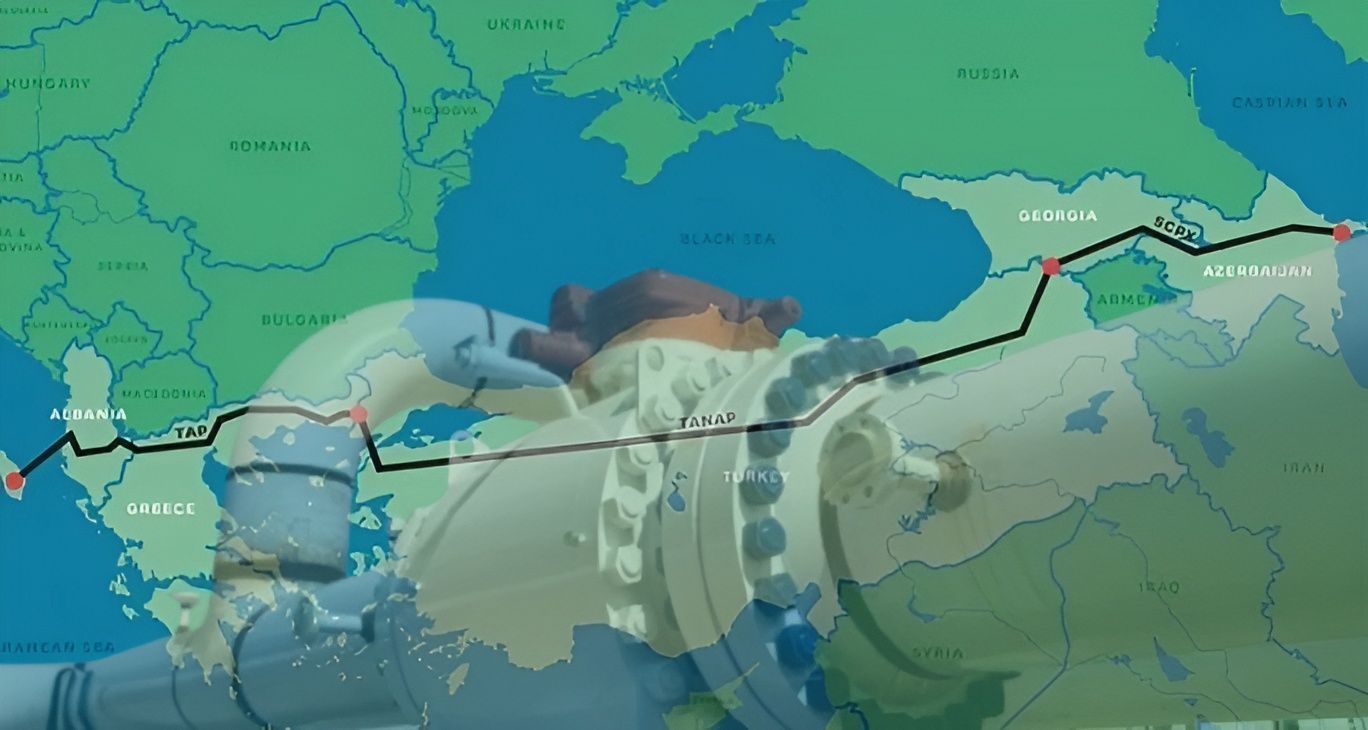
It was at this critical juncture that the narrative shifted from European indecision to Azerbaijani determination. Recognizing that the "all-or-nothing" approach of Nabucco was failing, Baku, in partnership with Ankara, took a historic gamble. Azerbaijan moved to replace the bloated, multi-national bureaucracy of Nabucco with a more focused, vertically integrated strategy. This was the birth of the Trans-Anatolian Natural Gas Pipeline (TANAP) and the Trans-Adriatic Pipeline (TAP). Unlike Nabucco, which was a project looking for a sponsor, TANAP and TAP were projects driven by a resource owner. Azerbaijan’s leadership through SOCAR decided to shoulder the primary financial and political risks, effectively saying to the world that if Europe was too timid to build the road, the supplier would build it themselves.
This shift was a masterclass in pragmatic geopolitics. By breaking the corridor into manageable segments and securing the primary investment from the State Oil Fund of Azerbaijan (SOFAZ) and SOCAR. The construction of TANAP across the rugged terrain of Anatolia and the subsea crossing of TAP into Italy represented a triumph of engineering and political will. It transformed Azerbaijan from a regional player into a continental energy anchor. The decision to prioritize a smaller, scalable, and economically viable route proved to be the correct one, as it allowed gas to flow while keeping the door open for future expansion.
The true significance of this Azerbaijani-led initiative became starkly apparent following the seismic shifts in global politics in 2022. The Russia-Ukraine war turned what was once a commercial project into a vital piece of geopolitical infrastructure. As Europe sought to permanently decouple from Russian gas, the Southern Gas Corridor emerged as the only functioning, non-Russian pipeline system capable of immediate expansion. This new reality has shifted the leverage back to the architects of the corridor. When the Turkish Energy Minister recently emphasized the "unused capacity" of the Southern Gas Corridor, he was not merely offering a technical update; he was firing a geopolitical starting gun. This emphasis comes at a precise historical crossroads where Europe is desperate to finalize its divorce from Russian energy. By highlighting that the infrastructure is already in place and merely awaits expansion, Ankara is signaling to Brussels that the solution to their existential energy crisis does not require decades of new construction, but rather a deeper political and financial commitment to the Baku-Ankara axis.
This push for expansion raises a fundamental question: Is Türkiye seeking to replace Russia as the primary transit power into Europe? While the volumes currently flowing through the corridor are a fraction of what Russia once provided, the strategic intent is clear. Ankara is positioning itself as the "Anti-Gazprom." Unlike the old model of a single dominant supplier, Türkiye is offering a diversified platform that can aggregate volumes from the Caspian, the Eastern Mediterranean, and potentially Central Asia. By leveraging the Southern Gas Corridor, Türkiye is not just replacing one pipe with another; it is replacing a monopoly with a strategic partnership, effectively moving the center of gravity for European energy security from the Siberian north to the Anatolian heartland.
This ambition points toward a grander vision: the transformation of Türkiye into the "Suez Canal of Gas." In the same way the Suez Canal serves as the indispensable chokepoint for global maritime trade—granting Egypt immense geopolitical leverage—Ankara aims to make its territory the unavoidable gateway for Eurasian energy. By transforming geography into a "geopolitical valve," Türkiye seeks to become more than a transit state; it is striving to become a "Hub" where gas is not only transported but priced and managed. This would grant Ankara unprecedented bargaining power with Brussels and NATO allies, turning every cubic meter of gas into diplomatic capital.
Before 2022, the Southern Gas Corridor was largely viewed through a commercial lens—a project about market competition and price stability. However, the Russia-Ukraine war has fundamentally altered its DNA. It has been recast as "geopolitical infrastructure," a strategic security asset that sits at the very heart of the West’s defense strategy. Azerbaijan and Türkiye are no longer just filling a supply gap; they are filling a power vacuum. As the "unused capacity" of the corridor begins to be tapped, the legacy of the Nabucco dream finally finds its practical home. What was once a poetic aspiration for liberty in a Viennese opera house has been forged into a hard-iron reality, ensuring that the keys to Europe’s energy future are now held by the pragmatic and decisive alliance of Baku and Ankara.
Here we are to serve you with news right now. It does not cost much, but worth your attention.
Choose to support open, independent, quality journalism and subscribe on a monthly basis.
By subscribing to our online newspaper, you can have full digital access to all news, analysis, and much more.
You can also follow AzerNEWS on Twitter @AzerNewsAz or Facebook @AzerNewsNewspaper
Thank you!