
Can Albania turn its Adriatic coast into gateway for Eurasian trade

Akbar Novruz
Read moreThe shortest route from Azerbaijan to Albania today is that of the natural gas pipeline rather than the rail link. But Albania wants to redraw the map. At a national holiday reception hosted in Baku on November 23, Albanian Ambassador Besart Kadia suggested the connection of the Middle Corridor, China and Central Asia to Europe via the Caspian, to the Albanian Adriatic port of Durrës and European Corridor VIII. It was an understated diplomatic move with a large geographical reach.
This proposal appeals to both countries; Azerbaijan wishes that its geographical location, which links the Caspian Sea and the Black Sea, provides more income than mere transit duties. Albania would like its own coastline to be used as the western gateway for Eurasian cargo transport rather than just the place where its regional business ends up. The problem is that this link is not even an approved project, much less a built railway.
The purpose of Corridor VIII is to connect the Adriatic to the Black Sea through Albania, North Macedonia, and Bulgaria. That would allow the transport of cargo from Azerbaijan using a more efficient alternative, namely the road via Türkiye and the Balkan region or the Black Sea route. However, it should be noted that the route passes through different countries, railway networks, and intermodal terminals. None of them will become more affordable because the two maps coincide.
Europe is willing to invest money in the reconstruction of the route. The European Bank for Reconstruction and Development (EBRD) has decided to fund a €30mn loan for an overall program that amounts to €120.5mn and envisages the rehabilitation and electrification of 34km of the corridor between Durrës and Rrogozhinë. However, according to the latest report of the European Commission, this section of the route is still under procurement, design, or study phases. Another agreement between North Macedonia and Bulgaria is intended to close another gap in the chain.
The same report noted that Albania had taken no concrete steps to transfer freight from Durrës to the proposed Porto Romano commercial port and that a tender for the new development had been cancelled. A Caspian–Adriatic offering would therefore need to establish not only where trains could run, but which port facilities would receive them.
The bridge actually already exists...
If this sounds premature, Baku and Tirana can point to a precedent. Because the Trans Adriatic Pipeline (TAP) crosses Albania before reaching Italy. By mid-November 2026, it had transported more than 64bn cubic metres of Caspian gas to European markets since commercial operations began in 2020. Its first expansion added 1.2bn cubic metres of annual long-term capacity in 2026. The pipeline is a working piece of continental infrastructure, rather than a diagram awaiting investors. However, for Albania, having the transit pipeline has not automatically meant household gas, since there is no infrastructure for delivering it at home. The gasification of Korçë, as planned by SOCAR and agreed in 2024 with Albanian partners, aims to change that situation. The geotechnical and geophysical surveys were ongoing in September 2026; completion of the citywide supply network cannot yet be considered an achieved goal.
The energy infrastructure creates the long-lasting contacts between regulatory bodies, ministries, financiers and operators. Such contacts facilitate further investment discussions, even though pipelines and transport corridors operate by completely different rules. The gas pipeline has its own contracts and regulated capacities. Container traffic requires shippers who will pay a market rate for the delivery of their cargo.
Now, the numbers make the task particularly evident. According to the officially published Azerbaijani figures, the total value of the country’s foreign trade operations with Albania amounts to merely $1.22 million during the first nine months of 2026: specifically $525,000 worth of exports and $693,000 worth of imports. The current bilateral trade market is too small in itself for launching a new freight corridor.
However, there is cargo to be transported. Kazakhstan’s railroad carrier reported a total of 44,200 twenty-foot equivalent units transported through the Trans-Caspian line during the first eight months of 2026 – which represented an increase of 58 per cent compared to the same period in the previous year. At the Adriatic end, the Port of Durrës reported a total of 3.09 million tons of freight and 197,700 TEU of container traffic over January to September of 2026.
However, according to the World Bank, a greater development of the Middle Corridor might increase cargo volumes threefold until 2030 as a result of infrastructure and border improvements. This is an estimate, which does not mean that any branch of it will be profitable. It will be necessary to make a comparison of Durres with more traditional corridors through Georgia's Black Sea ports, Türkiye, and Mediterranean ports.
One more thing to highlight is that Albania’s message does not end at containers. Kadia urged Albanian businesses to take a look at Azerbaijan’s Alat Free Economic Zone and called on Azerbaijani businessmen to invest in Albanian agriculture, green energy, technologies and tourism. Alat Free Economic Zone is located near Baku’s principal port and provides benefits in terms of taxes and customs for manufacturing and export production. It makes much more sense for businesses to use the route to transport goods which they manufacture, rather than goods passing through.
Furthermore, the ambassador proposed launching direct flights between Baku and Tirana contingent upon signing an air services agreement. Such flights will make only a negligible contribution to freight traffic but will facilitate travel of investors, engineers and tourists. Next month, in December, when the two governments will hold the second meeting of their intergovernmental economic commission in Tirana, these ideas may be elaborated into actual projects.
The Azerbaijani capital has for years been working on diversifying pathways between Asia and Europe instead of focusing on any one pathway or narrow sea passage. An Adriatic route will allow extending this policy toward the West and possibly creating some kind of competition between various gateways while dragging the Western Balkans into talks previously focused on the Caspian, Georgia, and Türkiye. It might also give Albania an interest in the system whose development was shaped by Eurasian logistics flows.
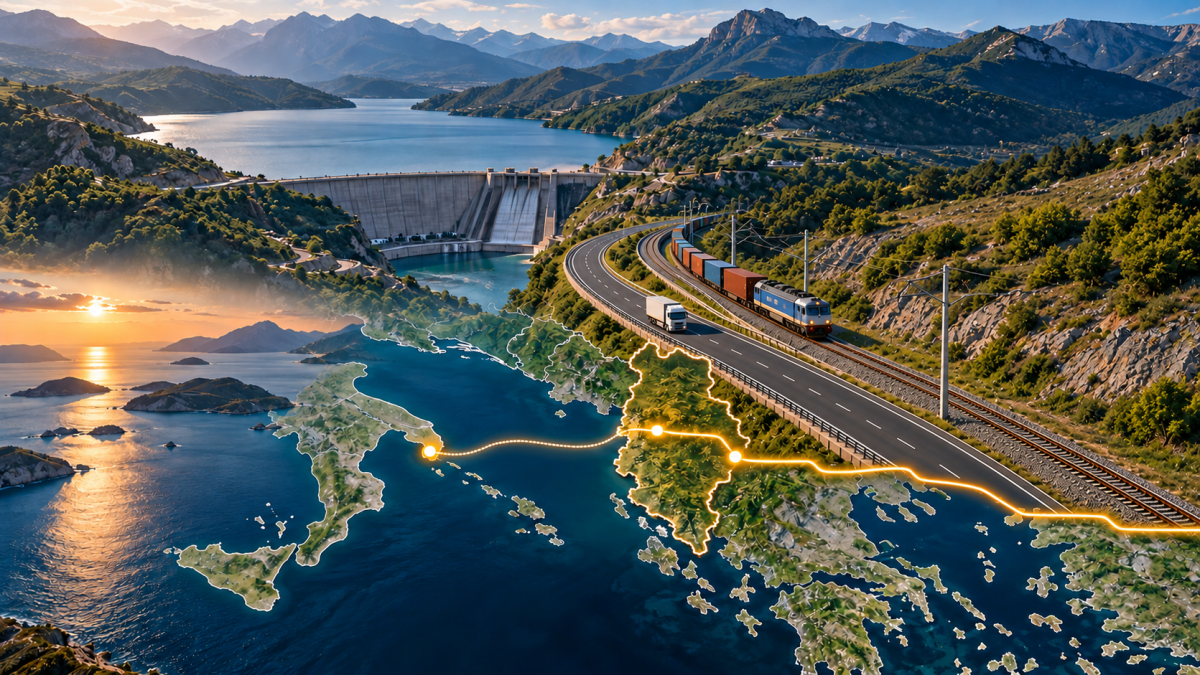
*cover image has been generated by AI
Here we are to serve you with news right now. It does not cost much, but worth your attention.
Choose to support open, independent, quality journalism and subscribe on a monthly basis.
By subscribing to our online newspaper, you can have full digital access to all news, analysis, and much more.
You can also follow AzerNEWS on Twitter @AzerNewsAz or Facebook @AzerNewsNewspaper
Thank you!