
Kazakhstan’s uranium dilemma puts Azerbaijan at center of Europe’s energy security

Akbar Novruz
Read moreWith Europe rushing ahead in developing nuclear energy and Western utility companies seeking to reduce their reliance on Russia’s infrastructure, the international nuclear fuel market has reached a crucial point. Right at the heart of it all stands Kazakhstan, the world’s largest uranium producer, accounting for more than 40 per cent of global uranium production. Having large amounts of raw material is just half the story; the second half involves getting it to the Western countries without going through Russia.
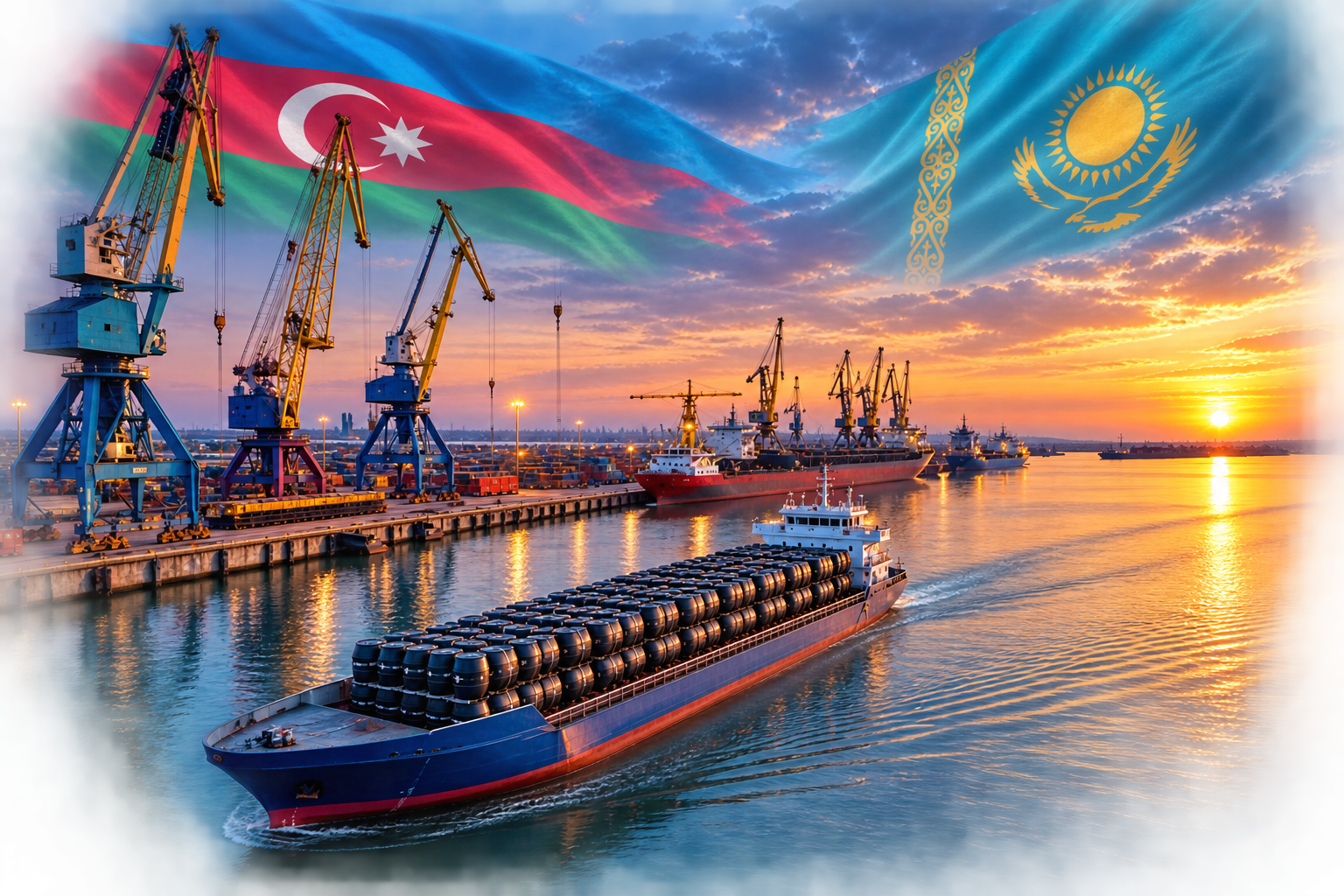
This is where the Trans-Caspian International Transport Route (Middle Corridor) serves as a vital strategic bridge.
Buried inside Fitch Ratings’ latest credit assessment of Kazatomprom sits a single sentence that illustrates this new reality: "The main alternative is the Trans-Caspian International Transport Route through Azerbaijan and Georgia, where Kazatomprom shipped 48% of its deliveries to western customers in 2025." This was a credit assessment comment about the riskiness of sovereign transit. What it was doing, potentially inadvertently, was identifying Azerbaijan as an integral link in the Western nuclear fuel supply chain. Not a potential link and not even an aspirational one. An existing one, currently transporting almost half the uranium fueling Western nuclear plants, passing through the Alat Port on the Caspian Sea's western shore. The Middle Corridor has been called the key alternative trade route in Eurasia for many years now. Usually with pictures of shipping containers and grain volumes. Uranium takes it to a whole new level.
To understand why the routing question matters, start with the market structure it operates within. The share of Kazakhstan in the global production of mined uranium is about 40-45% – which, for any other commodity, would prompt a desperate search for diversification in the importing countries. The current market share of Kazatomprom in the contracts of Western nuclear utilities is 17-18% – another key indicator for the utilities in Western countries and managers of their mining assets amid increasing geopolitical risks and growing cost of diversification through 2026. Thus, when it comes to the possible disruption of Kazatomprom's logistics chain, it will not be an issue of the commodity market anymore. It will be a matter of energy security and will have an immediate impact on the electric power grids operated by nuclear power. It is an energy security event, with direct implications for the electricity grids that nuclear power underpins in France, the UK, the Czech Republic, Slovakia, Finland, and the United States. Especially for France.
The renaissance of nuclear energy in Europe exacerbates this risk, as aforementioned. Indeed, the European Union, especially France, Eastern European countries, and Nordic countries, has significantly stepped up its investments in nuclear energy as part of its post-2022 energy self-reliance and green transition strategy. Indeed, Orano, Czech and Swiss energy companies, and Nordic energy producers have stepped up their long-term cooperation with Kazatomprom since Kazakhstan is the most stable source of uranium on a big scale. This cooperation produces a vicious circle since the more Europe depends on Kazakh uranium, the more strategic value the transport corridor that delivers it acquires. As Fitch said, "Kazatomprom retains some exposure to geopolitical risks, including its dependence on exports via its main transport corridor into Western customers – over 50% of Kazakhstan's uranium exports go through the Russian port of St. Petersburg. There are no current restrictions on exporting uranium from Russia, but we believe potential sanctions, if introduced, might disrupt shipments."
Possible mechanisms and risks as it stands out:
| St. Petersburg (Northern Corridor) | Still the majority route for Western deliveries; no current restrictions on uranium | Risk is high - Western sanctions expanding; uranium exemptions are a political decision, not a structural guarantee |
Transit dependency Entirely Russian-controlled; disruption requires no Western decision, only a Russian one |
| Middle Corridor (Trans-Caspian through Azerbaijan) | 48% of Western deliveries in 2025; sometimes 60–65% per CEO; operational since 2018 | LOW RISK - bypasses Russia entirely; no Western sanctions exposure; Caspian states not party to the Russia-Ukraine conflict | Kazakh rail → Aktau port → Caspian ferry → Alat Port (Azerbaijan) → Georgian rail → Poti → onward maritime |
| Swap mechanism (foreign inventories) | Available as a supplementary option; limited volume | Risk exposure is none, as it requires no physical transit | Depends on inventory positions held in Western storage; not scalable for full supply replacement |
In that sense, however, the "Fitch framing" – "no current limitations, but sanctions could cause disruption" – fails to recognize the operational risk on one specific count: disruption need not be caused by a sanctions decision from Western governments. The precedent is there with regard to multiple commodities. Since 2022, Russia has engaged in export restrictions, transit restrictions, and infrastructure restrictions as means of geopolitical pressure. At the moment, uranium has been outside the ambit of such measures; however, this is a political matter and not an intrinsic quality. Speaking to MINING.COM in June 2026, Kazatomprom CEO Meirzhan Yussupov laid out the rationale for diversification clearly: "We have a diversified portfolio of sales, and, as any other business, which doesn't want to keep all its eggs in one basket, we have diversified routes." The diversification of routes is not a preventive move; it is a strategic move.
Why Astana needs Baku, and vice-versa
Kazakhstan's position in the uranium transit equation is more constrained than its production dominance might suggest. Astana has three options to ship the uranium to the West: through Russia (safe, cheap, but vulnerable to sanctions), through Azerbaijan and Georgia (tried and tested route, no sanctions but difficult logistics-wise) or through swaps based on foreign stocks (available in limited quantities and cannot be scaled up). Only the middle option allows satisfying the risk management needs of the Western utilities, reducing the dependence on Russia and shipping at the required volumes. According to the chief commercial officer of Kazatomprom in 2023, 58% of all the uranium shipments from Kazakhstan to the West took place through the Trans-Caspian route in the first half of the year, with an objective to reach 71% by the end of the year. The fluctuations in the percentages described by the CEO in June 2026 from 48% to 65% are due to customer preference and optimization efforts, not because of the route's unreliability.
The structural dependency runs in both directions. Kazatomprom needs Alat Port to remain accessible, reliable, and certified for uranium handling. Azerbaijan needs Kazakhstan to keep routing Western deliveries through the Middle Corridor, both for the transit revenue and for the geopolitical weight that uranium transit confers on its role as a regional hub. The Caspian Green Energy Corridor, the Trans-Caspian fibre-optic cable, the joint investment fund, and the Treaty on Eternal Friendship signed in Tashkent last week are all superstructure built on a foundation that includes, quietly but consequentially, the physical movement of uranium fuel across the Caspian Sea to keep European nuclear reactors running. That is the relationship's deepest layer, and it is the one that makes every other layer more durable.
The Fitch credit note was, in one way, routine, a rating agency identifying a transit concentration risk for an issuer with a BBB rating. In another way, it was the briefest description of how the geopolitics of energy security have shifted positions after 2022. The Middle Corridor via the port of Alat was a fallback option for decades due to its logistical complexity and commercial insignificance. This is still true; however, the strategic importance of this route has acquired significance that cannot be achieved by any effort to promote investments in the Middle Corridor as efficiently as the behavior of Russia ever since the war in Ukraine. The country did not invent this scenario. It is only, as it has been during most of the past four-year crises, an indispensable geography for this scenario.
Here we are to serve you with news right now. It does not cost much, but worth your attention.
Choose to support open, independent, quality journalism and subscribe on a monthly basis.
By subscribing to our online newspaper, you can have full digital access to all news, analysis, and much more.
You can also follow AzerNEWS on Twitter @AzerNewsAz or Facebook @AzerNewsNewspaper
Thank you!