
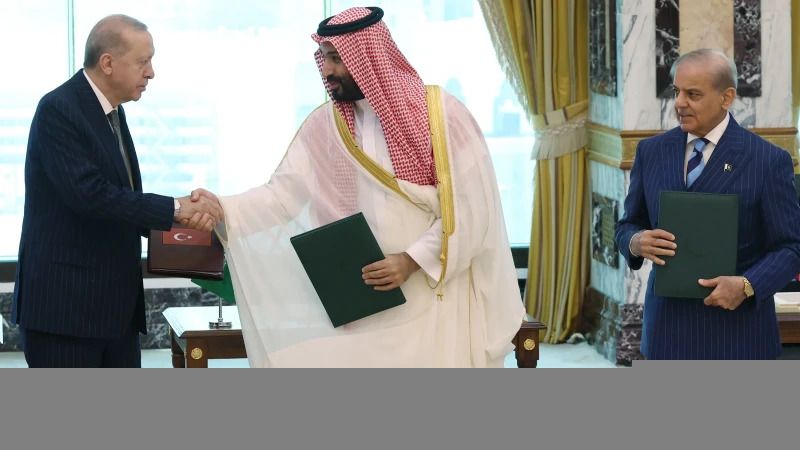
Türkiye-Pakistan-Saudi Mecca Pact could reshape regional power balance
By Nedret Ersanel
I place considerable emphasis on the geopolitics of the triangle because it is the most concrete indication that the theoretical framework concerning the region’s future and scope has moved beyond theory and been translated into practice.
The Türkiye-Pakistan-Saudi Arabia alliance is a step that goes beyond the policies of its current and prospective members and opens a broader channel extending from West Asia and the Caspian to Central Asia and, ultimately, the wider world. We first demonstrated the extent of its reach by examining its implications for India (“Why Did the US Call India the Day After the Mecca Agreement?”, 19/08).
Now let us take this a step further.
There are now many views that one dimension of the US-China rivalry, which has been brought into the ring for the final reckoning over the emerging order, is this pact. If that is the case, then the question must be asked: “What does China have to say about this pact?”
It would hardly be possible to argue that Beijing has failed to notice such a development. China has extensive regional interests in the Gulf and Iran, considers countries such as Afghanistan and India strategic priorities, attaches enormous importance to Pakistan, and has made massive economic and political investments through initiatives such as the Belt and Road Initiative. Even where energy resources are concerned, Beijing considers it vital not necessarily to own them, but to control who controls the routes and access to them. Of course, the Chinese have noticed. They have even taken a position.
China’s perception of the Mecca Agreement may surprise you. Put in the simplest terms, they see it as a clear manifestation of the growing weakness of US power. And they support it.
How can a pact supported by the West, described as a “good thing” by the US president himself, and one whose ultimate target is said to be China, while also extending into areas where Beijing has clear strategic interests, be viewed positively by China?
First, let us understand this issue of “weakness” that the Chinese are talking about.
The Iran war could serve as an example in itself, and a sufficient one at that, because, as we have repeatedly argued, the United States has been defeated and has become entangled in trying to figure out how to extricate itself from the situation. But we now have an example from the front line itself: North Korea and South Korea.
US initiatives to reduce its military presence in South Korea, cut defense spending there, suspend joint military exercises, and demand $10 billion annually to cover the costs of its presence had such an impact in Seoul that South Korean officials hurriedly held talks with China. This does not, of course, mean that Seoul’s policies have undergone a dramatic transformation. But it is clear that Washington’s unexpected moves have caught South Korea off guard.
The American steps did not stop there. Washington extended a kind of olive branch to North Korea. Trump announced that he wanted to meet North Korean leader Kim Jong Un sometime this year. The situation has reached a point where, and please pay attention to this, it has even been suggested that the United States could offer to withdraw from South Korea in exchange for North Korea ending the deployment of troops to the war in Ukraine.
All of this created a second shock in South Korea, but the impact was felt even more strongly in countries such as Japan and India. Where this will ultimately lead and how it will unfold is a separate question, but these are by no means insignificant developments.
These are the developments behind China’s definition of “weakness.” The weakening of US global hegemony is not new information. You have already read extensively here about its causes, including the most recent ones. The United States remains a military power and will remain one for some time — provided, of course, that its economy does not collapse in the meantime.
However, this new geopolitical moment represents a unique period for middle-sized countries seeking to protect and advance their own particular interests. This, too, is an issue we have discussed extensively in earlier debates.
Ankara has repeatedly explained that it views regional issues, including the Mecca Pact, precisely from this perspective. Türkiye has argued that if countries do not address the problems of their own regions themselves, outside powers will create even more serious problems. Therefore, it maintains that “regional ownership” must now become the guiding principle.
China has interpreted the Mecca Pact in exactly this way and has consequently viewed it positively. From Beijing’s perspective, the global significance of the initiative is the transition from an order imposed by a single superpower to a multipolar system.
The Mecca Pact is, of course, also a demonstration of power. From Ankara’s perspective, it represents an advanced stage of efforts to establish deeper relations with the Muslim and Arab worlds. It provides greater diversity and freedom of maneuver.
At the same time, a legitimate debate will continue, and it deserves maximum attention: If the West, the United States, and Britain support this initiative, is its ultimate destination really safe? Is every stage of the process necessarily in Türkiye’s interests?
But this time, we are approaching the issue from China’s perspective.
The Global Times, a newspaper close to the Chinese Communist Party, wrote that the initiative would inevitably redraw the regional map. It argued that the pact would push Gulf countries away from dependence on a unipolar system and toward a balancing policy within a multipolar order. It also described the initiative as a rapid step toward transforming Türkiye from a peripheral member of NATO into a central security architect of the Muslim world.
China, however, does not appear particularly receptive to the notion that the agreement constitutes a NATO-style security framework. Beijing does not believe that the countries involved would necessarily intervene directly in a future crisis.
Ultimately, the Chinese also agree with the assessment made by regional countries and international analysts that although the possibility of alliances with the United States collapsing remains low, perhaps even premature to discuss, these countries have nevertheless been forced to confront the reality that they can no longer fully rely on Washington’s security guarantees.
This parallels the processes now being experienced by countries such as South Korea, Japan, and India, and the argument that similar developments are taking place in the Middle East. Countries are spreading their risks and diversifying their sources of security.
Time will tell how accurate these assessments prove to be and whether they are intended, at least in part, to conceal other strategic calculations or expectations. But what will happen to the United States amid its current predicament, with increasingly difficult dilemmas closing in around it?
If America is unable to provide reliable security guarantees either here or to its partners in the Chinese sphere, and if its policies increasingly involve some form of withdrawal, how will it maintain the balance?
Here we are to serve you with news right now. It does not cost much, but worth your attention.
Choose to support open, independent, quality journalism and subscribe on a monthly basis.
By subscribing to our online newspaper, you can have full digital access to all news, analysis, and much more.
You can also follow AzerNEWS on Twitter @AzerNewsAz or Facebook @AzerNewsNewspaper
Thank you!