
Azerbaijan wants to turn car assembly into manufacturing
Akbar Novruz
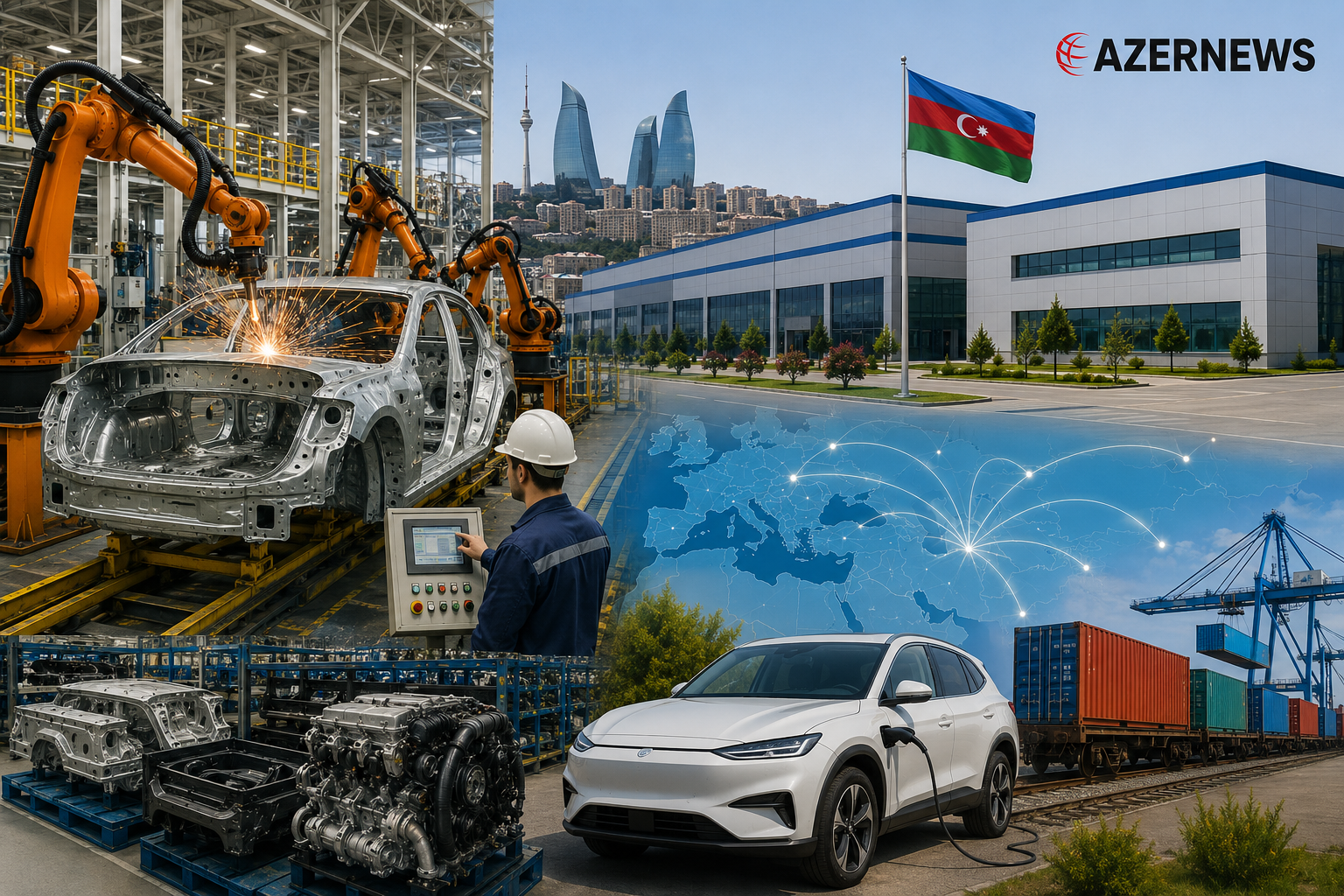
Read moreIt would be fair to say that when you think about Azerbaijan, you would rarely think about the capacity of its automobile industry - and maybe it would be the last thing to come to mind. It is relatively small. Yet beneath this low profile, a deliberate structural shift is underway. Baku is moving beyond simple resource extraction and is beginning to see vehicle manufacturing as an opportunity to test out non-oil industries, adaptation to technology, and value-added manufacturing. Although the industry is still a fraction of the size of established auto manufacturers, it is being subtly realigned as a meeting point between local supply chains, tax-favored industrial zones, and the global shift to electric transportation.
At roughly the same moment, Azerbaijani officials confirmed that a joint Azerbaijani-Uzbek enterprise in the Hajigabul Industrial District was completing preparatory work on an $84.3 million full-cycle automotive plant (surge of 88.4%), with production line orders placed and a mid-2027 commissioning target set. The worldwide automobile industry is not experiencing just a cycle of downturn in its traditional strongholds; rather, it is experiencing geographical reorganization, and the locations where manufacturing capacities are being built are not always those expected from the industry's map of the twentieth century.
The problems of the automotive industry following the pandemic were first correctly identified as a supply chain issue. However, that understanding was far from being comprehensive. The supply chain problem only made clear the structural flaw that has been brewing for decades, namely, that the manufacturers in Europe, America, and Japan have designed their production systems based on the stable trading order which no longer exists. Expensive labor, high taxation, dependence on energy prices, and expensive transformation to electric vehicles make European automotive manufacturing less and less competitive compared to Chinese manufacturers who have created their own advantages from scratch over the last decade.
In the whole case, what is important is China’s position. For example, in 2025, China produced about 34.53 million cars, which accounted for 39% of the total global production, while in the first half of 2026, about 3.38 million cars were exported by China, which is 48% higher than in the same period of time last year. The predictions are that annual Chinese exports will reach 10 million in the course of one-two years. The consequences of such an export development for other car manufacturers can be either positive or negative. On the one hand, owing to the presence of cheap Chinese cars in developing countries, it is becoming harder to attract customers. On the other hand, there is a place for those manufacturers that have the advantage of being close and that produce certain types of products that have never interested Chinese manufacturers.
Hajigabul transition's strategic logic
The difference between semi-knocked down (SKD) assembly and completely knocked down (CKD) manufacturing is technically described but economically revolutionary. SKD assembling entails bringing assembled parts of the car from abroad, assembling them, and selling the product – creating jobs and generating some economic activity, but providing little economic depth because the added value remains in the home country, and the assembler is necessarily dependent on an outside supply chain beyond its control. CKD manufacturing, however, entails building the body of the car from steel, painting it, welding sub-assemblies, and handling precision assembly, all processes that require capital equipment, skilled labor, and process engineering. Transitioning from SKD to CKD is much more than changing the manufacturing process. It is the start of genuine indigenous industry.
The construction of a $84.3m facility that is currently in development at Hajigabul by Azermash CP and Uzavtosanoat JSC is just the sort of facility that will make such a transition happen in Azerbaijan. The factory will implement automated body welding, industrial painting lines, and precise assembly operations, which, once implemented, provide the technological basis needed to produce component parts locally and eventually set up indigenous suppliers. According to the Uzbek Deputy Minister Khurram Teshabayev, all preparation work has already been completed and suppliers have been identified and orders have been made for the technological equipment and production lines, which will be commissioned in mid-2027.
Now, understanding the reasons behind its establishment [e.g., the Hajigabul plant] helps explain the legitimacy of the $84.3 million figure, which would not be considered a serious pledge if not for the economic rationale for this project. Put it in a fact that for substantial period of time, Ganja and Nakchivan were the only two cities carrying this responsibility on their shoulders. Indeed, for UzAuto Motors, which is an Uzbekistan's automotive flagship, with production of 235,700 units in the first half of 2026, having a CKD assembly base in Azerbaijan allows to get access to the market of South Caucasus (with 3 million consumers in Azerbaijan alone), access to the export corridor to Europe and Türkiye via Georgia, and, most importantly, a production base situated in the western end of the Middle Corridor.
The industrialisation programme not linked to the oil sector - enshrined in various state programmes and illustrated through the 10-year VAT exemption for domestically manufactured cars and VAT exemption on component importation until 2031 - requires anchor investments of sufficient magnitude to drive the development of suppliers and the transfer of skills. Such an $84.3 million CKD facility that will be developed and run by a firm with Uzbekistan's manufacturing capability and output is just such an anchor. As the Azerbaijani President noted during the Tashkent state visit that an investment of over $80 million is planned in Hajigabul, with a second plant under construction providing "a major impetus to Azerbaijan's automotive industry." The predictable revenue flow resulting from the government orders placed by various ministries and state organisations for domestic vehicles provides protection to the investor from market risks during the initial stage of production.
The 88.4% production growth figure is real and reflects genuine industrial momentum. At the same time, it also has to be seen in light of the market conditions which make sustaining the growth more difficult. The Chinese car brands - BYD, Chery, Geely, Changan – have invaded the Azerbaijani market in large numbers over the past three years, selling technologically advanced cars at prices which the assembly units using imported spare parts cannot afford to compete with. The second part of the market, second-hand vehicle imports, has grown as well as the strengthening of the manat has made used cars from Europe and Japan more appealing to consumers than the new locally assembled ones.
And that is exactly what the transition to CKD at Hajigabul aims to start. The time frame is not the commissioning in mid-2027; that is when the production capacity comes into existence. The important thing is the next two to three years during which local content ratios go up, the cost of importing parts goes down, and the difference in price between the locally assembled and the imported cars closes. The issue of whether Azerbaijan’s vehicle assembly factories can perform that transition before Chinese competition and used imports divide the market against them permanently becomes clear in about 2029 or 2030. The VAT incentive system and the Hajigabul project create the necessary conditions for success.
Here we are to serve you with news right now. It does not cost much, but worth your attention.
Choose to support open, independent, quality journalism and subscribe on a monthly basis.
By subscribing to our online newspaper, you can have full digital access to all news, analysis, and much more.
You can also follow AzerNEWS on Twitter @AzerNewsAz or Facebook @AzerNewsNewspaper
Thank you!