
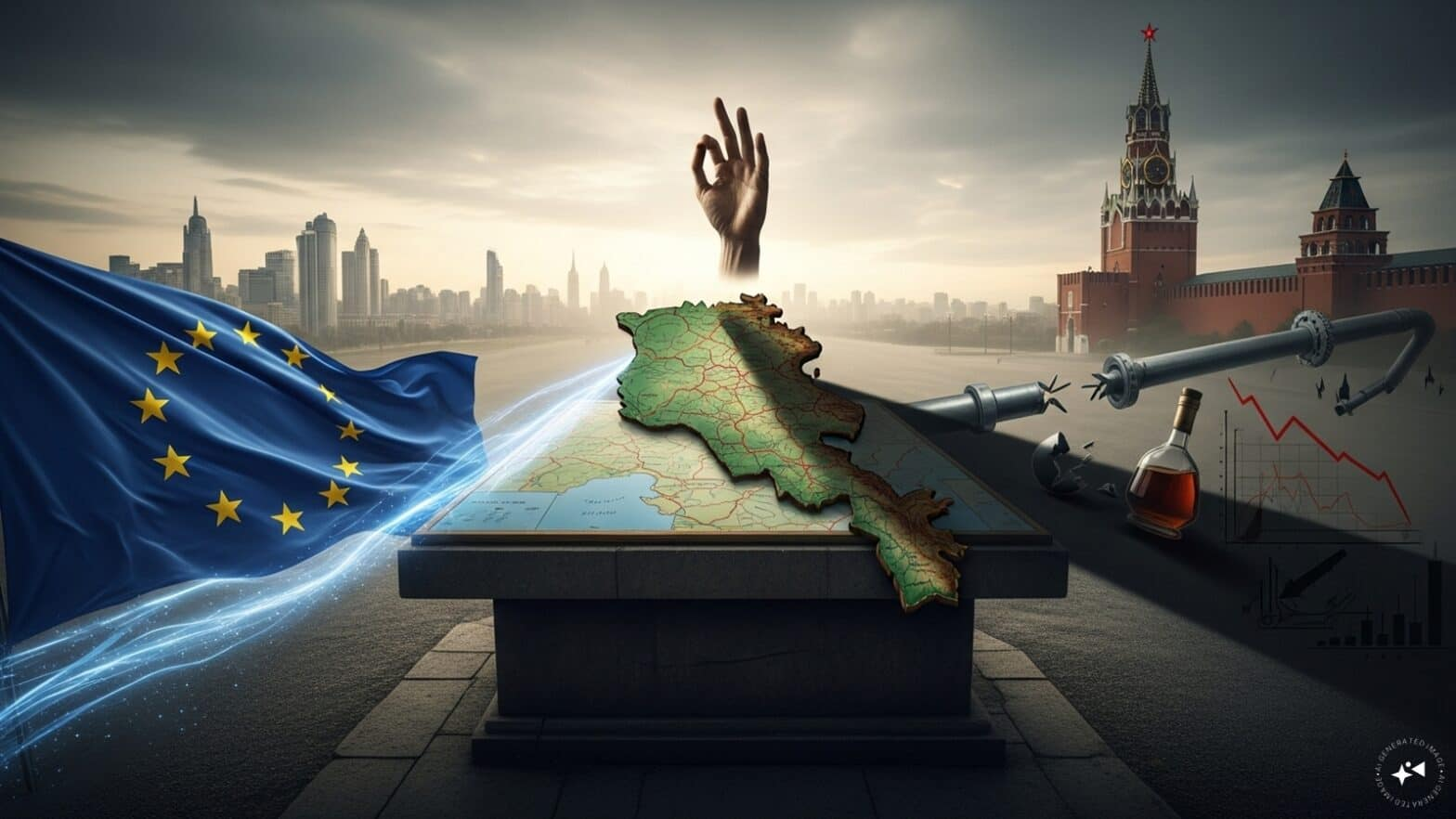
Armenia at a fork in the road: West or Moscow?

Ulviyya Poladova
Read moreArmenia’s internal political scene is once again dominated by serious scandal, infighting and confrontation. At the centre of the latest turmoil are members of the former ruling establishment, most notably Robert Kocharyan and Serzh Sargsyan, both of whom have been closely associated with Russia and have reportedly been detained by law enforcement authorities.
At this point, the famous words of Ibn Khaldun, one of the most influential thinkers of the Arab and Islamic intellectual tradition, come to mind: “Injustice ruins civilisation.” His political thought repeatedly draws a stark distinction between strong, legitimate authority and rulers whose corruption, complacency and pursuit of privilege ultimately undermine the very states they once controlled.
There is, therefore, little that should come as a surprise when those who once sought to build their power across a vast geography by seizing lands that did not belong to them eventually find themselves sitting in the defendant’s dock, answering questions before the very institutions of the state they once sought to dominate.
Recently, Armenian authorities detained former President Robert Kocharyan and his son Sedrak on August 25, marking one of the most consequential developments in the country’s recent domestic politics. Armenia’s Anti-Corruption Committee said the two men had been taken into custody as investigators pursued several lines of inquiry. According to investigators, Kocharyan acquired state property at below-market prices and transferred assets to affiliated companies. Now, the circumstances surrounding the transfer of 56 properties to the former president, as well as substantial payments allegedly made in his son’s name, are being closely examined.
At the same time, law-enforcement officers searched businesses linked to the Kocharyan family. The raids reportedly targeted the family-owned Orange Premium Fitness Club, a Toyota dealership, and the shops and offices of Pregomesh, a jewellery brand owned by Kocharyan’s daughter-in-law, the well-known Armenian singer Sirusho. National Security Service officers arrived at the home of Levon Kocharyan, a member of parliament from the Armenia Alliance and Robert Kocharyan’s elder son. Besides, a court in Yerevan has also ruled to keep former Armenian President Serzh Sargsyan at liberty under a travel ban, following a motion filed by Armenia’s Anti-Corruption Committee.
Kocharyan’s detention is the latest in a string of criminal cases involving Pashinyan’s political adversaries. The pressure became particularly visible during the parliamentary campaign.
In the June 7 election, the governing Civil Contract party won 49.7% of the vote and retained power. Samvel Karapetyan’s Strong Armenia came second with 23.2%, while Kocharyan’s Armenia Alliance received 9.9%. Even before voters went to the polls, opposition candidates and activists had been detained in cases involving alleged vote-buying. After his victory, Pashinyan made it clear that he had no intention of taking his foot off the gas. He branded the three largest opposition forces a "three-headed spy party of war", accusing them of opposing rapprochement with Azerbaijan.
The prime minister also argued that criminal investigations into opposition figures, along with efforts to confiscate allegedly illicit assets, should continue. His critics say this rhetoric blurs the line between legitimate law enforcement and political revenge. The government, however, maintains that no one should be above the law.
The confrontation between the government and its opponents began well before the election campaign. Businessman Samvel Karapetyan was arrested in the summer of 2025, shortly after publicly defending the Armenian Apostolic Church in its dispute with Pashinyan. He was accused of publicly calling for the seizure of power and was later placed under house arrest.
Pashinyan has also repeatedly clashed with senior religious figures. His conflict with the Armenian Apostolic Church erupted into the open in May 2025, when he demanded the resignation of Catholicos of All Armenians Karekin II and accused him of violating his vow of celibacy. The Church responded by accusing the prime minister of waging an anti-clerical campaign.
It appears that Nikol Pashinyan, having chosen a Western path for Armenia, is systematically removing all obstacles standing in his way, particularly political figures perceived as serving Russian interests. Although this may appear to contradict the very concept of democracy that Pashinyan champions as the cornerstone of his political course, he increasingly seems to regard the removal of elements that pose a threat to his choices as a political necessity.
There is, however, considerable room for scepticism in terms of its anti-Kremlin policy. The fundamental problem is that Armenia has yet to free itself fully from its dependence on Russia.
The contradiction becomes particularly stark in Pashinyan’s dealings with Putin. In July 2026, despite his government’s proclaimed pro-European trajectory, Pashinyan personally appealed to Putin to intervene over Russian restrictions on Armenian exports, arguing that Moscow’s measures violated bilateral agreements and EAEU rules. He also stressed that Yerevan sought to resolve the dispute through “open, partnership-based and friendly dialogue”.
In other words, while Yerevan presents itself as marching towards Europe, when its economic interests come under pressure, it still turns to Moscow for help.
Moscow, meanwhile, has repeatedly warned that Armenia cannot have its cake and eat it too. From Russia’s perspective, Yerevan cannot fully integrate with the EU while remaining a member of the Russian-led Eurasian Economic Union.
Armenia is neither a major European market nor an important source of natural resources. Its value to the EU is therefore less economic than geopolitical. From today’s perspective, Armenia could, in fact, become something of a headache for the European Union. The reason is simple: what strategic value does Armenia’s integration with the West offer a Europe struggling to find solutions to an energy crisis and security issues, when Yerevan itself continues to bend one way and another under the weight of its economic dependence?
For Armenia today, steps towards improving relations with Azerbaijan and Türkiye are arguably far more vital than symbolic alignment with the West. Seeking shelter under the shadow of the European flag cannot be more important than taking advantage of the strategic opportunities available to the country.
Where did Armenia’s European dream come
from?
Pashinyan rose to power after the 2018 Velvet Revolution on a wave
of public anger against corruption, entrenched elites and political
stagnation. His ascent was driven less by a formal promise of rapid
EU membership than by the hope that Armenia could become more
democratic, transparent and independent of its old ruling class.
That vision set him apart from figures such as Serzh Sargsyan and
Robert Kocharyan, who were widely viewed as closer to Moscow and
more resistant to compromise with Azerbaijan. Over time,
Pashinyan’s domestic reform agenda became intertwined with a
broader foreign-policy shift away from Russia and towards
Europe.
Recent events, however, have cast a long shadow over that project. The detention of opposition leaders and pressure on influential business figures raise questions about how far the prime minister is prepared to go to remove obstacles from his path. The proposed new constitution is another piece of the puzzle. Supporters describe constitutional change as necessary for building a modern state and securing peace with Azerbaijan.
Pashinyan is attempting to remake Armenia at breakneck speed. He wants to normalise relations with Azerbaijan, loosen the country’s dependence on Russia, move closer to Europe and dismantle the political networks associated with former leaders. If political competition is hollowed out along the way, Armenia could discover that it has traded one form of dependency and concentrated power for another.
Armenia’s shifting political agenda in the face of Azerbaijan’s new realities
Certainly, the arrest of Robert Kocharyan, Serzh Sargsyan and a number of other political figures once elevated to the status of national heroes is, in no small measure, a consequence of the realities created by Azerbaijan. This is not political rhetoric; it is a reality being written into the historical record.
Nikol Pashinyan is simply the first, and so far the only, Armenian political figure to have recognised and accepted these realities. Armenia’s recognition of the territorial integrity of Azerbaijan and its use of the internationally recognised names of Azerbaijani territories is, today, arguably a historic victory for Armenia itself even more than for Azerbaijan.
Those who refuse to confront reality, however, face a stark choice: either watch their country pay the price for their political illusions, or confront the consequences personally, including through imprisonment.
Image by Firstpost / *AI-generated image
Here we are to serve you with news right now. It does not cost much, but worth your attention.
Choose to support open, independent, quality journalism and subscribe on a monthly basis.
By subscribing to our online newspaper, you can have full digital access to all news, analysis, and much more.
You can also follow AzerNEWS on Twitter @AzerNewsAz or Facebook @AzerNewsNewspaper
Thank you!