
Armenia’s constitution: A fault line in peace process - Lessons from Munich
Akbar Novruz
Read moreArmenian civil society groups believe that a peace agreement between Armenia and Azerbaijan could be signed at any moment. Some even consider it unnecessary to wait until the elections in Yerevan for such a step to be taken.
Undoubtedly, the Armenian side is well aware that certain obstacles continue to delay the peace agenda, chief among them being the issue of Armenia’s constitution.
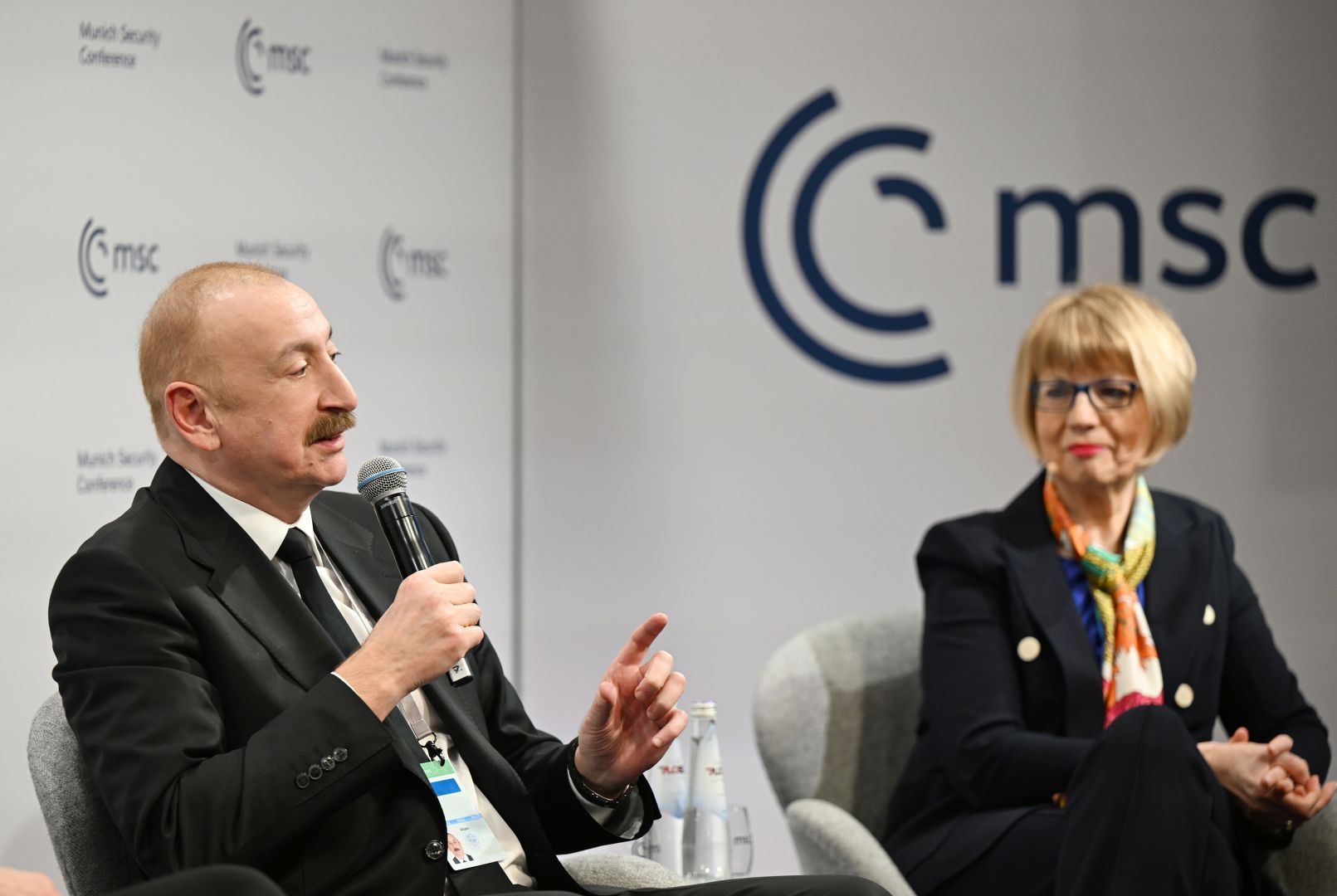
At the recent annual security conference held in Munich, a similar question was put to President Ilham Aliyev by an Armenian journalist during a panel discussion. Although the question sounded more like an assertion than an inquiry, it received a sufficiently clear response. The Azerbaijani president, while modestly acknowledging that he is not a lawyer, offered a substantive legal explanation that addressed the matter directly: “No decision of a constitutional court can be higher than the constitution itself.”
This suggests that, prior to the signing of any peace document, a number of steps must still be taken and obligations fulfilled; certainly responsibilities that rest primarily with official Yerevan.
Nevertheless, despite these outstanding issues, the possibility of peace between the two countries cannot be entirely ruled out under the present circumstances.
While answering journalists' questions at the 62nd Munich Security Conference President Ilham Aliyev also touched upon this issue: "There is de facto peace between Azerbaijan and Armenia." However, the President of Azerbaijan once again underscored that the ball is now in Armenia’s court. In other words, the practical steps required to secure peace now depend on Yerevan.
“You know that this does not depend on us. Our position has already been conveyed to the Armenian side for many years. The necessary changes must be made to Armenia’s Constitution. As soon as these changes are made, we can sign the peace treaty the very next day. Nevertheless, I believe that peace has already been achieved between Armenia and Azerbaijan.”
For years, this conflict, around which peace forecasts have long been made, is, for the first time, moving with a step toward culmination within a peace framework. With the initialing of the peace treaty in Washington on August 8, this peace train has started moving and is gaining speed. The restoration of economic ties, trade operations, and similar steps are among the latest examples, as are the several “Peace Bridge” roundtable meetings held between representatives of Armenian and Azerbaijani civil society. Following the first meetings held in Yerevan in October 2025 and then in Baku a month later, experts and public activists from both sides gathered again on February 13–14 in Tsaghkadzor (a.k.a. Dərəçəçiçək) to discuss issues such as regional security, prospects for economic cooperation, and the implementation of the peace agenda agreed at the leadership level.
This initiative is undoubtedly commendable, because the participants went not as state representatives but as members of civil society. Considering that civil society occupies an intermediary layer between the state and the public, its importance increases accordingly.
The question of how possible peace really is, however, remains an open topic of discussion. With his statement in Munich, the President raised this question openly and unconditionally for the first time. The problem lies not in Baku’s position but in Yerevan’s Constitution. The day Armenia removes its territorial claims against Azerbaijan, the peace treaty can be signed the next day.
This approach turns peace from a legal procedure into an issue of internal political transformation, which has been stated repeatedly.
The peace process is no longer measured by diplomatic formulas but by internal political resilience. The failure to sign the agreed peace text between Azerbaijan and Armenia is not due to technical details but to a fundamental question that Yerevan’s political system has been unable to resolve: on what reality is the state’s constitutional identity based?
Ilham Aliyev’s phrase “peace has been achieved” is not something that would come out spontaneously. The Washington agreements, the initialing of the text, the reduction of tensions at the border, all of these confirm the reality on the ground. The conflict has exited its active phase. The main knot here remains in the preamble of Armenia’s Constitution and in the documents referenced there. It is precisely at this point that it becomes clearer why the peace process has historically reached a dead end. The main problem in Armenia–Azerbaijan relations has not been merely the lack of will of specific governments, but the preservation over many years of political and legal frameworks that were “powerless” yet declared untouchable.
Although the provisions remaining in the preamble of Armenia’s Constitution and in the documents referenced there have in practice lost their legal force, they have been retained as political symbols. This has turned every new agreement into a potential source of risk.
In the past as well, whenever real normalization came onto the agenda, rhetoric of “threat,” “capitulation,” and “strategic loss” was activated in the domestic political arena. Today, one of the clearest expressions of this line comes from Robert Kocharyan and his political circle. In their rhetoric, regional integration projects such as TRIPP and steps toward peace are presented as threats to Armenia. In reality, however, these statements serve less to address future risks than to preserve political positions built on the past.
Nikol Pashinyan is the figure in the most difficult position in this process. Constitutional change could trigger broad public dissatisfaction within the country, and this dissatisfaction is not limited solely to the radical opposition. The issue is tied to national identity, the trauma of defeat, and the collapse of “return” illusions.
For this reason, the likelihood of postponing the referendum to the period after the parliamentary elections in June is quite high. Here, two perspectives emerge. Raising such an issue before the elections could amount to political suicide for Pashinyan.
The risk, however, is that if Pashinyan is not re-elected, the peace process itself could move into a more uncertain phase. The possibility that a new government would choose a harsher or more populist line is not small. Conversely, if Pashinyan remains in power, demonstrating the real results of the TRIPP program - that is, regional transport, trade, and integration mechanisms - will become his main political tool. The logic is quite simple: a painful “compromise” can only be justified by material and social benefits.
One of the main risks for Prime Minister Nikol Pashinyan is the opposition’s gradual transformation into a more structured and multipolar force.
In this regard, the official announcement of the “Strong Armenia” Party under the leadership of Samvel Karapetyan, well known in Russian–Armenian business circles, is seen as a possible turning point in the political configuration. The first news about this was shared on his profile using the hashtag "AI." He declared his candidacy for prime minister, despite being ineligible. This initiative appears to be aimed at forming an alternative political center, which is primarily supported by economic resources and business circles, particularly from Russia.
At the same time, the bloc formed around former ombudsman Arman Tatoyan seeks to appeal to an electorate disappointed with Pashinyan’s “velvet revolution” but unwilling to associate itself with the classical opposition. According to analysts, this line has the potential to attract a certain portion of Pashinyan’s existing voter base.
On the other hand, the formation of a third political bloc around businessman and former politician Gagik Tsarukyan is also being observed. The main target of this camp is the average voter group whose level of social welfare has weakened and whose economic dissatisfaction has increased. The Tsarukyan line seeks to foreground socio-economic problems.
Finally, the political camp formed around Armenia’s second president, Robert Kocharyan, does not hide its intention to consolidate the classic revanchist electorate. This bloc is particularly distinguished by its hardline rhetoric on security and regional processes and represents the most ideologically opposed position to Pashinyan.
Thus, this multipolar political landscape emerging on the eve of the elections can be considered a serious signal for Pashinyan. Until now, the fragmentation of the opposition was regarded as one of the prime minister’s main advantages. But now, the emergence of parallel blocs representing business elites, carrying a human-rights image, and targeting the social electorate further complicates the political scene and could narrow the ruling power’s vote base.
Political dynamics indicate that the main struggle will no longer be only along the government–opposition line, but also within the opposition itself, over leadership and coordination. If these blocs fail to form a unified tactical cooperation model before the elections, fragmentation may once again work in Pashinyan’s favor. However, if coordination is achieved, the upcoming elections could turn into one of the most intense political contests of recent years.
For Armenia, this change is not merely the deletion of a single clause. It means redefining the state’s post-conflict identity. Here, three main problems may arise:
First, a legitimacy crisis. If the results of the referendum are not accepted or society becomes divided in two, political stability could be seriously shaken.
Second, the strengthening of revanchist rhetoric. The opposition could present this process as a “historical renunciation” and activate street politics.
Third, the factor of time. As the process drags on, regional dynamics change and Armenia’s room for maneuver shrinks.
In short, the main burden in this process, in the literal sense, lies on Armenia. The thesis, long used against official Baku, that of a military pressure tool, is now being replaced. It has now shifted to a legal condition.
For Armenia, constitutional change is not the final stage of peace, but its most difficult stage. It is a test of whether society can come to terms with post-war reality.
Here we are to serve you with news right now. It does not cost much, but worth your attention.
Choose to support open, independent, quality journalism and subscribe on a monthly basis.
By subscribing to our online newspaper, you can have full digital access to all news, analysis, and much more.
You can also follow AzerNEWS on Twitter @AzerNewsAz or Facebook @AzerNewsNewspaper
Thank you!