
Global Baku Forum reflects world facing geopolitical rivalry
Akbar Novruz
Read moreThe international system is entering a period of unprecedented strain. Compared with just a year ago, global conflicts have deepened, geopolitical rivalries have intensified, and questions surrounding security, sovereignty, and energy stability have moved to the forefront of international debate.
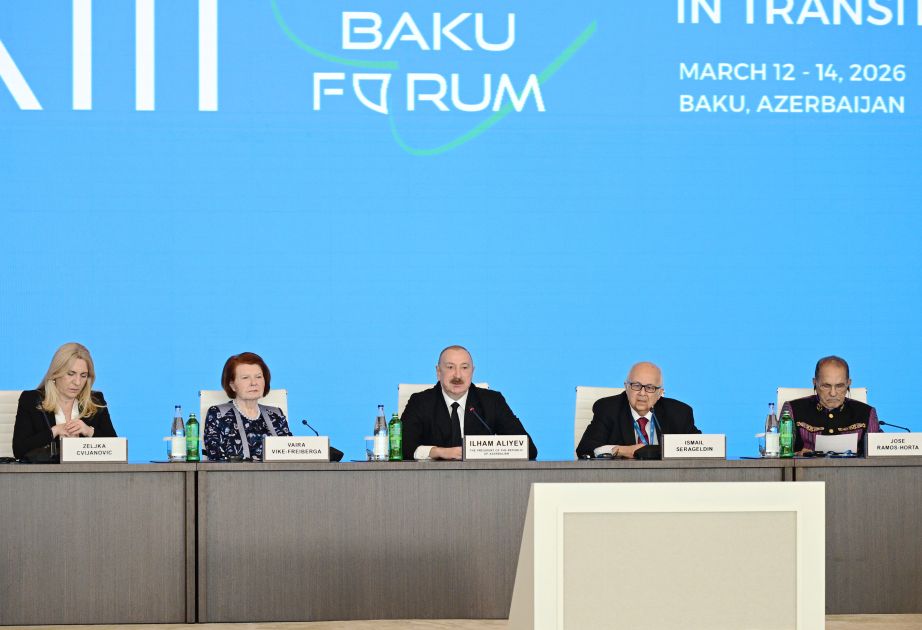
13th Global Baku Forum convened on Thursday under the theme 'Bridging Divides in a World in Transition', the choice of words felt less like diplomatic optimism and more like a precise description of Azerbaijan's own predicament.
Baku sits, with uncomfortable geographical exactness, sandwiched between two of the most active conflict zones on the planet. To its north and west, the Russia-Ukraine war has reshaped the security architecture of the entire post-Soviet space for over four years. To its south, the US-Iran confrontation and the cascading instability across the Gulf have introduced a new and more volatile frontier.
Last year’s forum centered on the theme “Rethinking World Order.” This year’s theme, “Bridging Divides in a World in Transition,” reflects a world that has become even more fragmented and uncertain. This year, the distance between theme and reality felt narrower than usual. Now, let us walk you through all the points that are being addressed and that should and must convey a message.
The question animating the room was whether a small, strategically located country navigating overlapping crisis zones can remain a stable hub, and what it costs to try. Perhaps, only a week ago, an Iranian drone fell on Azerbaijani territory in Nakhchivan. Four casualties were reported. The episode carried a significance disproportionate to its scale. It was a physical demonstration of how porous the boundaries of this conflict have become, and how exposed Azerbaijan is to processes it did not initiate and cannot fully control.
We reiterated that Nakhchivan is not an incidental territory. It is an exclave, separated from the Azerbaijani mainland by Armenian land, bordered by Iran to the south and Türkiye to the west. It is one of the most geopolitically compressed patches of territory in the South Caucasus, and the drone incident underscored that the Iran conflict is not contained to the Gulf.
The challenge is as much about perception as it is about proximity. Azerbaijan has spent years cultivating its image as a reliable transit and energy hub, a stable corridor in an unstable neighbourhood. Every stray projectile, every disrupted supply route, every spike in regional tension tests that reputation.
The Iran-Gulf confrontation has sent oil and gas prices sharply higher. For energy-exporting states, the conventional assumption is that this represents a windfall. President Aliyev pushed back against that framing directly at the forum. 'If somebody thinks that this unbalanced price is good for those who produce and export oil, it's wrong,' he said, a statement that deserves more attention than it typically receives.
The logic behind it is structural rather than altruistic. Extreme price volatility destabilises long-term investment in energy infrastructure, complicates supply agreements with partner countries, and generates the kind of economic stress in importing nations that ultimately undermines demand. For a country like Azerbaijan, which positions itself as a dependable, long-term supplier rather than an opportunistic one, price shocks driven by conflict are a strategic liability, not an asset.
Azerbaijan's role in European energy security has grown considerably since Russia's full-scale invasion of Ukraine prompted a continent-wide effort to diversify away from Russian gas. Now the gas has reached its recent 'peak point' - Germany and Austria. Aliyev noted that as a pipeline gas exporter by geographical coverage, Azerbaijan now ranks first in the world. The Southern Gas Corridor, feeding into European markets through Georgia and Türkiye, has taken on a strategic weight it did not previously carry. The Iran crisis adds a further dimension: with Gulf energy flows disrupted and tanker traffic through Hormuz severely curtailed, the value of overland pipeline infrastructure, less exposed to naval confrontation, has increased accordingly.
Another issue - Corridor(s) bridging continents is under a threat.
One of the points that makes the region a bit more sensitive is the "corridor web" connecting East and West, North and South. For example, cargo transportation along the International North-South Transport Corridor (INSTC) has been largely suspended since February 28 following the escalation of the armed conflict in the Middle East, according to sources from several shipping companies.
Industry representatives report that exporters have started halting shipments due to growing uncertainty and disruptions along routes that pass through Iran.
In particular, companies operating in the forest industry have suspended cargo deliveries via the corridor. Two sources from firms exporting wood materials confirmed that shipments along the North-South route were halted from February 28. One of the sources noted that the company plans to redirect exports towards markets in North Africa and Latin America.
The Middle Corridor, the transcontinental trade route running from China through Central Asia, across the Caspian, through Azerbaijan and Georgia, and into Europe, was already gaining strategic traction before the current crisis. The war in Ukraine made the northern route through Russia unreliable for many shippers. The Iran crisis has now complicated the southern route as well.
This leaves the Middle Corridor as the most viable overland alternative for east-west trade between Asia and Europe, and it runs directly through Baku. President Aliyev announced at the forum that Azerbaijan is working on a new extension of the corridor through Armenian territory following the peace agreement initialled seven months ago. If realised, this would represent a significant expansion of the corridor's reach and Azerbaijan's centrality to Eurasian connectivity.
"Conflicts lead to the disruption of traditional transportation routes, creating enormous difficulties for people, countries, economies, and supply chains. When connectivity is broken, the majority of the international community finds itself in a very difficult situation."
The geopolitical logic is straightforward: as both the northern and southern routes face sustained disruption, the Middle Corridor becomes not merely an alternative but a necessity. Azerbaijan's ability to position itself as the indispensable hub of that corridor depends, however, on its own stability holding, which returns the analysis to the question of how a country sandwiched between two conflict zones maintains the conditions for that role.
Cost of being a hub
Baku's approach to the surrounding turbulence has been characterised by deliberate neutrality and active engagement, a posture more difficult to sustain than it appears. Azerbaijan has maintained working relationships with Russia, Iran, Türkiye, the EU, and the United States simultaneously, a feat of diplomatic balancing that reflects both necessity and genuine strategic calculation.
The forum itself is an expression of that posture. Bringing together leaders and policymakers from across the geopolitical spectrum, including from states that are actively opposed to one another, requires a host that is trusted, or at least not distrusted, by all sides. That Baku has managed this role across thirteen consecutive forums is not incidental. It reflects a consistent investment in multilateral credibility at a time when such credibility is in short supply.
But credibility requires calm, and calm is increasingly hard to guarantee. The drone in Nakhchivan was a warning , not necessarily deliberate, but consequential regardless. It illustrated that Azerbaijan's geographic position, which is the source of its strategic value, is also the source of its exposure. The same location that makes Baku indispensable to Eurasian connectivity makes it vulnerable to the conflicts that surround it.
The forum's theme, bridging divides in a world in transition, carries a certain irony when examined against the landscape in which it was held. The divides in question are not abstract disagreements about global governance. They are live conflicts, disrupted energy flows, and a regional security environment in which miscalculation has become a genuine risk.
Azerbaijan's contribution to bridging those divides is largely structural: it provides routes, pipelines, and platforms that connect parties who are otherwise unwilling to engage. In a world where physical infrastructure has become as contested as political alignment, the ability to keep a corridor open and a forum running carries real weight.
What the 13th Global Baku Forum ultimately reflected was not optimism - or only not optimism. It reflected the particular kind of pragmatism that small states develop when they have no alternative to navigating complexity. Azerbaijan is not a great power. It cannot shape the conflicts that press against its borders. What it can do, and what it appears determined to do, is remain useful to enough parties that its stability becomes, in some measure, a shared interest.
Whether that calculation holds as the Iran crisis deepens and the pressure on regional chokepoints intensifies is the question that no forum theme, however carefully chosen, can yet answer.
Here we are to serve you with news right now. It does not cost much, but worth your attention.
Choose to support open, independent, quality journalism and subscribe on a monthly basis.
By subscribing to our online newspaper, you can have full digital access to all news, analysis, and much more.
You can also follow AzerNEWS on Twitter @AzerNewsAz or Facebook @AzerNewsNewspaper
Thank you!