
Oil volatility returns as Strait of Hormuz disruption shakes global markets

AzerNEWS Staff
Read moreIn the backdrop of rising regional tensions, energy issues have once again come to the forefront. The closure of the Strait of Hormuz has intensified transit problems, while growing demand has pushed oil prices upward. Azerbaijani oil has surpassed the $100 mark per barrel, reaching levels not seen since Russia’s full-scale invasion of Ukraine. Yet history shows that prices tend to return to average levels after such spikes. The question now is: if the conflict continues, what scenarios might unfold for oil prices in the coming months? Could they climb to $110–120 per barrel? To explore this, AzerNEWS spoke with energy expert Ilham Shaban.
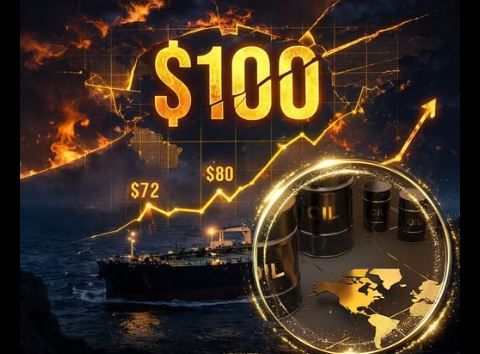
The expert notes that Brent crude reached $119.5 per barrel on March 8 at 6:30 a.m. Baku time in electronic trading, based on futures contracts for May delivery. Prices then fell below $107, reflecting what he calls “short-term emotional volatility.” He explains that before the outbreak of the U.S.-Israel conflict with Iran, Brent was trading at $72.48, but tensions quickly drove prices up to $92.69. “This military conflict acts as the locomotive pushing oil prices upward,” he emphasizes, recalling that the last time oil traded above $110 was in June 2022.
According to him, the sharp rise at the start of the week was triggered by reports that Saudi Arabia, Iraq, the UAE, and Kuwait had reduced production. “During the first week of the war this did not happen, except in Iraq, because oil was being stored in tanks. As those tanks filled, cutting production became logical due to limited export capacity,” the expert explains.
Looking ahead, Ilham Shaban believes that major importers may resort to their strategic reserves to avoid buying expensive oil. This would act as a brake on further price increases. He points out that Japan’s reserves could cover 254 days of imports, while China’s undisclosed reserves are estimated to last around 200 days. The United States holds more than 400 million barrels in its strategic reserves. Azerbaijan, as an exporter, stores oil in SOCAR’s facilities near Sangachal and Boyukshor, though official figures are not disclosed.
For Azerbaijan, higher oil prices translate into greater revenue opportunities, but the expert cautions that the gains are situational and unstable. “Oil companies pay taxes quarterly, so the Ministry of Finance will only have real data by mid-April on how much extra revenue has entered the budget compared to forecasts,” he explains.
Globally, volatility remains high. Brent crude fell from $119 to about $98.5 within a single trading session. Ilham Shaban attributes this sharp drop to comments by French Finance Minister Roland Lescure, who announced after a G7 meeting that member states were considering tapping reserves in response to Middle East tensions. The International Energy Agency (IEA), which oversees 1.2 billion barrels of reserves across 32 member countries, could release supplies in emergencies. “The IEA has taken such steps five times since 1974. The last was in March 2022, when the Russia-Ukraine war sent prices soaring. At that time, member countries released 2 million barrels per day, with the U.S. adding another 1 million. Prices fell from $130 to $95 within a month,” he recalls.
The trajectory of oil prices will depend on the interplay of geopolitical tensions, production cuts, and the use of strategic reserves. As the expert underscores, the market is highly volatile, creating both risks and opportunities. For Azerbaijan, the situation offers potential short-term gains, but the broader global economy faces uncertainty as energy markets remain on edge.
Here we are to serve you with news right now. It does not cost much, but worth your attention.
Choose to support open, independent, quality journalism and subscribe on a monthly basis.
By subscribing to our online newspaper, you can have full digital access to all news, analysis, and much more.
You can also follow AzerNEWS on Twitter @AzerNewsAz or Facebook @AzerNewsNewspaper
Thank you!