
US moving forces into Middle East - What comes next with Iran?
Akbar Novruz
Read moreTalk of another US–Iran showdown is no longer confined to whispers in Washington. In recent weeks, a familiar pattern has begun to re-emerge: sharpened rhetoric from the White House, a visible uptick in American military movements across the Middle East, and a steady stream of open-source clues pointing to heightened readiness rather than routine deterrence.
Earlier this month, US President Donald Trump issued a pointed message to Iranians protesting against their government, declaring that “help is on its way”. The remark, delivered via social media rather than diplomatic channels, was deliberately ambiguous. But in the weeks since, it has been followed by something far less abstract: a slow, methodical and highly visible build-up of American military power across the Middle East.
The United States, already the world’s most formidable military force, has demonstrated in recent history that it is willing and able to strike Iran directly. In June last year, Operation Midnight Hammer targeted Iranian nuclear facilities in a rare, overt attack. More than 100 aircraft took part, including B-2 stealth bombers flying non-stop from the continental US to deliver precision “bunker-buster” munitions designed to penetrate hardened underground sites. It was a reminder not only of American reach, but of its willingness to use it when red lines are judged to have been crossed.
Now, the question hanging over the region is whether Washington is preparing to do so again. Trump has fuelled that speculation himself, warning Tehran that unless it agrees to curb its nuclear programme, “the next attack will be far worse”. In the same breath, he spoke of a “massive armada” moving towards Iran, invoking the language of overwhelming force while insisting that time for diplomacy was “running out”.
Behind the rhetoric lies a substantial and expanding military footprint. Up to 50,000 US personnel are already stationed across the Middle East, with major bases in Qatar, Bahrain, Saudi Arabia, the United Arab Emirates, Jordan and Oman. Around 10,000 troops are based at al-Udeid airbase in Qatar alone – the largest US military installation in the region and a critical hub for air operations. Since the strikes last year, al-Udeid has also been a target: Iran launched missiles at the base in retaliation, underscoring its centrality to any future confrontation.
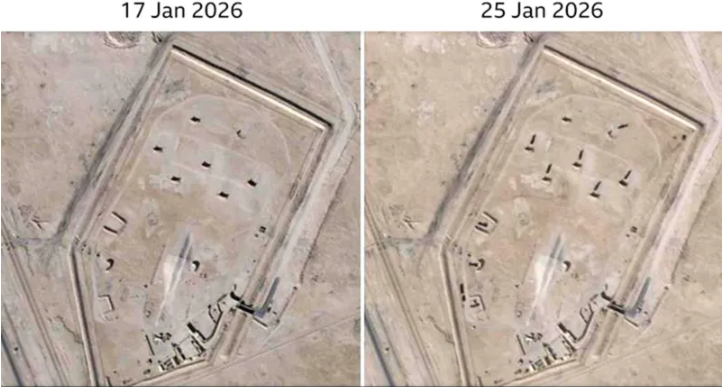
In recent weeks, open-source intelligence has documented a notable surge in American military activity. Satellite imagery shows new structures appearing on the perimeter of al-Udeid, which experts believe are linked to enhanced air and missile defence systems. Flight tracking data has revealed the arrival of F-15 fighter jets, aerial refuelling tankers, transport aircraft and surveillance platforms, including P-8 Poseidon maritime patrol aircraft and long-range intelligence planes operating close to Iranian airspace.
A US carrier strike group has also moved into the region. The USS Abraham Lincoln, previously deployed in the Indo-Pacific, was ordered to reverse course and head towards the Gulf. While its precise location is no longer publicly broadcast, tracking data suggests carrier-linked aircraft are operating near Oman. With an air wing of around 70 aircraft, including F-35 stealth fighters, and an escort of destroyers armed with Tomahawk cruise missiles – often supported by a nuclear-powered submarine – a carrier strike group represents one of the most potent instruments of American military power.
The Pentagon has offered little public detail on these movements, framing them as routine exercises and defensive measures. But taken together, the scale, composition and timing of the deployments suggest more than signalling alone. Britain, too, has dispatched a squadron of Typhoon jets to the region “to boost regional security”, while the US Air Force has announced a major exercise aimed at demonstrating its ability to deploy and sustain combat airpower across the Middle East.
Whether this posture is designed to deter Iran, coerce it back to the negotiating table, or prepare the ground for another strike remains unclear. What is evident is that Washington is positioning itself to move quickly if a decision is made. As Trump himself put it: “We have a big flotilla going in that region – and we’ll see what happens.”
Iran, having announced a two-day live-fire navy drill in the Strait of Hormuz, the US warns it will not tolerate any unsafe or provocative actions. The drill is set to begin on Sunday, after the US deployed the aircraft carrier Abraham Lincoln and other military assets in the Middle East. The US Central Command has issued a firm warning to Iran’s Revolutionary Guard Corps (IRGC) ahead of planned two day live-fire drill, that it will not tolerate any unsafe actions.
Is Washington preparing to strike Iran again?
The visible buildup of US military assets across the Middle East has prompted renewed speculation about whether Washington is laying the groundwork for another strike on Iran. According to a geopolitical analyst, President of Scarab Rising, Inc., Irina Tsukerman's remarks to Azernews, the answer is more nuanced than a simple yes or no.
She argues that the current posture reflects preparation without commitment—a deliberate effort to preserve the ability to escalate rapidly without signalling inevitability. The United States, she says, is not advertising an imminent strike, but ensuring that one could be launched immediately if conditions shift.
“The current US posture reflects deliberate preparation for escalation without committing to execution. Force deployments are structured to create credible strike capacity across air, naval, missile, cyber, and intelligence domains.”
Rather than symbolic shows of force, Tsukerman points to enabling activities that support sustained high-intensity operations. Expanded aerial refuelling, pre-positioned deep-penetration munitions, tighter integration between carrier aviation and land-based strike aircraft, and reinforced missile defences all suggest readiness for complex strike sequences.
“These measures indicate readiness for complex strike sequences rather than one-off demonstrations.”
Carrier deployments, in her assessment, serve a practical operational role. Carrier-based aviation allows Washington to operate independently of regional political constraints, but at the cost of heightened escalation sensitivity.
“Carriers reduce reliance on host-nation political constraints, but they also concentrate risk by presenting high-value targets that require extensive defensive resources.”
What would actually trigger escalation?
Tsukerman stresses that escalation timelines are not driven by public rhetoric or political deadlines, but by intelligence assessments and battlefield events that rapidly narrow decision space.
A credible judgment that Iran is approaching a nuclear breakout threshold, she explains, would fundamentally alter US calculations.
“Once such assessments are accepted internally, delays are viewed as risk rather than restraint.”
Another trigger would be a direct attack causing mass American casualties. While limited proxy attacks are often absorbed within escalation-management frameworks, a high-fatality incident would force a response regardless of broader strategic preference.
“An attack producing significant American deaths forces a response. That dynamic both gives Iran leverage and constrains its freedom to act.”
Absent such triggers, escalation remains conditional—dependent on weather, intelligence confidence, readiness of strike packages, and force-protection posture. In these circumstances, operational probability outweighs political optics.
The escalation before the escalation
Before overt strikes, Tsukerman expects pressure to build through covert and non-kinetic measures designed to degrade Iranian capability while maintaining deniability.
“Cyber operations, interdictions of procurement networks, seizures of sanctioned cargo, and intelligence-driven sabotage test Iranian thresholds while preserving plausible deniability.”
Iran’s engagement with Russia, she adds, should be understood less as alliance-building and more as contingency signalling.
“Russia can complicate post-strike diplomacy, but it cannot materially deter US action.”
How would Iran retaliate?
Iran’s retaliation strategy, Tsukerman argues, is built around layered escalation, not decisive confrontation. The goal is to impose sustained costs without triggering overwhelming retaliation.
“The objective is to restore deterrence through indirect action, deniability, and geographic dispersion.”
Direct retaliation against US forces is most likely in Iraq and Syria, where proxy militias possess rockets and drones capable of striking installations with minimal warning.
“These attacks are difficult to prevent entirely and impose constant force-protection burdens.”
Maritime disruption represents another pressure point, with even limited incidents capable of triggering wider economic effects.
“Harassment of shipping raises insurance premiums and disrupts commercial traffic far beyond the immediate theatre.”
Missile strikes against US bases would mark a sharper escalation, likely calibrated to demonstrate reach while avoiding mass casualties.
Cyber retaliation, meanwhile, offers Iran a means to blur civilian and military boundaries.
“Energy networks, ports, aviation systems, and financial infrastructure are all potential targets.”
Retaliation against US allies—particularly Israel and Gulf states—is highly likely and may be prioritised.
Could the US actually neutralise Iran’s nuclear program?
On the question of whether a large-scale precision strike could decisively cripple Iran’s nuclear capabilities, Tsukerman is sceptical.
She notes that Iran’s program is designed for survivability rather than efficiency, with distributed facilities and built-in redundancy.
“Physical destruction of a single site does not equate to functional elimination.”
Underground hardening, concealment, decoys, and unknown facilities further complicate targeting.
“Strikes can produce dramatic imagery while leaving the core enrichment pipeline operational.”
Battle-damage assessment remains uncertain, particularly for buried targets, increasing the likelihood of repeat strikes and campaign expansion.
“Uncertainty encourages escalation rather than closure.” Beyond technical challenges, Tsukerman highlights strategic risks. A strike could accelerate Iran’s determination to weaponise, pushing programs deeper underground and reducing future visibility.
“Human capital survives physical destruction. Reconstitution can proceed faster than anticipated.”
Political constraints further limit outcomes, as justifications centred on nuclear prevention restrict campaign scope while broader targeting risks eroding international support.
Here we are to serve you with news right now. It does not cost much, but worth your attention.
Choose to support open, independent, quality journalism and subscribe on a monthly basis.
By subscribing to our online newspaper, you can have full digital access to all news, analysis, and much more.
You can also follow AzerNEWS on Twitter @AzerNewsAz or Facebook @AzerNewsNewspaper
Thank you!