
Moscow’s evasive answers leave AZAL crash investigation grounded in doubt

Akbar Novruz
Read moreThere are moments when documents speak louder than statements, and moments when they speak instead of them. The recently surfaced letter attributed to Russia’s Investigative Committee regarding the crash of an AZAL aircraft belongs firmly to the second category. Its tone is restrained, almost clinical. Clouds, failed landing attempts, and an unfortunate impact with the ground. A tragedy without an author. A case without responsibility.
At first glance, everything appears orderly. Time stamps are precise, the sequence of events neatly arranged, the language deliberately neutral. The disaster is reduced to a chain of impersonal circumstances, where nature intervenes, and institutions merely observe. Yet the real problem with such narratives is never what they contain, but what they carefully avoid naming.
Because memory, inconveniently, has not been grounded.
A year ago, the airspace near Grozny was not simply overcast; it was militarised. The airport was operating amid what Russian officials later described as a drone threat. Airspace was not closed. Civilian crews were not warned. Communications were disrupted. Shortly afterwards, a civilian aircraft fell from the sky. These are not speculative interpretations or emotional accusations; they are elements acknowledged in different forms during the first days after the tragedy, supported by physical evidence and expert assessments.
This is where the newly published explanation begins to resemble less an investigation and more a curtain. Weather, after all, is an ideal witness: it cannot testify, it cannot contradict, and it cannot demand accountability. Clouds do not ask why air defence systems were active near civilian flight paths, nor why standard aviation safety protocols were quietly set aside.
Recently, photos of an official document sent to Azerbaijan by the Russian authorities regarding the termination of the criminal case into the AZAL plane crash have been made public. According to the document, the Azerbaijani airliner was unable to land in Russia due to unfavourable weather conditions, and the aircraft ultimately crashed during its attempted landing. Based on this explanation, the Russian Investigative Committee declared the criminal case closed.
With the appearance of a letter on the Telegram channel BT News, reportedly signed by Alexander Bastrykin, head of the Russian Investigative Committee, and addressed to Azerbaijan’s Prosecutor General Kamran Aliyev. How the document reached the channel remains unclear, but such leaks rarely happen by chance; there is likely a calculated political motive behind its disclosure. In the letter, Bastrykin presents an account that seems to exist in its own detached reality: the AZAL flight left Baku for Grozny, encountered “adverse weather,” failed to land twice, and eventually crashed near Aktau while diverting.
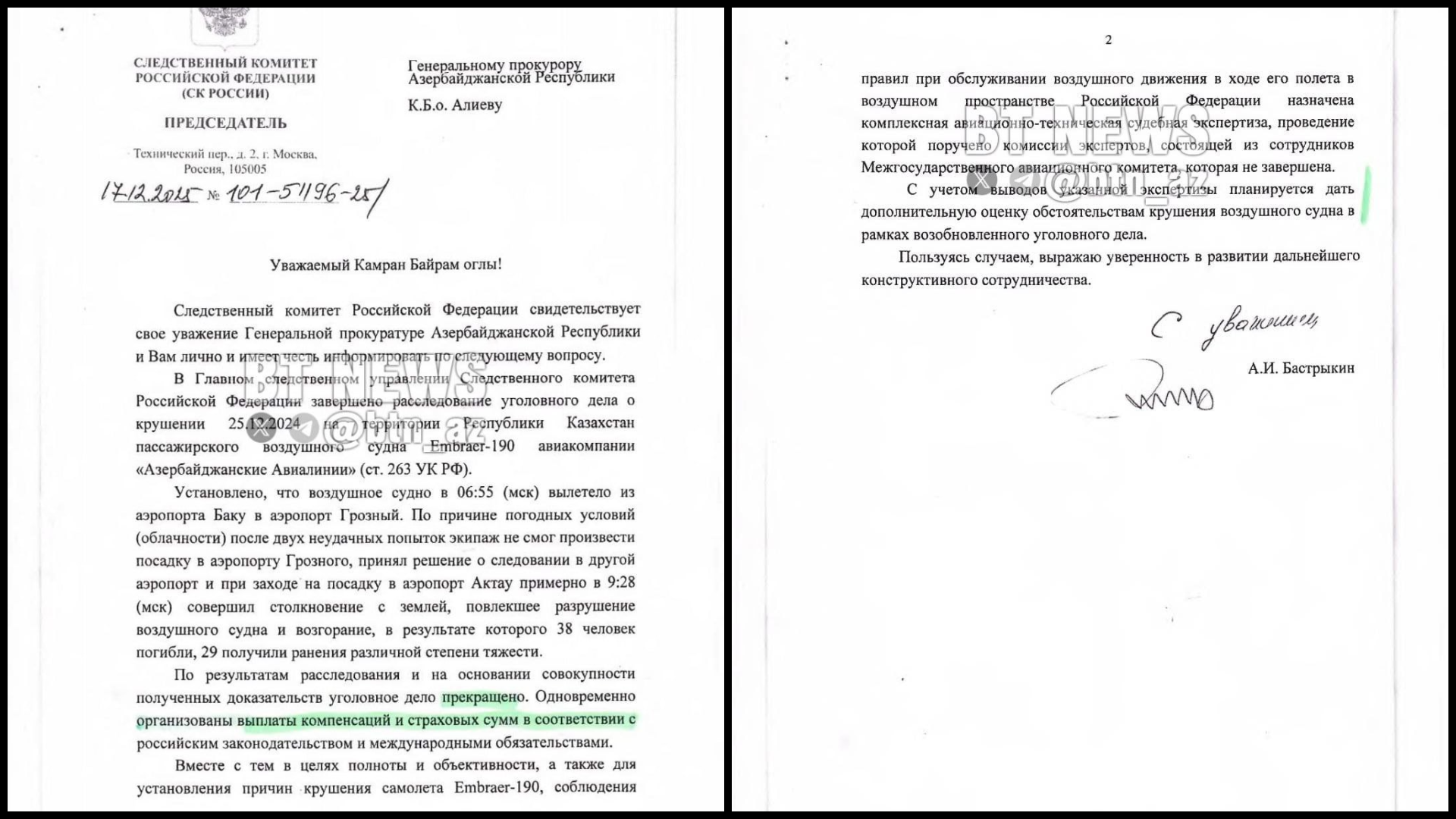
What makes this version particularly fragile is not only what it claims, but how sharply it contradicts what was previously said, publicly, directly, and at the highest political level. At the CIS summit in Dushanbe, Vladimir Putin did not hide behind meteorology. He acknowledged that Russian air defence systems were involved and expressed readiness to take responsibility, including compensation and further steps. These words were not whispered; they were delivered openly and received as a rare moment of clarity in an otherwise evasive process.
Yet clarity, it seems, has a short lifespan once it encounters institutional paperwork.
The investigative conclusion now suggests that no one is to blame. No chain of command requires scrutiny. No decisions demand review. Responsibility quietly shifts to circumstances, and, by extension, to pilots who can no longer speak for themselves. It is a familiar mechanism: when accountability becomes politically inconvenient, gravity is invited to take the stand.
This logic does not emerge in isolation. The figure behind the letter represents an institution known for its ability to close sensitive cases with procedural efficiency. Files disappear into formal conclusions; contradictions are resolved through silence rather than explanation. In that context, the revival of alternative theories feels less like a discovery of truth and more like a reflex.
But there is a broader question hovering over this entire episode, one that extends beyond the AZAL tragedy itself. If Russia, and Vladimir Putin personally, are convinced of the correctness of their position, why the persistent avoidance? Why the selective presence on international platforms? Why the noticeable absence from key meetings, discussions, and formats where difficult questions might require direct answers rather than written explanations?
Confidence, after all, usually seeks the spotlight. Avoidance suggests something else.
This pattern is not unfamiliar to the international community. The same logic of denial, reframing, and procedural deflection has long accompanied Russia’s actions in Ukraine. Civilian infrastructure destroyed becomes a “military necessity.” Documented atrocities turn into “provocations.” Independent investigations are dismissed, while alternative narratives are produced at speed and scale. In that sense, the AZAL case does not stand apart; it fits. The tools are the same, only the context differs.
Here, too, responsibility is diluted. Facts are reclassified. Timelines are reshaped. And when contradictions become too visible, the solution is not engagement, but withdrawal, from meetings, from dialogue, from accountability itself.
Meanwhile, the political consequences ripple outward. After the crash, instead of transparent cooperation, bilateral relations deteriorated. Explanations multiplied, each weaker than the last. Pressure on the Azerbaijani community in Russia intensified, as if unresolved responsibility needed a social outlet. These developments did not occur by accident; they followed the familiar arc of evasion turning into resentment.
For a brief moment last autumn, it seemed that a different path was possible. Presidential dialogue reopened space for resolution. Apologies were issued. Compensation was mentioned. Expectations were raised, not excessively, but reasonably. What followed, however, was not progress, but procedural closure.
Now the issue is no longer confined to a single investigation. It touches on credibility itself. If presidential assurances can be quietly neutralised by institutional letters, then where exactly does decision-making power reside? In public commitments made before international partners, or in internal conclusions that never face independent scrutiny?
Azerbaijan’s position has been consistent from the outset: acknowledgement, accountability, compensation, and justice. These are not political demands; they are the standard language of international aviation responsibility. Attempts to reduce the tragedy to unfavourable weather do not merely fail to satisfy these demands; they implicitly deny that they were ever warranted.
At this stage, official clarification is not a diplomatic courtesy but an obligation. The authenticity and legal status of the published document must be confirmed or denied. More importantly, the reasoning behind the termination of the case must be explained, not through abstractions, but through facts that withstand scrutiny.
And beneath all technicalities, one question continues to surface, quietly but persistently: if Russia is right, as it so often insists, why does it keep stepping away when it is time to defend that rightness in the open?
Between clouds, silence, and selective absence, responsibility has a habit of disappearing. But silence, unlike weather, does not absolve.
Here we are to serve you with news right now. It does not cost much, but worth your attention.
Choose to support open, independent, quality journalism and subscribe on a monthly basis.
By subscribing to our online newspaper, you can have full digital access to all news, analysis, and much more.
You can also follow AzerNEWS on Twitter @AzerNewsAz or Facebook @AzerNewsNewspaper
Thank you!