
How Baku advances post-oil economic strategy - key takeaways from Azerbaijani President
Akbar Novruz
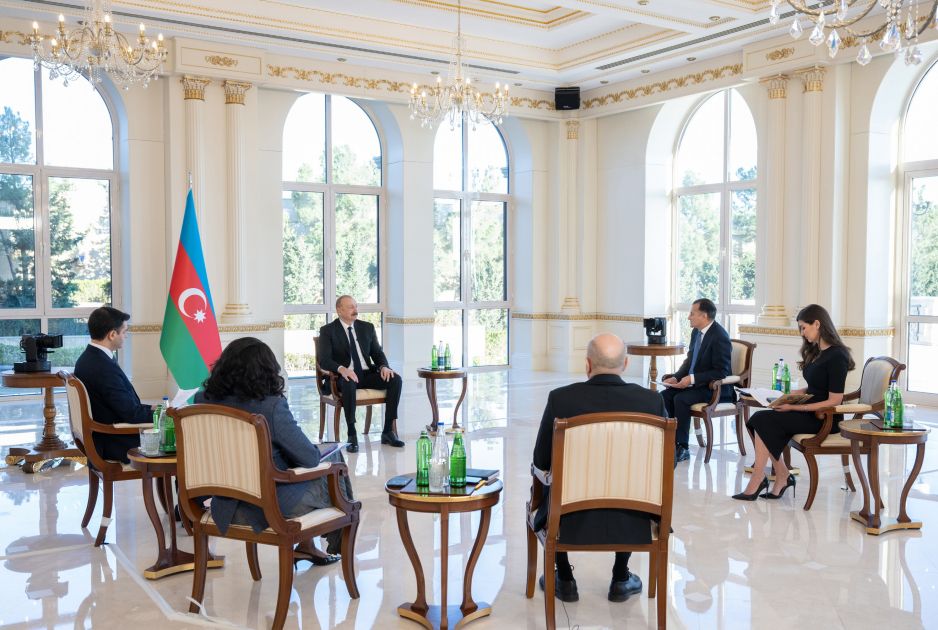
Read moreAs a yearly tradition, President Ilham Aliyev gave an interview to local TV channels. As we step into a new year, we can say that a new economic geometry is emerging in Azerbaijan. Energy, transit, and industry are being folded into a single strategic axis, by design, not accident. The aim is to outgrow hydrocarbons without forfeiting energy primacy, to turn geography into bargaining power, and to fuse green electricity with industrial heft through a recalibrated partnership with China. Renewables, manufacturing localisation, and the Middle Corridor are no longer adjacent policies; they are mutually reinforcing parts of a single development model.
That logic shaped the recent high-level interview itself. The range of questions and their density forced repeated returns to the same economic terrain. But each pass sharpened the picture. Familiar themes were revisited from different angles, with successive answers adding depth rather than repetition.
Read as a whole, the responses form a connected argument. Diversification, clean energy, and transit are not being pursued in isolation but welded into a strategy meant to future-proof growth and recast Azerbaijan as both a green-energy node and a regional conduit in a more crowded global economy.
The core claims of that strategy merit closer examination, in sequence.
The comprehensive strategic partnership between Azerbaijan and China is proving to be a catalytic force in turning President Ilham Aliyev’s ambitious vision for economic diversification into tangible, large-scale projects, especially in renewable energy and industrial modernization.
“I believe that one of the events of great importance is our strategic partnership with China. Last year, during my state visit to China, a Joint Statement on Comprehensive Strategic Partnership was signed, and this can also be considered a great success. Because China is one of the leading countries in the world, and this political framework, political platform, of course, can be viewed as evidence of our successful diplomacy.”
Expanded in context, this statement underlines that Azerbaijan’s engagement with China is not transactional, but structural. By anchoring cooperation in a comprehensive political framework, Baku ensures that economic projects, especially in energy and industry, are protected from short-term fluctuations and geopolitical pressure. The partnership institutionalizes trust, allowing large-scale investments in sensitive sectors such as energy grids, renewables, transport corridors, and high-tech manufacturing.
This is reinforced by the President’s emphasis on continuity:
“I believe that the important political documents signed between us… resulted in two documents on strategic and then comprehensive strategic partnership being adopted and signed, giving a significant boost to the development of bilateral economic ties.”
Recent developments show Chinese enterprises signing agreements on several renewable energy projects, including photovoltaic and wind power plants with a combined capacity of over 1,570 megawatts, a move that is expected to double Azerbaijan’s renewable generation capacity once commissioned. Chinese firms are also set to build a 3 GW solar panel manufacturing facility in the Alat Free Economic Zone, a development that could seed high-tech manufacturing and localization of clean energy equipment in Azerbaijan’s economy.
Beyond renewable energy, this partnership supports broader connectivity ambitions. China is funding new rail links involving complex terrain engineering projects, which will increase freight traffic to the Caspian Sea and reinforce Azerbaijan’s role in the Middle Corridor, further diversifying non-oil transit revenue streams.
Baku has firmly positioned renewable energy at the heart of its future development model. President Aliyev has articulated clear national targets:
“According to the existing plans, 6,000 megawatts of solar, wind, and hydropower will be included in our system by 2030, and 8,000 megawatts by 2032.”
This expansion is part of a broader strategy to reduce reliance on natural gas for electricity generation, allowing for additional gas exports and domestic savings, while simultaneously enabling clean energy exports where feasible. The push towards renewable capacity is already attracting global investment: UAE’s Masdar, Saudi Arabia’s ACWA Power, and bp are building major solar and wind plants. Local Azerbaijani companies are also joining this renewable trajectory.
At the UN General Assembly, President Aliyev noted that almost 40 % of Azerbaijan’s electrical energy could be generated by renewables by 2030, underscoring how integral clean energy has become to the national energy mix.
A decisive challenge, and opportunity, lies in grid expansion and energy storage. President Aliyev acknowledged that to absorb the planned renewable capacity, Azerbaijan must strengthen its transmission networks and build battery storage systems, a cornerstone of modern renewable grids.
Infrastructure alone does not guarantee durability. The leadership’s emphasis on education reform suggests an understanding that energy transition and industrial ambition rest ultimately on human capital.
"Improving the quality of education, the social security and professionalism of teachers, the testing system, etc. All these factors pursue one goal – to make society literate and knowledgeable. Only then can we achieve long-term development. Otherwise, after our oil and gas run out, we may find ourselves in a very difficult situation. But now we must try to see the future of our people and state decades and centuries ahead. Therefore, this is an extremely important area, and I do hope that the reforms carried out will lead to good results", - the President stated.
Beyond domestic use, Azerbaijan is pursuing regional electricity connections, including potential under-sea cables across the Caspian Sea to Kazakhstan and Uzbekistan, and export corridors reaching Georgia and potentially Europe. These corridors promise to enhance Azerbaijan’s role as a regional clean power hub and not just a producer for domestic consumption.
China’s contribution goes beyond financing. The country is a global leader in renewable technologies, with installations and manufacturing capacity unmatched globally. This expertise supports Azerbaijan’s renewable rollout and local manufacturing ambitions, from solar panel production to electric vehicle assembly lines, indicating a shift from pure energy projects to integrated industrial development.
The projected 3 GW solar panel plant in Alat is more than an energy facility: it represents the beginning of localized clean tech production, which can spark job creation, technology transfer, and value-added manufacturing.
Azerbaijan’s strategic partnership with China has accelerated its renewable energy ambitions and strengthened the foundations of a diversified, non-oil economy.
The leadership is betting that energy transition, industrial upgrading and transit connectivity are strongest when pursued together. The hydrocarbons era is not being abandoned; it is being leveraged to finance and stabilise a more complex economic architecture.
The partnership with China illustrates this approach well. It is less about quick capital and more about embedding Azerbaijan into global supply chains for clean energy, logistics and manufacturing. Renewable capacity feeds export potential, industrial localisation deepens value creation, and the Middle Corridor turns geography into sustained revenue. Each pillar reinforces the others.
Whether this model delivers will depend on execution, particularly grid resilience, skills development and regulatory consistency. But the direction is clear. Azerbaijan is no longer positioning itself merely as an energy supplier or a transit route. It is attempting to become a system, one that connects power, production and passage in a region where all three are increasingly contested. If successful, this new economic geometry may prove harder to ignore than the old one.
Here we are to serve you with news right now. It does not cost much, but worth your attention.
Choose to support open, independent, quality journalism and subscribe on a monthly basis.
By subscribing to our online newspaper, you can have full digital access to all news, analysis, and much more.
You can also follow AzerNEWS on Twitter @AzerNewsAz or Facebook @AzerNewsNewspaper
Thank you!