
Universe expand faster than expected
by Alimat Aliyeva
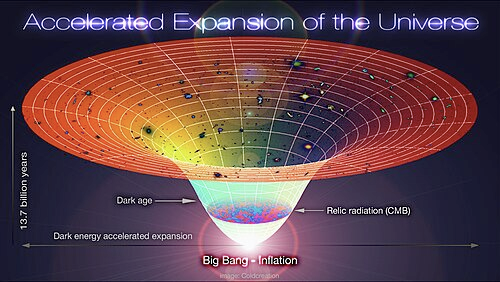
A major international study by astronomers has confirmed that galaxies near our Solar System appear to be moving away from us faster than expected. This recession speed is described by the Hubble constant, which measures how quickly the universe is expanding. The new analysis gives a value of about 73.5 kilometers per second per megaparsec, meaning that the farther a galaxy is, the faster it recedes from us, AzerNEWS reports.
However, when scientists study signals from the early universe — such as the cosmic microwave background — they consistently obtain a lower value of about 67 kilometers per second per megaparsec.
At first glance, this difference may seem small, but in modern cosmology it is extremely significant. The discrepancy, known as the “Hubble tension,” has persisted for more than a decade despite increasingly precise instruments, improved observations, and refined calculations. Because of this, researchers no longer treat it as a simple measurement error.
To reduce uncertainties, astronomers have combined several independent distance-measuring techniques, including observations of Type Ia supernovae, variable stars known as Cepheids, and entire galaxy systems. These methods are assembled into a so-called cosmic distance ladder, which allows scientists to cross-check results at different scales of the universe.
Even with this careful approach, the expansion rate in the nearby universe remains consistently higher than the value inferred from the early universe. This has led scientists to two main possibilities: either there is still a hidden systematic error in our measurements, or our current understanding of cosmology is incomplete.
Some theorists suggest something even more intriguing — that unknown physics, such as early dark energy or subtle changes in the properties of dark matter, could be influencing cosmic expansion. If confirmed, this would require a serious revision of the standard model of the universe.
For now, the mystery remains unsolved. The universe continues to expand in a way that challenges our best theories — and may be hinting that there is still something fundamental about space, time, and gravity that we have yet to discover.
Here we are to serve you with news right now. It does not cost much, but worth your attention.
Choose to support open, independent, quality journalism and subscribe on a monthly basis.
By subscribing to our online newspaper, you can have full digital access to all news, analysis, and much more.
You can also follow AzerNEWS on Twitter @AzerNewsAz or Facebook @AzerNewsNewspaper
Thank you!