
Turkiye seeks active role in Gaza reconstruction as Board of Peace meets
By News Centre
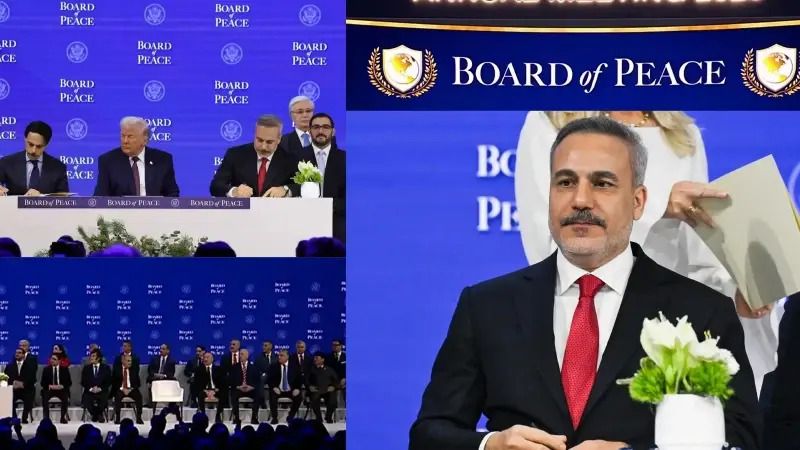
The Board of Peace, established at the initiative of U.S. President Donald Trump to achieve a lasting ceasefire and peace in Gaza, will hold its first meeting today in Washington, D.C. Turkiye will be represented at the meeting by Foreign Minister Hakan Fidan. Israeli Prime Minister Binyamin Netanyahu is not expected to attend the summit, which will see Ankara deliver five critical messages regarding the future of Palestine, Gaza, and the West Bank.
According to sources from the Turkish Foreign Ministry, Hakan Fidan is expected to begin his address in Washington by emphasizing that efforts to resolve the Palestinian issue must continue with determination and reaffirm Turkiye’s full support for the process. He is also expected to call for an immediate end to Israel’s ceasefire violations and practices that hinder the uninterrupted delivery of humanitarian aid. In this context, Turkiye’s continued provision of humanitarian assistance in Gaza and readiness to contribute to reconstruction efforts will be strongly underscored during the meeting.
Additionally, Turkiye’s willingness to play an active role in international mechanisms established to protect the rights and security of the Palestinian people in Gaza will be reiterated. Minister Fidan is expected to stress that the international community must take urgent action against Israel’s increasing pressures, illegal settlement activities, and settler violence in the West Bank, while confirming Ankara’s unwavering support for a two-state solution.
Following President Trump’s announcement that member countries of the board had pledged financial support exceeding $5 billion, attention has turned to the contributions that countries will make. Sources indicate that Turkiye will focus less on direct financial contributions and more on supporting the reconstruction process in Palestine, restoring infrastructure, and providing humanitarian aid.
Looking back at the process leading up to today, a significant diplomatic effort is evident. The first step was taken on September 23, 2025, when President Erdoğan and seven other leading Muslim leaders met with U.S. President Trump to seek a ceasefire and peace in Gaza. Following this historic meeting, Trump unveiled a new Peace Plan. On October 13, 2025, at the Sharm el-Sheikh Peace Summit in Egypt, a joint statement signed by Turkiye, the U.S., Qatar, and Egypt announced the establishment of a ceasefire, marking the first stage of the Peace Plan. The plan was officially recognized on November 17, 2025, with the adoption of UN Security Council Resolution 2803.
On January 14, the Gaza National Committee, consisting of 15 Palestinian technocrats, was established to administer Gaza. On the same day, U.S. President Trump’s Special Envoy to the Middle East, Steve Witkoff, announced the transition to the second stage of the process. On January 16, the formation of the Board of Peace and its affiliated bodies was announced, with Minister Fidan confirmed to join the Gaza Executive Council.
Some countries initially declined to participate in Trump’s initiative due to concerns that the Board of Peace, born from the idea of establishing peace in Gaza, could become an alternative structure to the United Nations. However, 25 countries have signed the boards’s charter and taken their place in the process.
While these steps were being taken in the political arena, uncertainty and hardship greeted the first day of Ramadan this year in the Gaza Strip, which has been devastated by Israeli attacks. On the Gaza coast, young people wrote “Welcome Ramadan” in the sand, while displaced families struggled to survive in tent camps, clinging to life amid scarcity. Families are hoping to make it through Ramadan relying solely on support from humanitarian aid distribution programs.
The black market for essential food items such as flour, olives, and sugar before Ramadan has further exacerbated the hardships faced by Gazans. Hanan Attar, 55, described how her family survives by grinding lentils mixed with pasta and rice received through aid, saying: "There is no flour or oil. For the past three Ramadans, we have been grinding lentils and mixing them with the pasta and rice we get from aid. These days will pass. What matters is that we never go through war again."
Here we are to serve you with news right now. It does not cost much, but worth your attention.
Choose to support open, independent, quality journalism and subscribe on a monthly basis.
By subscribing to our online newspaper, you can have full digital access to all news, analysis, and much more.
You can also follow AzerNEWS on Twitter @AzerNewsAz or Facebook @AzerNewsNewspaper
Thank you!