
First map of rare mantle earthquakes compiled
by Alimat Aliyeva
Scientists at Stanford University have created the first global map of earthquakes occurring not in the Earth’s crust, but in the deeper layers of the planet’s mantle. The results, published in the journal Science, open new avenues for studying Earth’s internal processes, from the movement of tectonic plates to the origins of widespread destructive earthquakes, Azernews reports.
Most earthquakes are recorded in the Earth’s crust, typically at depths of 10 to 30 kilometers. The mantle, by contrast, is a warmer and more ductile layer, long thought to be unfavorable for accumulating the stresses necessary for seismic ruptures. However, data collected over recent decades show that rare but real earthquakes do occur in the mantle.
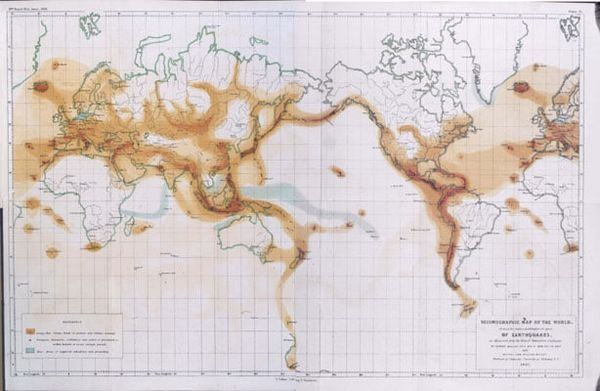
By analyzing seismic data from around the world, the researchers identified 459 “continental mantle earthquakes” that have occurred since 1990. These events are unevenly distributed, with the densest clusters found in the Himalayas, along the Bering Strait, and other tectonically active regions.
Importantly, these earthquakes occur beneath continents, not in subduction zones where oceanic plates dive deep into the mantle—locations where deep tremors have long been documented. In some cases, the sources of these events were located at depths exceeding 80 kilometers below the Mohorovičić boundary (commonly known as the “Moho”), the transition zone between the crust and mantle.
The study’s breakthrough came from a new method of analyzing seismic waves. Scientists compared two types of vibrations: one traveling through the crust, and the other through the upper mantle. By examining the ratio of these signals, they could accurately determine the depth of the earthquake source. According to the authors, this method fundamentally changes how deep earthquakes are studied, allowing them to be identified by the “signature” of the waves themselves, rather than indirect indicators.
Mantle earthquakes occur at such great depths that they pose no direct threat to people or infrastructure. Nevertheless, their significance is profound. These deep quakes provide a unique window into processes at the crust-mantle boundary and in the upper mantle, where magma forms and tectonic forces are generated.
The researchers suggest that some mantle earthquakes may be responses to strong fluctuations in the crust, while others may be driven by internal mantle convection, including the recycling of subducting crustal plates. Understanding these processes could improve our ability to predict where surface earthquakes may occur and refine models of Earth’s internal structure.
The newly created map is considered conservative. Scientists believe the actual number of mantle earthquakes is much higher, especially in remote regions with sparse monitoring networks, such as the Tibetan Plateau. Expanding seismic monitoring and applying advanced analytical methods will likely reveal many more deep events in the coming years.
According to the study’s authors, earthquakes in the crust and mantle should be viewed as parts of a single, interconnected system, where deep and surface processes are closely linked. Understanding this relationship is a key step toward more accurate assessments of natural hazards and a deeper understanding of the dynamic Earth beneath our feet.
Here we are to serve you with news right now. It does not cost much, but worth your attention.
Choose to support open, independent, quality journalism and subscribe on a monthly basis.
By subscribing to our online newspaper, you can have full digital access to all news, analysis, and much more.
You can also follow AzerNEWS on Twitter @AzerNewsAz or Facebook @AzerNewsNewspaper
Thank you!