
World’s oldest rock art found in Indonesian cave
by Alimat Aliyeva
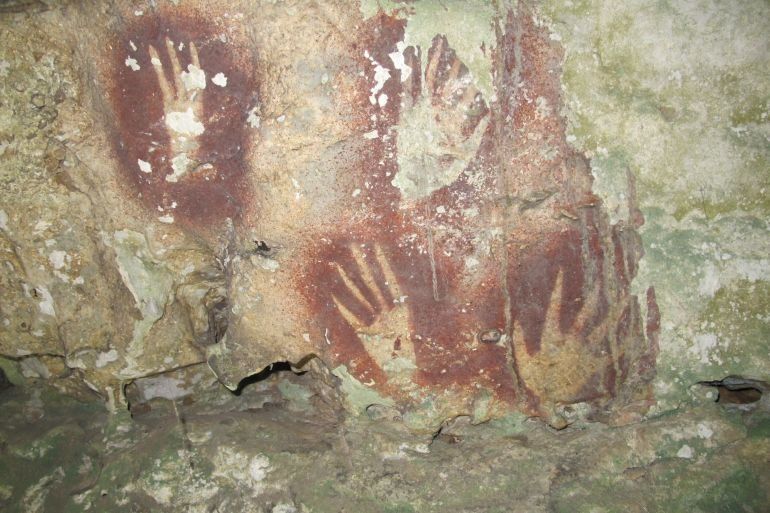
Researchers say a faint drawing of a human hand discovered in a cave on the Indonesian island of Muna may be the oldest known example of rock art in the world, dating back at least 67,800 years, Azernews reports.
The red hand stencil has faded significantly over time and is barely visible on the cave wall. Even so, it represents a remarkable early expression of human creativity—one that likely spread across the globe after originating in Africa. According to the researchers, the creators of the artwork belonged to a population that migrated from mainland Asia through the Indonesian archipelago and eventually reached Australia.
The handprint was found in the limestone cave of Liang Metanduno on Muna Island, located off the southeastern peninsula of Sulawesi, east of Borneo. Scientists determined the minimum age of the image by analyzing trace amounts of uranium in mineral layers that gradually formed over the pigment. The technique suggests that the image was created by placing a hand against the rock wall and blowing or applying pigment around it—a method still recognizable in later prehistoric art around the world.
"The oldest handprint documented here is unique to Sulawesi," said Maxim Ober, an archaeologist at Griffith University in Australia and lead author of the study published Wednesday in the journal Nature. "The fingertips were deliberately modified to create a pointed shape, indicating a distinct local artistic tradition."
The newly identified handprint predates a rock painting of three humanoid figures from Leang Karampuang in southwestern Sulawesi, as well as a Neanderthal hand stencil from Maltravieso Cave in Spain, which dates back roughly 64,000 years.
Although the image itself is difficult to discern, researchers identified nearly identical hand stencils in better condition elsewhere in the region. Earlier studies in Sulawesi have also revealed complex depictions of human figures with animal-like features dating back at least 48,000 years, suggesting the island was a major center of early symbolic and artistic expression.
Experts say the discovery adds to growing evidence that early humans in Southeast Asia were not only skilled toolmakers and navigators, but also among the earliest artists, reshaping long-held assumptions that Europe was the primary birthplace of prehistoric art.
Here we are to serve you with news right now. It does not cost much, but worth your attention.
Choose to support open, independent, quality journalism and subscribe on a monthly basis.
By subscribing to our online newspaper, you can have full digital access to all news, analysis, and much more.
You can also follow AzerNEWS on Twitter @AzerNewsAz or Facebook @AzerNewsNewspaper
Thank you!