
Armenia’s unwillingness in Karabakh conflict settlement lead to hostilities
By Sara Rajabova
Political analyst believe that diplomacy and peace negotiations have been at a minimum and military processes at the maximum level in settling Nagorno-Karabakh conflict over the past 20 years.
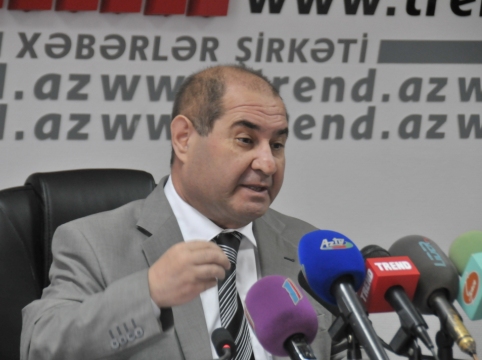
Director of the Center for Political Innovations and Technologies, Mubariz Ahmadoglu told Trend news agency that Armenia is unwilling to resolve the conflict.
"This unwillingness will, in turn, pave the way for military solution of the conflict," Ahmadoglu noted.
He said over the past decades, the power balance in Nagorno-Karabakh conflict, as well as the impact of the major centers of power in the regional processes has changed dramatically in favor of Azerbaijan.
Ahmadoglu noted that the United States, Russia and the European Union do not support Armenia further as it was before.
"Mechanism of lies", launched by Armenia, has exhausted its time and resources without leading to desired effects. Russia, U.S. and Europe have already been informed about the realities of the conflict and are well aware of Azerbaijan's just position, as well as the aggressive policies of Armenia," Ahmadoglu said.
He further said when assessing Nagorno-Karabakh conflict, it is important to understand that the South Caucasus have long been a scene of confrontation between different geopolitical power centers.
He said neighboring Georgia and OSCE Minsk group co-chair France could contribute to the settlement of the Nagorno-Karabakh conflict.
The meeting of presidents of Georgia and France, George Margvelashvili and Francois Hollande, in Paris could play a decisive role in this regard, Ahmadoglu added.
Visiting Armenia, French President Hollande publicly stated that Armenian version of a solution to the Nagorno-Karabakh conflict was wrong and it is necessary to find the right version. Hollande is the only foreign leader who discussed the Nagorno-Karabakh conflict not only in Azerbaijan and Armenia, but also in Georgia," he said.
The expert also noted that Azerbaijani and Armenian presidents have already held talks in the capitals of different countries except Tbilisi.
"Logically, Georgia and France should propose to hold a meeting between Azerbaijani and Armenian presidents over the Nagorno-Karabakh settlement in Tbilisi. If France and Georgia are seriously interested in this proposal, then it could lead to real and practical results," Ahamdoglu said.
Azerbaijani and Armenian presidents met last time on November 2013 in Vienna to discuss ways of resolving the Nagorno-Karabakh conflict.
The conflict emerged in 1988 when Armenia made territorial claims against Azerbaijan. Since a lengthy war in the early 1990s that displaced over one million Azerbaijanis, Armenian armed forces have occupied over 20 percent of Azerbaijan's internationally recognized territory, including Nagorno-Karabakh and seven adjacent regions.
The UN Security Council's four resolutions on Armenian withdrawal have not been enforced to this day.
Peace talks, mediated by Russia, France and the U.S. through the OSCE Minsk Group, are underway on the basis of a peace outline proposed by the Minsk Group co-chairs and dubbed the Madrid Principles. The negotiations have been largely fruitless so far.
Here we are to serve you with news right now. It does not cost much, but worth your attention.
Choose to support open, independent, quality journalism and subscribe on a monthly basis.
By subscribing to our online newspaper, you can have full digital access to all news, analysis, and much more.
You can also follow AzerNEWS on Twitter @AzerNewsAz or Facebook @AzerNewsNewspaper
Thank you!