
New Eurasian trade reality fuels Middle Corridor expansion

Ulviyya Poladova
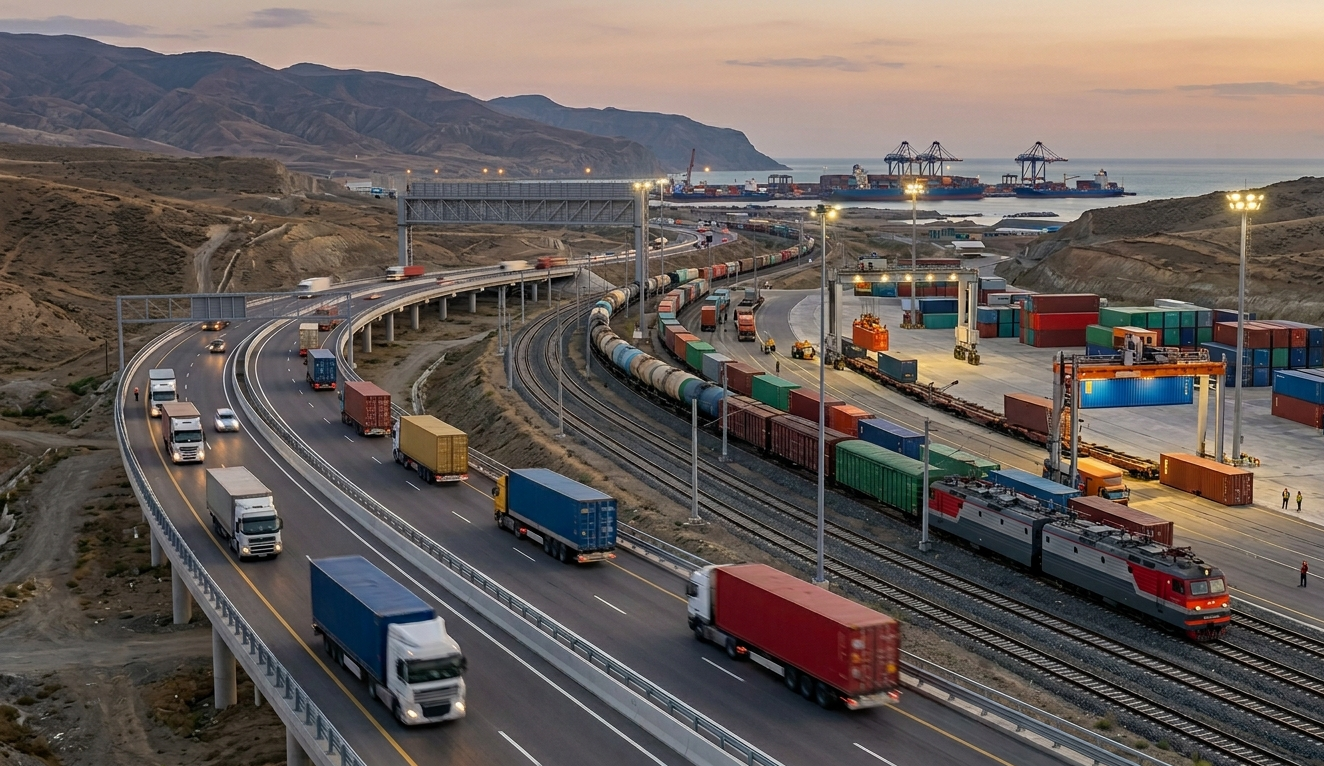
Read moreGlobal trade today relies on a complex network of transportation systems. Air freight moves high-value goods quickly across continents, maritime shipping carries the bulk of global cargo at low cost, and rail and road transport ensure connectivity across regions. While air and sea routes often receive the most attention due to their scale and speed, land transportation remains the backbone of regional and intercontinental logistics. It connects production centers with ports, bridges landlocked countries to global markets, and enables continuous supply chains across borders.
Land transportation refers to the movement of goods and passengers over land using railways and road networks. It is typically divided into two main categories: rail transport and road transport.
Rail transport is especially important for heavy and long-distance cargo such as oil products, grain, metals, and industrial materials. Roads are more flexible and are widely used for short and medium distances or where rail infrastructure is not available.
The growing importance of international transport corridors has further highlighted the role of land transportation. Major corridors connecting Asia, Europe, and the Middle East have become essential channels for trade and economic cooperation. Projects such as transcontinental railway networks and modern highway systems facilitate the movement of goods across multiple countries, reducing transit times and creating alternative routes to traditional maritime shipping lanes.
The South Caucasus represents a particularly important example of this trend. Located at the intersection of Europe and Asia, the region serves as a strategic transit bridge between major markets. Infrastructure initiatives, including modern railways, highways, and logistics hubs, have strengthened connectivity and increased the region’s role in international trade. These developments have enhanced the efficiency of cargo flows between Central Asia, the Caspian region, Türkiye, and European markets.
According to logistics expert Sairan Mederov, Director of GR and Compliance at TransExpeditions (Kazakhstan), the global logistics system is undergoing a profound transformation driven by geopolitical fragmentation, supply chain disruptions, and accelerating demand for route diversification. Against this backdrop, the Middle Corridor - also known as the Trans-Caspian International Transport Route - is rapidly evolving from a supplementary pathway into a strategically significant Eurasian trade artery.
In a commentary provided to AzerNEWS, Mederov stated that maritime transport continues to dominate global trade by volume, handling more than 80% of world cargo flows, as reported by UNCTAD. However, he emphasized that structural changes in global trade routes over the past three years have significantly increased the importance of land-based corridors across Eurasia.
He noted that disruptions affecting traditional shipping routes - including sanctions-related constraints on the Northern Corridor via Russia and instability in the Red Sea region - have accelerated the shift toward multimodal land-sea logistics systems. According to Mederov, this has elevated the Middle Corridor from a "backup option" to a "competitive and increasingly essential alternative" for global shippers.
Mederov emphasized that rail and road transport should not be viewed as competing modes, but rather as complementary components of a unified logistics ecosystem.
He stated that railway transport remains the backbone of long-distance container flows between China and Europe due to its scale efficiency, predictability, and lower cost per ton-kilometer.
At the same time, he highlighted the flexibility of road transport, particularly in door-to-door delivery, oversized cargo handling, and urgent shipments. According to Mederov, road transport plays a critical role in project logistics - especially in sectors such as oil and gas, energy, and infrastructure - where cargo dimensions and technical constraints often exceed the capabilities of rail systems.
However, he also pointed out the structural limitations of both modes, noting that rail depends on long-term infrastructure development and suffers from interoperability challenges across national systems, while road transport becomes less efficient over long distances and remains vulnerable to border delays and administrative bottlenecks.
An expert further emphasized that digital transformation is fundamentally reshaping operations along the Middle Corridor.
He stressed that traditional paper-based customs procedures - once characterized by repeated stamping and manual clearance at each border - are being replaced by electronic customs systems and real-time cargo tracking platforms. As a result, customs clearance times have reportedly been reduced from days to hours, while shipment visibility and predictability have significantly improved.
Addressing the question of route reliability, Mederov noted that neither maritime nor land routes can be considered fully secure in the current geopolitical environment.
He observed that maritime corridors, despite their scale and historical reliability, have demonstrated vulnerabilities in recent years, while land routes are exposed to geopolitical conflicts, infrastructure limitations, and administrative restrictions.
As an example, he referenced the Northern Corridor via Russia, which he said effectively became inaccessible to many European shippers within a short period of time due to geopolitical developments.
By contrast, he highlighted the relative stability of the Middle Corridor, stating that it passes through countries such as Kazakhstan, Azerbaijan, Georgia, and Türkiye - states that are structurally incentivized to maintain and expand transit flows due to the economic importance of transit revenues.
"The correct approach is not to determine which route is more reliable, but to build logistics systems that do not depend on a single corridor," Mederov noted, emphasizing that diversification is the true foundation of resilience in global trade.
He pointed to the Middle Corridor’s growing economic impact across the Caspian and South Caucasus region, describing it as a "structural transformation rather than a simple transport project."
Mederov referenced significant growth figures, including a 62% increase in freight volumes in 2024 to 4.5 million tons, a near tripling of container traffic to 56,500 TEU, and a sixfold increase in total cargo turnover over the past five years. He added that forecasts for 2025 indicate continued expansion, with targets of 96,000 TEU and 5.2 million tons, and long-term ambitions reaching 10 million tons and 300,000 TEU by 2030.
He also underlined the strategic roles of regional countries: Azerbaijan as a key transit hub between the Caspian and Europe via the Port of Alat and the Baku–Tbilisi–Kars railway; Kazakhstan as a gateway to global markets; Georgia as a critical link between the Caspian and Black Sea; and Türkiye as a central corridor connecting Europe and the Middle East.
Outlining the key advantages of the Middle Corridor, Mederov highlighted several structural factors, including improved transit speed, geopolitical neutrality, risk diversification, and suitability for project logistics involving heavy and oversized cargo.
He noted that transit times have already been reduced from 38–53 days to approximately 18–23 days, with further optimization potentially bringing it down to 14–18 days or even 12 days under fully integrated multimodal systems.
In conclusion, Mederov said that the defining strength of the Middle Corridor lies in its simultaneous relevance to all participating stakeholders.
"This is what makes it structurally resilient and strategically sustainable in the long term," the expert added.
Here we are to serve you with news right now. It does not cost much, but worth your attention.
Choose to support open, independent, quality journalism and subscribe on a monthly basis.
By subscribing to our online newspaper, you can have full digital access to all news, analysis, and much more.
You can also follow AzerNEWS on Twitter @AzerNewsAz or Facebook @AzerNewsNewspaper
Thank you!