
Mathematics of US-Iran war: missiles, drones and endurance [ANALYSIS]
![Mathematics of US-Iran war: missiles, drones and endurance [ANALYSIS]](https://www.azernews.az/media/2026/03/06/us_irnwar34905872398465.jpg)

Akbar Novruz
Read moreAfter joint US–Israeli strikes killed Iran’s Supreme Leader and senior officials, Tehran responded within hours. Missiles and drones were launched towards Israel and US-linked sites across the Gulf, signalling that this would not be a symbolic exchange, but the opening phase of something potentially longer.
First and foremost, the issue must be approached from the perspective of military capability. Take Iran as an example: the situation there remains somewhat opaque, largely because no fully reliable or transparent official accounting of Tehran’s military arsenal exists. This lack of clarity inevitably gives rise to a number of uncertainties.
Even at the height of the conflict, the United States, lacking complete and verified intelligence, began to exercise a degree of caution regarding large-scale military action against Iran, weighing the potential risks and unknown variables.
However, in order not to stray from the core of the discussion, let us return to the central question - the key questions now are the capabilities of both sides:
How much firepower does Iran actually have at its disposal?
How long can Israel sustain interception, mobilisation and war spending at current levels?
Which side faces exhaustion first, militarily or economically?
Let’s break it down by capability, range and endurance.
Iran’s military doctrine does not rely on air superiority. Instead, it is built around missiles, drones, survivable launch platforms, and strategic geography. Iran fields the largest and most diverse missile arsenal in the Middle East, spanning short-, medium- and longer-range systems.
Short-range ballistic missiles (150–800km)
These are Iran’s “first punch” systems, built for rapid, high-volume regional strikes.
Key systems include:
Fateh variants
Zolfaghar
Qiam-1
Shahab-1/2
Why they matter statistically:
The range covers Israel and US bases in Iraq and the Gulf. Can be launched in salvos. Shorter flight times reduce interception windows. Designed to overwhelm air defences through volume.
In the first three days of the current confrontation, Iran launched over 200 ballistic missiles toward Israel, nearly half the volume used in the 12-day war in June 2025. If sustained at similar rates, the conflict quickly becomes a numbers contest: Missiles fired vs interceptors available.
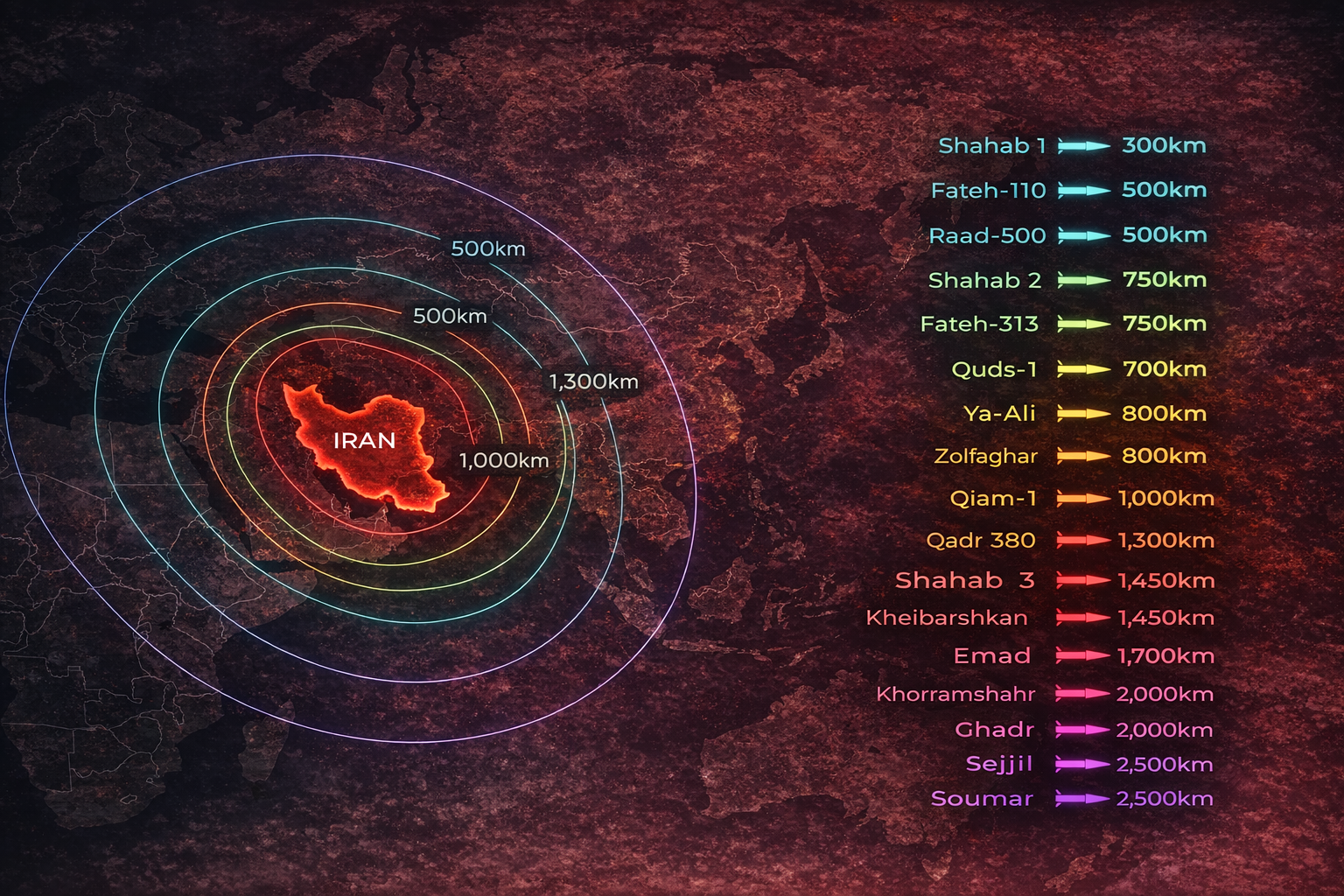
Medium-range ballistic missiles (1,500–2,000km)
Systems such as:
-
Shahab-3
-
Emad
-
Ghadr-1
-
Khorramshahr
-
Sejjil
-
Kheibar Shekan
These expand the battlefield dramatically.
Statistical implications:
-
Entire Israeli territory is within range.
-
US-linked bases in Qatar, Bahrain, Kuwait, Saudi Arabia and the UAE fall inside the strike envelope.
-
Solid-fuel systems like Sejjil reduce launch preparation time.
The longest-range Iranian missiles reach 2,000–2,500km, but cannot reach the United States itself, despite political rhetoric suggesting otherwise.
Cruise missiles and drones
Cruise missiles such as:
-
Soumar (2,500km range)
-
Ya-Ali
-
Quds variants
-
Ra’ad
Unlike ballistic missiles, cruise missiles fly low and hug terrain, making them harder to detect.
Drones introduce a different statistical pressure:
-
Slower, but cheaper.
-
Launched in waves.
-
Designed to exhaust air defences over hours rather than minutes.
If ballistic missiles are the shock factor, drones are the attrition factor. And perhaps those are the scariest capability of Iran. Production cost is minor in comparison to the cost for its destruction. For example: Shahed-136 drone: $20,000 – $50,000; More sophisticated attack drones: $50,000 – $200,000.
A single wave of 100 drones might cost an attacker around, $2–5 million. But if defenders intercept those drones using Patriot missiles, the defensive bill could reach $300–400 million. Even cheaper systems like Iron Dome still create a financial imbalance if large numbers of drones are launched simultaneously.
Underground “missile cities”
Iran’s survivability matters as much as its inventory.
Its missile infrastructure includes:
- Hardened underground tunnels
- Concealed storage depots
- Protected launch sites
The statistical question here is not how many missiles Iran has, but how many survive first-wave strikes. If survivability is high, the conflict shifts from a short exchange to prolonged attrition. Iran does not need to formally blockade the Strait of Hormuz to make an impact.
Through:
-
Anti-ship missiles
-
Naval mines
-
Fast attack craft
-
Drone harassment
It can disrupt shipping enough to:
-
Raise insurance costs
-
Divert vessels
-
Spike energy prices
Already, tanker traffic hesitations and suspended crossings show that economic pressure can escalate faster than battlefield outcomes. In war calculus, this is force multiplication without direct engagement.
Now next question is how long can Israel sustain this war?
If Iran’s strategy is based on volume and survivability, Israel’s rests on interception and technological superiority.
Israel operates three main air defence systems:
-
Iron Dome
-
David’s Sling
-
Arrow 2 and Arrow 3
Each incoming ballistic missile typically requires at least one interceptor.
Now consider the numbers:
-
Over 200 Iranian ballistic missiles were launched in the first three days.
-
Around 500 were launched during the 12-day war in June 2025.
-
Interceptor stocks are undisclosed.
-
During the previous conflict, Israel reportedly began running low.
If missile launches continue at high frequency, Israel faces a mathematical problem:
Interceptor stockpile vs sustained Iranian volume. Without US resupply, airspace control could become significantly harder to maintain.
But how about the US firepower?
Another variable shaping the war is the role of the United States. Washington has repeatedly suggested that it can sustain a prolonged conflict, with officials emphasizing that American forces have the logistical depth and industrial capacity to continue supplying weapons and ammunition for as long as necessary. How true is the thesis, “unlimited munitions”?
The United States maintains the most extensive military presence in the Middle East. Perhaps, given the fact that the US has been highly active over the years, it is much easier to get the details more comprehensively.
-
Around 40,000–50,000 US troops are stationed across the region.
-
These forces operate from at least 19 military sites, including several permanent bases.
Key hubs include:
-
Al Udeid Air Base (Qatar) – the forward headquarters of US Central Command.
-
Naval Support Activity Bahrain – headquarters of the US Navy’s Fifth Fleet.
-
Prince Sultan Air Base (Saudi Arabia) – a major air defence and command centre.
-
Al Dhafra Air Base (UAE) – a key base for US fighter and surveillance aircraft.
-
Camp Arifjan and Ali Al Salem Air Base (Kuwait) – major logistics and air hubs.
This network allows the United States to launch air operations, move reinforcements, and supply allied forces across the entire Gulf and eastern Mediterranean.
During the first phase of the current conflict, American forces reportedly operated with:
-
over 50,000 personnel
-
around 200 fighter jets
-
multiple long-range bombers including B-2, B-1 and B-52 aircraft
-
two aircraft carrier strike groups operating in surrounding waters.
In the first 100 hours of the campaign, US forces struck nearly 2,000 Iranian targets, ranging from missile launch sites and air defence systems to naval infrastructure.
US forces in the region rely heavily on layered missile defence systems to counter Iranian missiles and drones.
The main systems include:
THAAD (Terminal High Altitude Area Defense)
-
Designed to intercept ballistic missiles at high altitude during the final phase of flight.
Patriot missile systems
-
Used to defend against shorter-range ballistic missiles, cruise missiles and aircraft.
These systems have been deployed across several bases in the region in anticipation of Iranian retaliation.
If the conflict evolves into a sustained campaign, the US role may ultimately determine the balance of endurance.
Iran’s strategy relies on:
-
missile volume
-
drones and saturation attacks
-
survivable underground launch infrastructure
The United States counters with:
-
air dominance
-
advanced missile defence systems
-
global logistics and production capacity
The strategic question therefore becomes less about who can strike harder in the opening phase, and more about which side can sustain the pace of operations over weeks or months.
And despite the rhetoric about “unlimited munitions,” even the world’s largest military must still manage the arithmetic of war: stockpiles, production rates and supply chains.
Economic strain
Military endurance is also about budget. The United States of America is the biggest economy in the world, so its endurance is much higher than the other fighting sides. Even with the inclusion and the possibility of "war without strategy", it has more space of flexibility.
Israel’s war expenditures:
-
$31bn in 2024 (Gaza and Lebanon conflicts)
-
$55bn in 2025 (preliminary figures)
Public morale remains high for now, but sustained missile alerts, shelter rotations and economic pressure test endurance over time.
Iran's physical expenditures, estimated and reportedly (Source: White House media accounts)
Over 20 Iranian warships have been destroyed in air, land, and sea operations. There has been a 73% decrease in Iranian drone launches and an 86% decrease in Iranian ballistic missile launches.
According to unverified numbers, Iran's decreasing missiles and drones over the 5-day period, World Insights On X:
Ballistic Missiles:
- Day 1: 350
- Day 2: 175
- Day 3: 120
- Day 4: 50
- Day 5: 40
Drone Swarms:
- Day 1: 294
- Day 2: 541
- Day 3: 200
- Day 4: 85
- Day 5: 45
Total estimated war spending after six days:
United States $5B – $5.5B
Israel $1.2B – $2B
Iran $500M – $900M
Over time, this dynamic transforms war into not only a military confrontation but also an economic contest of endurance. But let us monitor which side will give up first.
Here we are to serve you with news right now. It does not cost much, but worth your attention.
Choose to support open, independent, quality journalism and subscribe on a monthly basis.
By subscribing to our online newspaper, you can have full digital access to all news, analysis, and much more.
You can also follow AzerNEWS on Twitter @AzerNewsAz or Facebook @AzerNewsNewspaper
Thank you!