
Russia’s railway grip casts long shadow over Zangezur corridor

Akbar Novruz
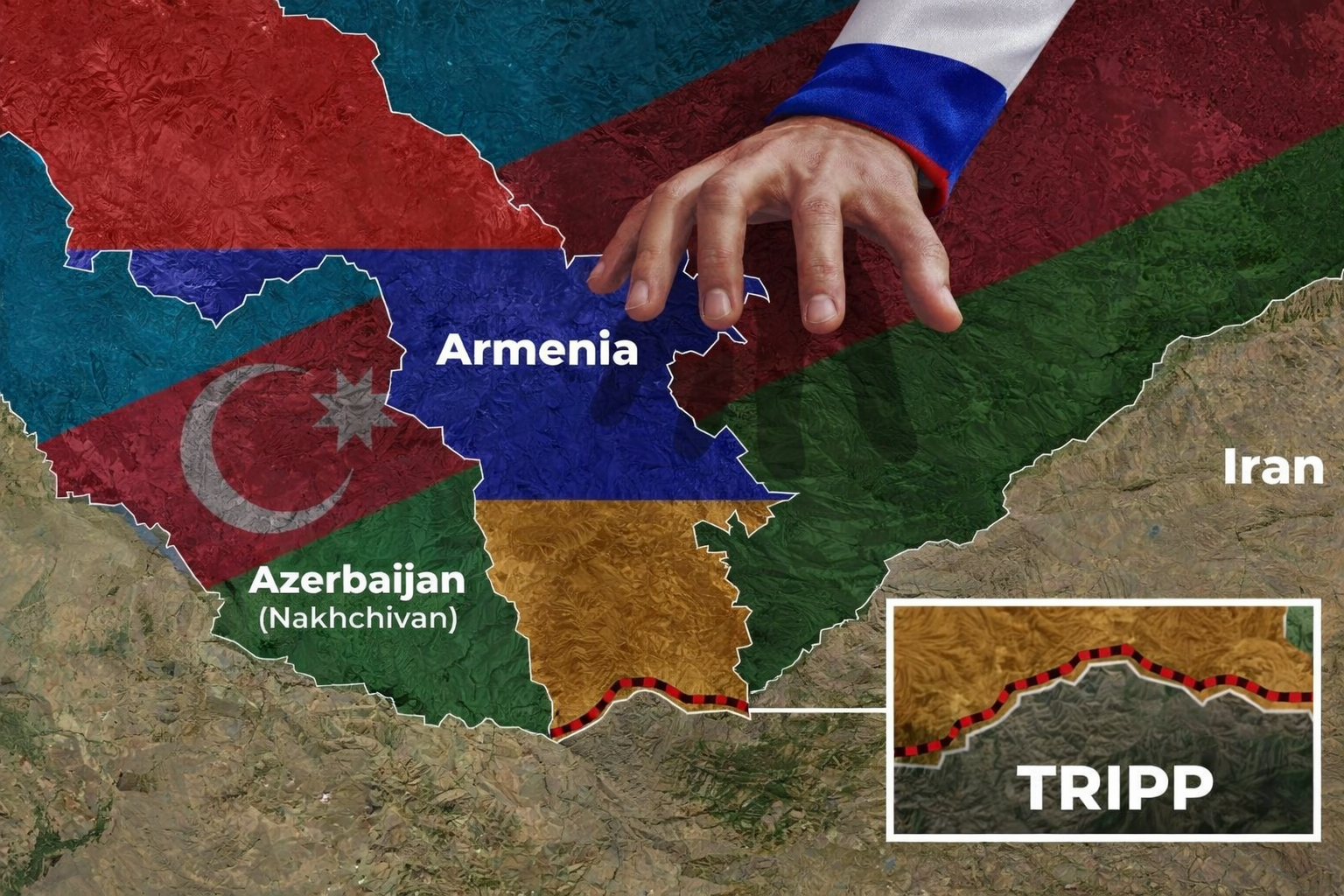
Read moreThe opening of the Zangezur Corridor, also known as the Trump Route for International Peace and Prosperity (TRIPP), envisioned as a direct land connection between mainland Azerbaijan and its exclave Nakhchivan, remains delayed, despite repeated political commitments. At the center of the issue lies not only infrastructure, but control.
A key obstacle is that Armenia’s railway system has been under the operational management of Russian Railways since 2008. While the infrastructure formally belongs to Armenia, its concession to the South Caucasus Railway company, a subsidiary of Russian Railways, gives Moscow substantial influence over operational decisions. Yerevan has reportedly explored options to involve a third country friendly to both Armenia and Russia in the management structure, yet Moscow has not agreed to such adjustments.
The matter is further complicated by history. During the Soviet period, the railway lines in question were part of the unified Transcaucasian network, and Azerbaijani and Armenian workers alike were paid from centralized Soviet budgets administered through the Republic of Azerbaijan. However, after independence, ownership followed territorial jurisdiction, and Armenia assumed sovereign control over the infrastructure on its territory. Whether this historical legacy has legal relevance today remains disputed.
AzerNEWS spoke to experts to assess how the Russian concession affects the Zangezur corridor process, whether Moscow is using it as leverage, and what legal and geopolitical dynamics are at play.
Transport expert Rauf Aghamirzayev frames the issue within the broader regional transport architecture:
“The Zangezur Corridor is a corridor from Alat to Kars. One segment of it is a 43 km route passing through Armenia, which is called TRIPP, according to the agreement signed in Washington in August last year. It constitutes a segment of this corridor. According to the agreement, that section will be managed by the Armenian-American Consortium. Decisions will be made in the near future on the construction of a feasibility study.”
He distinguishes this section from the rest of Armenia’s railway system:
“The railway network in other parts of Armenia is under the concession of the South Caucasus Railway company, which belongs to Russian Railways. The company has been managing this network for a period of 30+10 years since 2008. This is an internal matter of Armenia and there are many possibilities and questions about how they will manage this concession in the future.”
According to Aghamirzayev, there are discussions about potential amendments to the agreement and even the possibility of involving other countries:
“Several countries have been named here that could be offered to exploitation. These include Kazakhstan, Qatar and the United Arab Emirates. Either it remains a Russian company and the rapid restoration of the railways demanded by Armenia will be ensured.”
He notes that Armenia has called for improvements to several railway lines, including the Yeraskh–Sadarak, Gyumri–Kars, and Gazakh–Ijevan lines. However, restoration is not purely technical.
“As for Azerbaijan, our primary demand and top priority remains the Zangazur Corridor, which ensures direct access to the exclave of Nakhchivan and a strategic link to Türkiye. However, official Baku does not oppose the opening of other transport routes and is interested in the phased activation of proposed alternatives. If we examine our current railway network, almost the entire system is operational right up to the Armenian border. With specific upgrades and restoration work, we can fully ensure the network's functionality. Nevertheless, several critical factors must be addressed: first, the active implementation (construction and commissioning) of the TRIPP project within the Zangazur Corridor framework; and second, the essential return of Azerbaijan’s enclaves, Sofulu and Barkhudarli. Since the restoration of the Qazakh-Ijevan railway involves an 18-km section passing through these enclaves, their return is mandatory for Azerbaijan to complete the reconstruction of its designated segment.”
Financial considerations further complicate the matter:
“There are landslides in some areas in Armenia, beyond the mentioned Azerbaijani enclaves, and the cost of the project is considered one of the most expensive. It is worth about $500 million. Ultimately, I think that everything will be resolved in stages. Now the main question is whether Armenia will cancel this concession or increase its leverage against Russia to fulfill its obligations; it is more a matter of time.”
This is a functional lever and not merely symbolic, tells British analyst Neil Watson to AzerNEWS.
“Whilst formal ownership of the assets remains with the Armenian state, operational decisions, such as modernisation priorities, technical planning, timelines, bottlenecks, tariff policy, and access rules pass through the management structure, and therefore through a broader political influence framework. If the operator has no incentive to accelerate the process, or is waiting for political conditions, delays can occur in the form of technical reviews, feasibility studies, safety assessments, tariff negotiations or investment sequencing.”
Watson also highlights the security dimension under the November 10, 2020, trilateral statement:
“Control over transport communications along the route between the western regions of Azerbaijan and Nakhchivan is exercised by the Russian FSB Border Service. This gives Moscow not only an infrastructural lever, but a security-regime lever. A functioning Azerbaijan–Nakhchivan transit route through southern Armenia would alter three fundamental dynamics.”
He lists them: reducing Russia’s gatekeeper role, weakening Armenia’s structural dependence on Moscow, and decreasing reliance on northern corridors tied to Russia’s logistics architecture. If management proposals include third-country or Western participation, Moscow may interpret this as a shift in control over a strategic access node.
On whether Soviet-era ownership can be used legally today, Watson is cautious:
“This is useful as a political-historical argument, but not as a decisive argument. Assets located within the territory of newly-independent republics typically passed under the jurisdiction of those states unless otherwise agreed by treaty. Therefore, such arguments are unlikely to provide a direct legal pathway to reclaim ownership in the absence of a specific binding agreement. Similarly, the likelihood of Azerbaijan gaining legal control over Armenian railway infrastructure is limited. Rail infrastructure on Armenian territory falls under Armenian sovereignty. Azerbaijan could pursue enforceable transit guarantees, such as access regimes, tariffs, technical standards, and border procedures within the framework of post-conflict agreements.”
Watson concludes that Russia’s priority is strategic positioning:
“Russia’s priority is to retain its role as indispensable gatekeeper via border security oversight and through operational leverage within the railway system. It also seeks to prevent the corridor from symbolising a post-Russian logistical order in the South Caucasus. Thus, delaying tactics function as negotiation leverage. Delays are likely to persist until there is clarity on who controls the control mechanisms, including the access regime, security procedures, tariff authority and operational oversight.
He outlines three possible scenarios:
continued Russian oversight, a sovereign Armenian framework with multi-operator participation but Russian security influence, or prolonged negotiations if Western management is pursued."
Here we are to serve you with news right now. It does not cost much, but worth your attention.
Choose to support open, independent, quality journalism and subscribe on a monthly basis.
By subscribing to our online newspaper, you can have full digital access to all news, analysis, and much more.
You can also follow AzerNEWS on Twitter @AzerNewsAz or Facebook @AzerNewsNewspaper
Thank you!