
Risks and rewards of Azerbaijan’s leap into artificial intelligence [ANALYSIS]
![Risks and rewards of Azerbaijan’s leap into artificial intelligence [ANALYSIS]](https://www.azernews.az/media/2026/02/12/ai_in_aze.jpg)

AzerNEWS Staff
Read moreAzerbaijan is entering a decisive phase of technological transformation, positioning digital development and artificial intelligence not merely as sectoral priorities but as core elements of its long-term economic strategy. This shift is no longer confined to internal reforms. On February 10, Azerbaijan and the United States signed a Charter on Strategic Partnership, identifying Artificial Intelligence (AI) and Digital Infrastructure as one of the key pillars of bilateral cooperation. Earlier this year, Azerbaijan also signed a new memorandum of understanding with Israel on artificial intelligence, signaling a targeted push toward infrastructure development, talent formation, and practical AI applications. These agreements indicate that Azerbaijan’s digital transformation is becoming embedded in its foreign policy architecture and geopolitical partnerships.
Domestically, the government’s action plan for technological advancement is built on four strategic pillars:digitalization, artificial intelligence, the innovation ecosystem, and cybersecurity. The initiative reflects not only sectoral reform but a structural shift in the country’s development model, as the global digital economy increasingly outpaces traditional industries. According to Minister of Digital Development and Transport Rashad Nabiyev, while the transport sector grew by 5 percent last year, the ICT sector expanded by 8.5 percent, underscoring the rising weight of digital technologies in national economic growth. Globally, artificial intelligence alone is projected to generate up to $16 trillion in added value by 2030, making participation in this transformation a strategic necessity rather than a policy choice.
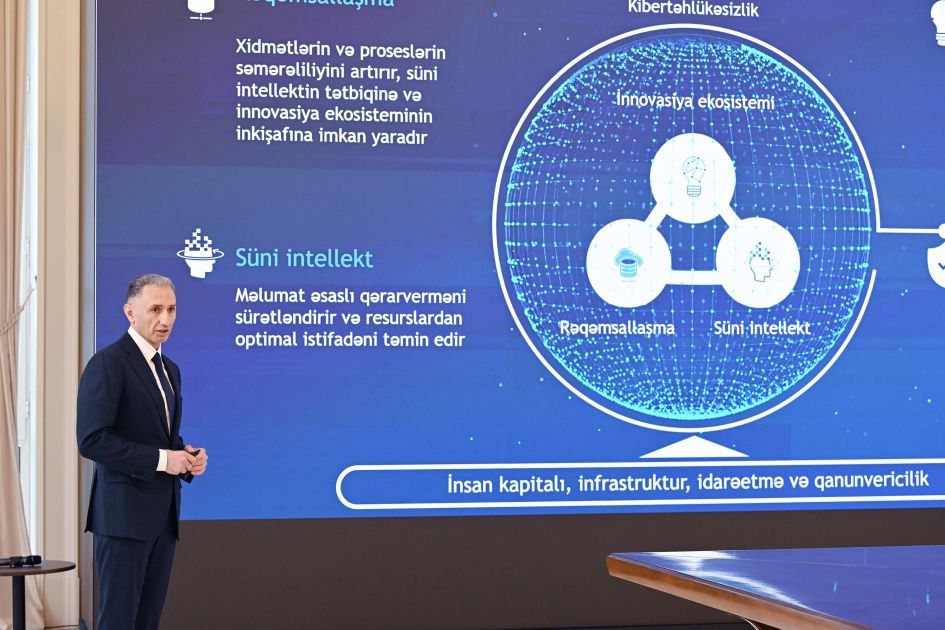
The government’s approach follows a staged model. The first phase involves digitizing information - transferring paper-based data into electronic systems. The second stage focuses on digitizing services and processes, an area where both public institutions and private companies in Azerbaijan have already made visible progress. The final and most strategic phase is digital transformation itself - the creation of “smart,” predictive, and AI-driven services. Nearly 200 regulatory and legal acts have been amended or adopted following the approval of the digital development concept, reflecting a significant modernization of the legal framework.
Infrastructure development has been one of the most tangible achievements. The “Online Azerbaijan” project has raised average internet speeds from 12 Mbps to 90 Mbps nationwide, with state institutions reaching 150 Mbps and a target of 200 Mbps by the end of the year. Broadband coverage now extends to even the most remote areas of the country. At the same time, the Government Cloud has been fully established, with the number of state institutions hosting digital resources increasing from 50 to 270. The “SIMA” biometric signature has reached 4 million users, enabling fully remote access to banking and public services. Meanwhile, the renewed “MyGov” platform has rapidly expanded its user base from 2.2 million monthly active users to 2.5 million within months, with a target of 5 million by year-end.
President Ilham Aliyev’s recent meeting on “Azerbaijan’s New Digital Architecture” introduced critical structural reforms that elevate digital transformation to the highest governance level. By presidential instruction, each ministry will appoint a deputy minister responsible for digitalization, innovation, and artificial intelligence, ensuring institutional accountability and direct coordination with the Ministry of Digital Development and Transport. The President also limited the creation of separate digital applications by ministries, requiring that services be delivered through the unified “MyGov” platform. This decision aims to eliminate fragmentation, create a single digital center, and strengthen coordination. Artificial intelligence will be integrated into state institutions, with civil servants expected to use AI agents to reduce errors and increase efficiency in decision-making.

Most importantly, the President emphasized energy as the strategic foundation of artificial intelligence. In the global AI race, cheap and reliable energy has become a new form of fuel. Azerbaijan’s strong energy base and renewable energy expansion position the country as a potential regional hub for AI-driven data centers.
Persistent challenges and solutions
Despite measurable progress, several structural challenges remain. In some state institutions, documentation is still paper-based, and digitalization is not always prioritized. Fragmented data standards prevent the formation of a unified national “data lake,” which is essential for effective AI deployment. Without standardized and centralized databases, artificial intelligence systems cannot function at full capacity. Human capital remains another bottleneck, particularly in AI, cybersecurity, and data science. Migration regulations may also limit the country’s ability to attract foreign specialists, freelancers, and digital nomads. Cybersecurity risks will inevitably increase as more services move into virtual environments.
Addressing these challenges requires accelerating the transition to fully paperless governance, establishing a unified national data governance framework, expanding AI-focused education and professional training, liberalizing migration rules for digital professionals, strengthening cybersecurity capabilities, and deepening public-private partnerships to stimulate innovation. The introduction of the regulatory “Sandbox” regime is a positive step, allowing fintech and other digital solutions to be tested under controlled supervision before full-scale adoption.
Azerbaijan’s competitive advantages - macroeconomic stability, strong energy resources, favorable geopolitical positioning, and growing international partnerships - provide a solid foundation for this transformation. However, the next stage will determine whether the country merely digitizes existing systems or successfully builds an AI-driven, innovation-based economy. If energy capacity is effectively combined with digital infrastructure and institutional reform, Azerbaijan has the potential to position itself not only as a consumer of global technologies but as a regional center for artificial intelligence and advanced digital services.
Here we are to serve you with news right now. It does not cost much, but worth your attention.
Choose to support open, independent, quality journalism and subscribe on a monthly basis.
By subscribing to our online newspaper, you can have full digital access to all news, analysis, and much more.
You can also follow AzerNEWS on Twitter @AzerNewsAz or Facebook @AzerNewsNewspaper
Thank you!