
With inflation under control, Azerbaijan’s Central Bank gains room to ease


Akbar Novruz
Read moreWith inflation tamed and external buffers swollen, the Central Bank of Azerbaijan is signalling a longer, gentler descent in interest rates.
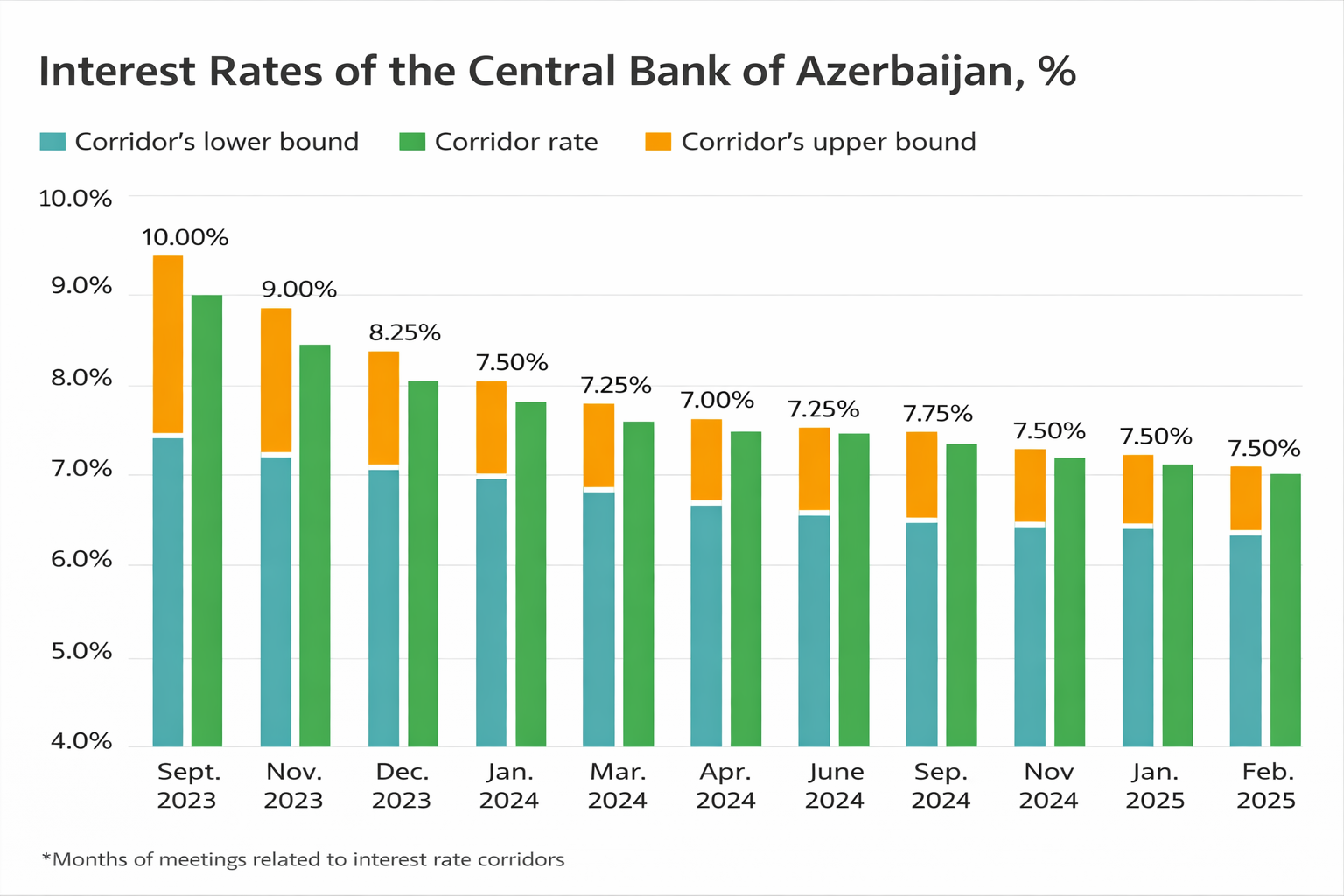
At its February 2026 meeting, the Central Bank of Azerbaijan (CBA) did something that, a year ago, would have looked premature. It eased again. All three parameters of its interest-rate corridor were trimmed by a quarter point, taking the policy rate to its lowest level since September 2021. The move was modest in size but revealing in tone: the CBA sounds more at ease with risk, and more confident that inflation is no longer the threat it once was.
The official justification rests on a familiar triad, prices, expectations and buffers, but the emphasis has shifted. Inflation is not merely “within target”, as the bank had said before; it is now described as declining, with the stubborn residue “under control”. Core inflation at 4.8% is presented as evidence that underlying pressures are converging on the middle of the target band. The bank underlines the recent momentum too: inflation has been easing for two consecutive months. Comfort, rather than caution, dominates the language.
This marks a clear evolution from December’s stance. Then, the CBA acknowledged progress but hedged its bets, noting only the possibility of a downward revision to its inflation forecast. By February, that possibility had materialised. The forecast for 2026 was nudged lower, and by 2027, inflation is expected to settle close to the target’s centre. In a regime where the target range spans 2–6%, such convergence gives policymakers room to manoeuvre.
The easing bias has been building since mid-2025, but February’s decision makes it explicit. The bank’s reaction function remains orthodox, tighten near the ceiling, loosen near the floor, but the balance of risks has tilted decisively. What has changed is not just inflation, but the strength of the external backdrop that insulates it.
Here, the CBA’s confidence is striking. Exchange-rate stability is elevated from a helpful condition to a pillar of price stability. The foreign-exchange market shows excess supply; deposit dollarisation has ebbed; reserves have climbed to a level that leaves little doubt about the bank’s capacity to smooth shocks. Even at the retail end of the market, currency flows favour stability, with purchases outpacing sales over the past year. The exchange-rate channel, so often the Achilles’ heel of small, open economies, looks unusually well protected.
External accounts tell a similar story. In December, the current account outlook was cautiously framed around near-term indicators. By February, the bank was prepared to look further ahead, projecting surpluses through 2026 and 2027. The quality of that surplus matters: strip out gold imports and the trade balance remains strongly positive, a sign that the cushion is not merely cyclical.
While Azerbaijan’s monetary policy has softened, global central banks exhibit a varied landscape. Some, like the European Central Bank, have held rates steady while cautiously revising inflation and growth forecasts amid softer energy prices. Others, such as Russia’s central bank, have also trimmed rates in response to cooling inflation, albeit in a different macroeconomic context.
Azerbaijan’s approach is distinctly calibrated to its own economic structure: a small, open energy exporter with a strong external surplus, relatively stable currency, and inflation pressures that have not escalated sharply. Against this backdrop, the central bank’s easing looks judicious rather than opportunistic, more like a reflection of greater confidence in inflation control and external resilience.
Lower interest rates typically aim to stimulate credit and investment by reducing borrowing costs for businesses and households. For Azerbaijan, this could support broader economic activity as the country continues to diversify beyond hydrocarbons. It may also improve conditions for sectors sensitive to financing costs, including construction and non-oil industries.
Yet risks remain. Global commodity prices, food inflation, and external demand can shift rapidly. The CBA’s decision to reduce rates is based on a favourable snapshot of the current environment, but the projected tightening and loosening cycles will continue to depend on how inflation expectations evolve and how external conditions unfold.
Put together, these elements explain the CBA’s softening stance. Inflation risks are receding; expectations are being pulled toward the target; and the external sector provides a sturdy buffer against volatility. None of this guarantees a smooth glide path, global conditions can still intrude, but it does suggest that Azerbaijan’s central bank believes it has earned the right to ease, carefully, without inviting the old dangers back in.
Here we are to serve you with news right now. It does not cost much, but worth your attention.
Choose to support open, independent, quality journalism and subscribe on a monthly basis.
By subscribing to our online newspaper, you can have full digital access to all news, analysis, and much more.
You can also follow AzerNEWS on Twitter @AzerNewsAz or Facebook @AzerNewsNewspaper
Thank you!