
Preparing for war or preventing it? Xi’s military purges and Taiwan timeline
Akbar Novruz
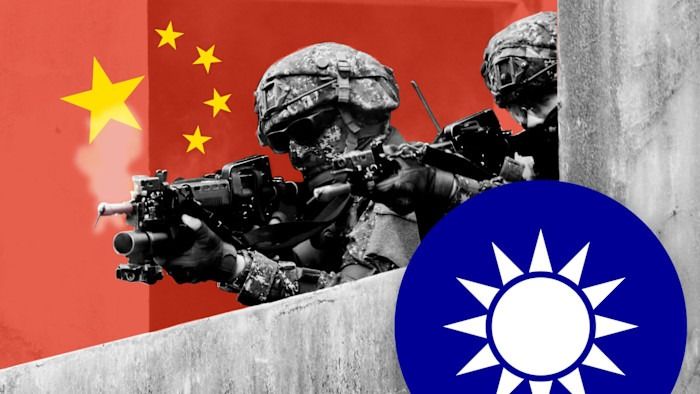
Read moreChina’s accelerating nuclear expansion and the sweeping purge of senior military figures have unfolded over a clearly traceable sequence, pointing to a pivotal phase in Xi Jinping’s rule. After more than a decade in power, Xi has consolidated authority to a degree unseen since Mao, yet developments since the early 2020s suggest growing anxiety, both about China’s external security environment and about the reliability of its own armed forces, at a time when tensions over Taiwan have steadily intensified.
Xi’s intention to resolve the Taiwan question has been made explicit on multiple occasions, most prominently in his latest 2026 New Year’s Eve address, where he has reiterated “national reunification” as inevitable and historically unavoidable. These statements have been reinforced since 2022 by increasingly frequent and complex People’s Liberation Army exercises around Taiwan, designed to normalise high-intensity military pressure. By late 2024 and early 2025, drills simulating blockades and joint operations had become routine, coinciding with sharper rhetoric from Beijing and growing concern in Western intelligence assessments.
In parallel, China’s nuclear posture has shifted markedly. Since the early 2020s, US and allied intelligence agencies have reported a rapid expansion of China’s nuclear arsenal and delivery systems, a departure from Beijing’s long-standing doctrine of maintaining a relatively small deterrent. This expansion has taken place against the backdrop of the collapse of key arms control agreements, the modernisation of US nuclear forces, and Russia’s open nuclear threats during the war in Ukraine, developments that have reshaped Beijing’s threat perceptions and strategic calculations.
Internally, Xi has moved decisively to reshape the military’s leadership. Beginning with the purge of senior figures in the PLA Rocket Force in 2023, the campaign widened in 2024 and 2025 to include two defence ministers, procurement officials, and at least eight senior generals in a single wave. The most dramatic moment came with the removal of General Zhang Youxia, long seen as one of Xi’s closest allies and the second-most powerful figure in the military hierarchy. As a result, the Central Military Commission, appointed in 2022 with seven members, has been reduced to its smallest size in the post-Mao era, concentrating authority almost entirely in Xi’s hands.
To the outside world, General Zhang Youxia seemed relatively secure at the top of China’s military machine. As secure as anyone can be under President Xi Jinping. Zhang, vice-chair of the powerful Central Military Commission and second-in-command of the army to Xi, had survived earlier purges that cut down the top generals around him. He was thought by some to be a close ally of Xi. They had grown up together as “princeling” sons of China’s communist revolutionary elite. But most importantly, he was a rare breed of Chinese general with actual combat experience.
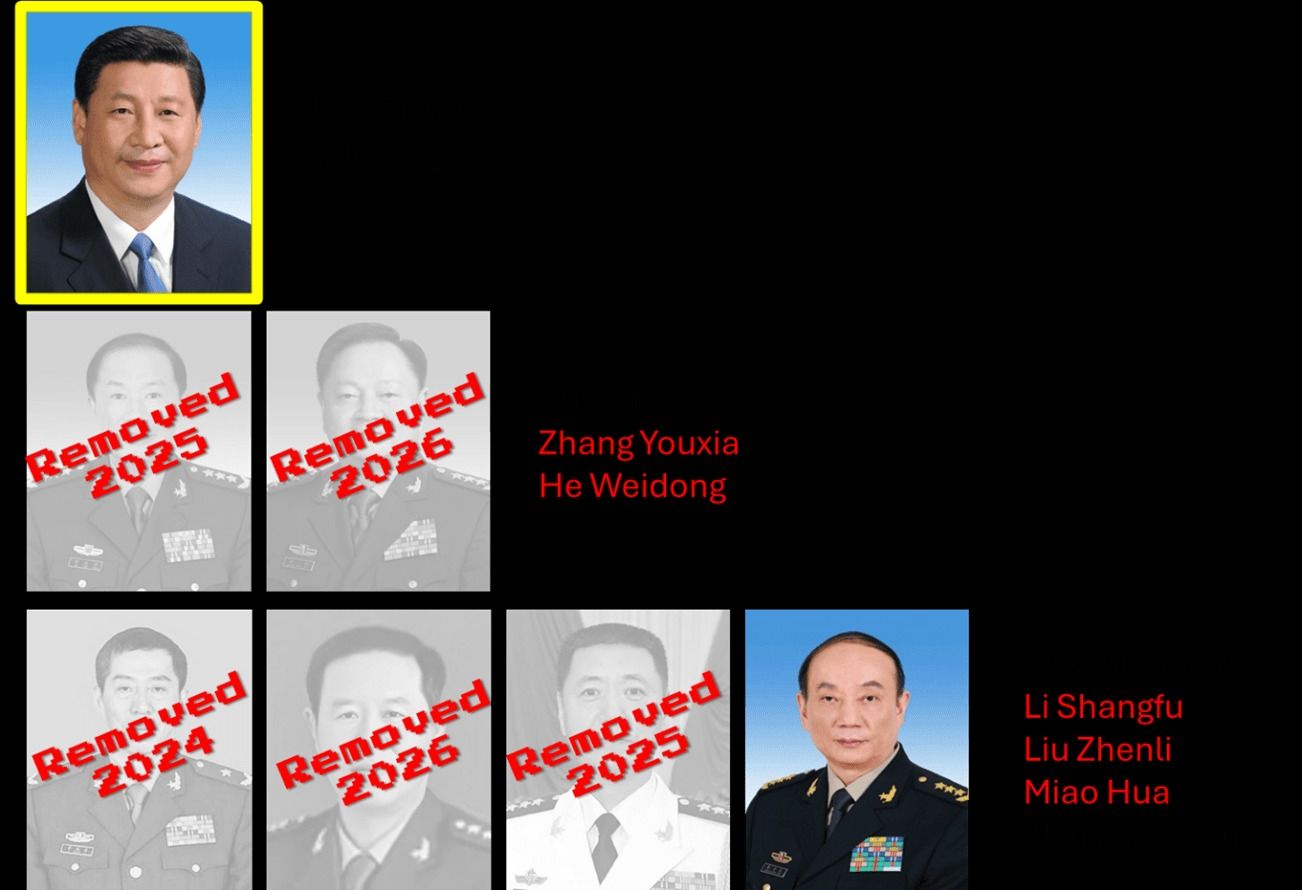
These purges have unfolded alongside US disclosures that China has set itself a benchmark of being militarily ready to move against Taiwan by 2027. Whether this date represents a firm objective or a flexible capability target has become a central question, particularly as the removals suggest doubts about readiness, corruption, and the accuracy of internal reporting. Leadership churn at this scale inevitably disrupts planning and cohesion within an institution that depends on stability to conduct complex joint operations.
The convergence of these timelines, explicit reunification rhetoric, expanding nuclear capabilities, intensifying military pressure around Taiwan, and the systematic dismantling of senior military leadership creates a strategic paradox. China appears more centralised and assertive than ever, yet these moves also hint at uncertainty and risk aversion at the top. Are the purges slowing Beijing’s appetite for a large-scale conflict, or are they a preparatory step toward tighter control ahead of a more confrontational phase? Is nuclear expansion primarily a response to global instability, or a tool to deter intervention in a Taiwan contingency? And as 2027 approaches, do these overlapping processes point toward restraint, escalation, or a more volatile and unpredictable status quo?
According to Germany-based geopolitical analyst Brendan Ziegler's remarks to AzerNEWS, the answer is more complex than it may seem from the outside:
"First of all, for Xi Jinping, nuclear expansion is partly about parity and prestige, ending what Beijing sees as an outdated hierarchy dominated by the US and Russia. But it is also driven by fear. Xi watches Washington modernise its arsenal, abandon arms-control guardrails, and use force against non-nuclear states. From Beijing’s perspective, nuclear strength is the ultimate insurance policy in a world Xi increasingly frames as governed by “the law of the jungle”. So, is this about Taiwan and Xi’s personal legacy, you might ask, very likely. Taiwan sits at the core of Xi’s historical mission. Nuclear muscle-flexing raises the perceived cost of US intervention and strengthens China’s coercive leverage short of war. For a leader obsessed with legacy after more than a decade in power, strategic intimidation may look like a way to reshape the balance without firing the first shot."
Military purges fit into this picture as more of an act of doubt, the German analyst argues.
"By removing senior commanders and dismantling procurement networks, Xi appears to believe readiness has been overstated, reporting it unreliable, or systems compromised. This is striking given the US-revealed benchmark for PLA readiness on Taiwan by 2027. The goal looks like a capability target, not a war deadline. Given the fact that he might fear the idea of espionage, Xi is doing his best to be cautious. However, to support this 'Taiwan' casus belli, a military general's (generals') purge might be riskier than it seems," he claims.
"The Central Military Commission has shrunk to its smallest size in the post-Mao era, reinforcing Xi’s personal control while hollowing out professional leadership. Doubts about readiness lower Xi’s tolerance for catastrophic failure; leadership churn degrades planning for complex joint operations; and risk aversion spreads as commanders avoid decisions that could be politically fatal. Exposing dysfunction makes a discretionary war less attractive. Streamlining command can tighten obedience and accelerate decision-making, raising operational risk. Beijing may also feel compelled to demonstrate military “proof-of-life” through larger, denser drills and coercive activity around Taiwan. Over-compliance by ambitious officers could normalize higher-tempo pressure, increasing the chance of miscalculation or incidents.
Xi’s decisions are a political correction to increase confidence and control, not a prelude to imminent war. They likely reduce the odds of a near-term invasion of Taiwan while increasing sharper coercive pressure short of war. The nuclear buildup reflects a world sliding back into competitive deterrence, fewer brakes, weaker trust, and leaders convinced that intimidation works. Perhaps it can be assumed that he observed the actions of the US and came to a conclusion about the limitations of China's capabilities, or that he was motivated by Washington's current belief that those who hold power also have the ability to dictate."
"The danger is less about intent than momentum: a world sliding back toward nuclear competition with fewer brakes, weaker trust and leaders who believe intimidation works," he concluded.
Here we are to serve you with news right now. It does not cost much, but worth your attention.
Choose to support open, independent, quality journalism and subscribe on a monthly basis.
By subscribing to our online newspaper, you can have full digital access to all news, analysis, and much more.
You can also follow AzerNEWS on Twitter @AzerNewsAz or Facebook @AzerNewsNewspaper
Thank you!