
Layoffs without recession: What AI economy is really doing to jobs


AzerNEWS Staff
Read moreThe world is entering a new and unsettling phase of economic history: the Fourth Industrial Revolution. Unlike previous technological revolutions, where innovation ultimately created more jobs than it destroyed, this one challenges a foundational assumption of modern capitalism itself: that human labor remains indispensable.
Technology was once humanity’s tool to make life easier. Today, it increasingly threatens to make parts of humanity economically redundant. The uncomfortable question is no longer whether some jobs will disappear, but whether large segments of society risk becoming structurally unnecessary to the labor market. And if a person has no job, no income, and no purchasing power, what role do they play in a consumption-driven economic system?
At stake is not only employment, but the sustainability of the social contract.
A historic break in the jobs - markets relationship
For decades, a simple relationship held true in the U.S. economy: when markets rose, employment followed. When markets declined, hiring slowed. This correlation persisted through recessions, recoveries, financial crises, and booms.
Then, in late 2022, something unprecedented happened.
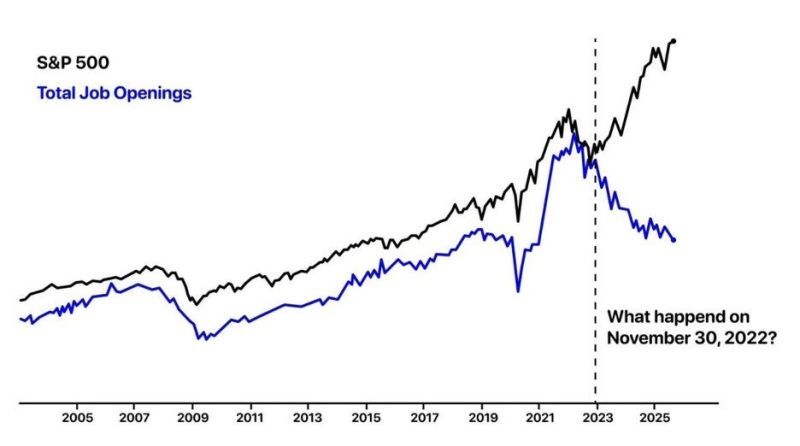
Financial markets surged to record highs, while job openings declined sharply. The two lines - markets and labor demand - decoupled for the first time in modern economic history.
Since the launch of ChatGPT in November 2022, the S&P 500 has climbed more than 70%, while job openings have fallen by roughly 30%. The visual contrast became known online as the “scariest chart in the world,” symbolizing a growing fear: that productivity, profits, and growth may no longer require proportional human employment.
The data itself is real. Job openings peaked at 11.5 million in March 2022, the highest level since tracking began in 2000. By August 2025, openings had fallen to about 7.18 million. Over the same period, the S&P 500 rose from roughly 3,840 to nearly 6,700.
But attributing this divergence solely to artificial intelligence would be analytically simplistic.
Monetary policy, not AI, triggered the initial decline
A closer look reveals that job openings peaked months before ChatGPT’s release. The turning point came in March 2022, when the U.S. Federal Reserve launched its most aggressive interest-rate tightening campaign in decades to curb inflation.
Higher interest rates raised borrowing costs, cooled investment, and slowed hiring - especially in capital-intensive industries. By July 2023, the Fed had raised rates 11 times. Only in late 2025 did policymakers begin cutting rates again to prevent further labor market deterioration.
Trade and immigration policies added further pressure. Tariffs increased input costs, while stricter immigration enforcement reduced labor force growth. According to estimates from the National Foundation for American Policy, restrictive immigration measures could shrink the U.S. workforce by up to 15 million people over the next decade, cutting long-term growth by nearly one-third.
In other words, macroeconomic policy - not AI - explains much of the initial cooling in hiring.
The sectoral evidence complicates the AI panic
If artificial intelligence were already destroying jobs at scale, the most AI-exposed sectors should be collapsing first. Yet the opposite appears true.
Sector-by-sector data shows that the “Information” sector - home to software engineers, data scientists, and AI developers - experienced the smallest decline in job openings after ChatGPT’s release. The steepest drops occurred in manufacturing, construction, and energy extraction - industries most sensitive to interest rates, trade policy, and labor supply constraints.
Construction job openings, for example, fell from 303,000 in mid-2025 to just 188,000 by August, the lowest level in nearly a decade. By late 2024, openings were down nearly 40% year-over-year.
This evidence suggests that AI is not yet the primary driver of job losses - but that conclusion comes with an important caveat.
While labor demand softened, AI-linked corporate profits surged. According to JPMorgan, AI-related stocks accounted for 75% of S&P 500 gains and 80% of earnings growth since late 2022. Roughly 30 AI-focused firms now represent nearly half of the index’s total value, generating an estimated $5 trillion in household wealth gains.
This concentration signals a deeper structural shift: economic value creation is becoming increasingly detached from broad-based employment. Economic growth is increasingly driven by capital, data, and advanced algorithms rather than by the expansion of human labor.
That distinction matters.

Layoffs without recession: A structural shift
By early 2026, the labor market entered one of the largest waves of workforce reductions in recent memory—without a traditional recession.
Amazon alone announced nearly 30,000 corporate layoffs since late 2025, despite strong profitability. UPS plans to eliminate up to 30,000 jobs in 2026, following nearly 50,000 cuts the previous year. Across technology, finance, retail, and manufacturing, layoffs are accelerating at a pace 42% higher than a year earlier.
Crucially, these cuts are not driven by collapsing demand, but by automation, AI integration, and organizational redesign. Tasks once handled by entire teams are now performed by algorithms, decision systems, and software tools.
Amazon’s restructuring illustrates this new reality. The company is reducing roles in HR, operations, support functions, and even parts of cloud services - areas once considered insulated from automation. These are not factory jobs being replaced by machines, but cognitive and administrative roles replaced by code.
This brings us to the most uncomfortable question: what happens to people who are no longer economically needed?
One proposed solution is expanded state support - covering basic needs such as food, healthcare, and housing. Others argue for aggressive retraining programs, faster job matching, or higher taxes on AI-driven corporations to fund social safety nets.
But each solution runs into the same dilemma: what if the next job can also be automated?
A society where large numbers of people are permanently excluded from productive participation faces not just economic risk, but social instability. Crime, inequality, and political radicalization are not abstract possibilities - they are historical patterns.
No state benefits from a future where prisons replace workplaces.
How could these technological developments influence Azerbaijan’s labor market and the broader employment landscape in countries with similar economic profiles?
For countries like Azerbaijan, the impact of AI-driven transformation will be shaped less by mass automation and more by structural vulnerability. Azerbaijan’s labor market is still heavily dependent on energy, construction, public sector employment, and low-to-mid skill services - sectors that are either sensitive to global capital cycles or gradually becoming automated through digital systems. While large-scale AI displacement may not arrive as abruptly as in advanced economies, the risk lies in missed adaptation: if productivity gains are imported through foreign technology without parallel investment in local skills, education, and digital infrastructure, job creation may lag behind economic growth. This could deepen dependence on extractive industries, widen income inequality, and limit upward mobility for younger workers. For Azerbaijan, the challenge is not AI replacing jobs overnight, but whether the country can create new forms of value and employment before global technological shifts reshape demand faster than the labor market can respond.
The deeper question: Do we still need humans?
From a purely economic standpoint, AI offers something irresistible: tireless, emotionless, disease-free productivity. A “super-worker” that never sleeps, never complains, and constantly improves.
From a human standpoint, this is where the model breaks.
Human beings are imperfect. But that imperfection - emotion, judgment, creativity, moral responsibility - is not a bug in the system. It is the system. Removing humans from economic relevance may optimize efficiency, but it destabilizes society itself.
The Fourth Industrial Revolution is not just a technological transition. It is a test of whether capitalism can adapt to a world where productivity no longer guarantees employment, and whether societies can redefine human value beyond economic output.
The answer to that question will define the coming decades.
Here we are to serve you with news right now. It does not cost much, but worth your attention.
Choose to support open, independent, quality journalism and subscribe on a monthly basis.
By subscribing to our online newspaper, you can have full digital access to all news, analysis, and much more.
You can also follow AzerNEWS on Twitter @AzerNewsAz or Facebook @AzerNewsNewspaper
Thank you!