
Gas prices spike in EU as winter bites, and what that means for Azerbaijan

Akbar Novruz
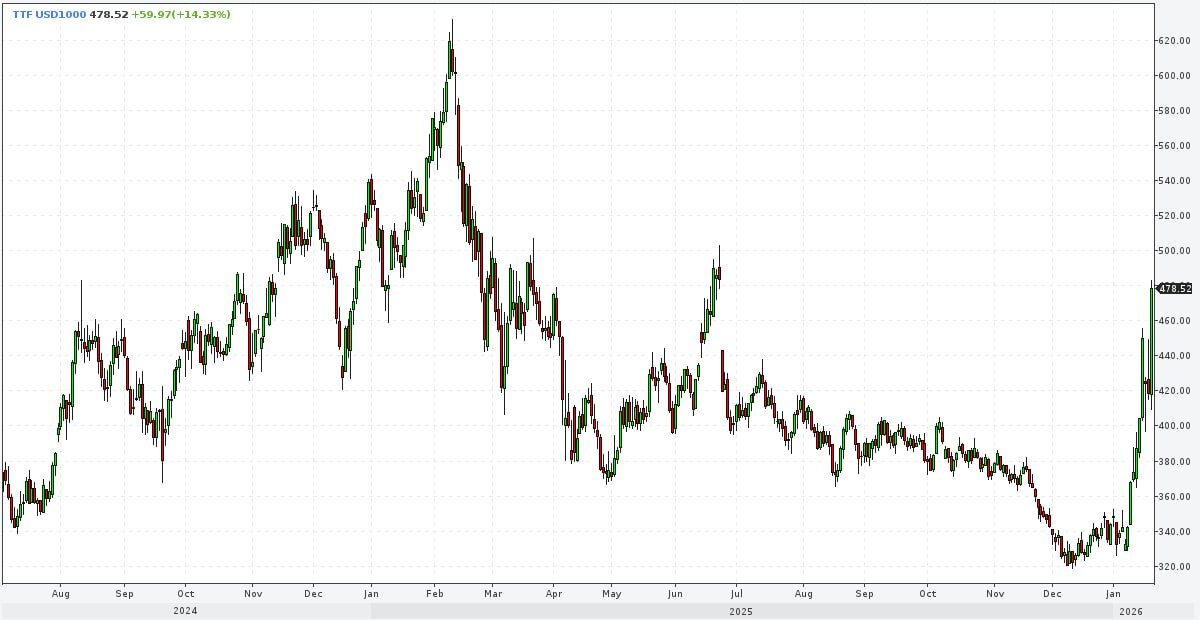
Read moreNatural gas markets are once again on edge. In recent days, the Dutch Title Transfer Facility (TTF) benchmark, Europe’s main wholesale gas price, climbed sharply to about $478 per 1,000 cubic meters, its highest level in roughly six months, representing a roughly 14% daily jump on the back of sudden demand and tightening conditions in storage and supplies.
Several converging factors have pushed prices higher. A chilly onset of winter across much of Europe and parts of Asia has heightened heating demand at a time when inventories are significantly below the recent five-year average, making markets more sensitive to temperature swings and demand spikes.
Cold weather alone can boost daily gas consumption by multiples as homes, businesses and power plants rely on gas for heat and electricity. That effect is amplified when storage is low: European gas reserves are reported at around 50% of capacity, well under normal seasonal levels, narrowing buffers and steepening price reactions.
On the supply side, concerns persist. Liquefied natural gas (LNG) flows, a crucial complement to pipeline gas in Europe, face production and export constraints in some key regions, while competition for cargoes has been rising. The U.S. market, for example, has seen an “arctic cold wave” push Henry Hub prices higher, reflecting similar demand pressures on the other side of the Atlantic.
Yet the longer horizon for gas markets is less uniformly tight. Industry analysts and recent energy outlooks expect global LNG supply to grow in 2026, driven by new export capacity in the United States, Qatar and elsewhere, a shift that could temper price volatility and increase cargo flows to Europe and Asia if projects come online as planned.
Why this matters for Azerbaijan?
For Azerbaijan, natural gas isn’t just a commodity; it is a strategic export and economic barometer. Gas accounts for roughly 35% of the country’s total export earnings, a share that influences foreign exchange inflows, public finances and broader economic stability. Higher regional gas prices can indirectly lift Azerbaijan’s export revenue potential, even for volumes sold under long-term contracts, because they strengthen regional price benchmarks and negotiating leverage.
Production and export figures illustrate the scale of Azerbaijan’s engagement in European and regional gas markets. In 2025, the country produced approximately 51.5 billion cubic meters (bcm) of gas and exported about 25.2 bcm. Those exports generated around $8.21 billion in foreign exchange, underlining gas’s role as a significant source of convertible currency.
Azerbaijani gas reaches a broad market. In 2025:
~12.8 bcm was delivered to Europe, making up a substantial share of the country’s export portfolio.
~9.6 bcm went to Türkiye, with a portion moving through the Trans-Anatolian Natural Gas Pipeline (TANAP).
Around 2.3 bcm was sent to neighboring Georgia.
These figures reflect continued diversification in export routes and destinations, with Azerbaijani gas now supplied to numerous European countries and under long-term sales agreements that are becoming more prominent in the context of Europe’s post-Russian supply restructuring. In fact, Azerbaijan has expanded natural gas deliveries to European markets, including Germany and Austria, under recent agreements that strengthen its role in EU energy security amid shifting geopolitical alignments.
Azerbaijan’s gas position sits at the intersection of geopolitics, energy security and market economics. Europe’s move away from traditional supplies, particularly Russian pipeline gas, has elevated the strategic value of alternative sources, including Caspian pipeline gas. Even as LNG growth promises to alleviate some pressure on prices in 2026, short-term volatility around storage and weather can boost near-term revenues, and reinforce the urgency for diversified supplies.
For Baku, price spikes like the recent TTF rally are not an isolated market event but part of a larger narrative: energy transition, supply diversification and geopolitical leverage. Higher prices in Northwest Europe can have knock-on effects on contract renegotiations, future pipeline flows, and Azerbaijan’s own investment choices in upstream capacity and export infrastructure. All of this adds up to an environment in which natural gas decisions carry both economic and strategic weight.
In this context, Azerbaijan’s ongoing expansion of export capacity and its deepening ties with European energy markets signal not just commercial opportunity, but longer-term integration into regional gas security frameworks, an evolution that could strengthen Gazprom’s historical grip on the continent even as global markets recalibrate.
Here we are to serve you with news right now. It does not cost much, but worth your attention.
Choose to support open, independent, quality journalism and subscribe on a monthly basis.
By subscribing to our online newspaper, you can have full digital access to all news, analysis, and much more.
You can also follow AzerNEWS on Twitter @AzerNewsAz or Facebook @AzerNewsNewspaper
Thank you!