
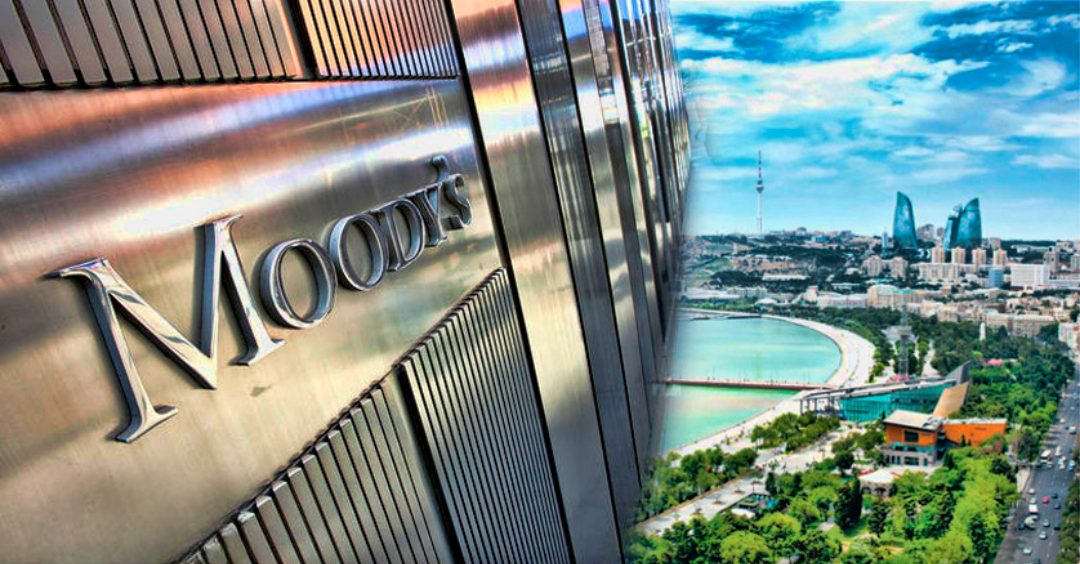
Moody’s outlook shows Azerbaijan prepared for less forgiving global economy

Akbar Novruz
Read moreAfter years of being judged largely by the rise and fall of oil prices, Azerbaijan is entering a more restrained and arguably more consequential chapter in its economic story. The era of windfall-driven headlines is giving way to something less dramatic but far more telling: the ability to maintain stability when conditions are no longer unusually favourable.
In its latest analytical update, Moody’s sketches a country adjusting to a cooler oil market without losing its macroeconomic balance. Growth is set to be moderate, inflation contained, and public finances steady.
For an energy exporter navigating lower prices and regional uncertainty, that combination is no small achievement.
Moody’s now expects Azerbaijan’s real GDP to expand by 3 percent in 2026, followed by growth of 2.5 percent in 2027. This represents a firmer outlook than earlier projections for 2025, when growth had been put at 1.5 percent. The revision suggests confidence that non-oil activity, public investment and macroeconomic management can offset softer hydrocarbon revenues. While the pace is hardly spectacular, it points to an economy settling into a more sustainable rhythm after years of volatility driven by commodity cycles.
Inflation, another long-standing concern for emerging markets, appears to be on a downward path. According to Moody’s, average annual inflation is expected to fall to 4.8 per cent in 2026 and ease further to around 4 percent in 2027 and 2028. This trajectory implies that monetary policy remains broadly credible and that price pressures, including those imported through energy and food markets, are gradually subsiding.
External balances remain one of Azerbaijan’s strongest pillars. Moody’s forecasts that the current account surplus will average about 5.1 percent of GDP in 2026–2027, following an estimated 7 percent surplus in 2025. These figures are lower than the windfall years of exceptionally high oil prices but still point to a country earning more from abroad than it spends. In 2024, the surplus reached 4.7 billion US dollars, equivalent to 6.3 percent of GDP.
For 2025, the Central Bank of Azerbaijan expects a surplus of roughly 3.7 billion dollars, assuming an average oil price near 70 dollars per barrel. Even as prices normalize, Azerbaijan continues to generate external buffers that many peers would envy.
Public debt metrics reinforce this picture of resilience. Moody’s projects total public debt at 23.9 percent of GDP in 2026, easing slightly to 23.8 percent in 2027, broadly unchanged from the expected level in 2025. These ratios are low by international standards and reflect years of conservative borrowing.
The agency does note, however, that debt relative to budget revenues is set to rise as oil income normalizes and state spending increases. That ratio, which stood at 41.6 percent in 2022 during a period of high oil receipts, is projected to climb to around 74.6 percent in 2026 and 78.4 percent in 2027. Even so, Moody’s still considers this range comfortable in terms of fiscal sustainability.
Debt servicing costs remain modest. Interest payments are expected to absorb only 5.7 percent of budget revenues in 2026 and 6.1 percent in 2027, well within manageable limits. This reflects both the low level of debt and favorable borrowing conditions accumulated in previous years.
Underlying all these projections is a more cautious oil-price assumption. Moody’s bases its outlook on an average Brent price of 69 dollars per barrel in 2025 and about 60 dollars in 2026–2027, with medium-term fluctuations expected between 55 and 75 dollars. The message is clear: Azerbaijan is no longer being assessed on the assumption of persistently high oil prices, but on its ability to cope when they are merely adequate.
This macroeconomic stability feeds directly into the country’s credit standing. Moody’s has reaffirmed Azerbaijan’s sovereign rating at Baa3 with a positive outlook. The agency highlights the government’s large net creditor position as a central strength, providing liquidity buffers and limiting external vulnerability.
Such cushions matter, particularly in a region where geopolitical tensions remain an ever-present risk factor in credit assessments.
Moody’s is careful to stress that its latest statement is an analytical opinion rather than a formal rating action. Still, the tone is unmistakable. Azerbaijan is portrayed as an economy that, while exposed to oil prices and regional uncertainty, has built enough financial ballast to navigate a less forgiving global environment. In a world of sharper shocks and thinner margins, that quiet competence may prove to be its greatest asset.
Here we are to serve you with news right now. It does not cost much, but worth your attention.
Choose to support open, independent, quality journalism and subscribe on a monthly basis.
By subscribing to our online newspaper, you can have full digital access to all news, analysis, and much more.
You can also follow AzerNEWS on Twitter @AzerNewsAz or Facebook @AzerNewsNewspaper
Thank you!