
Moldova’s unification debate, stripped of romance

Akbar Novruz
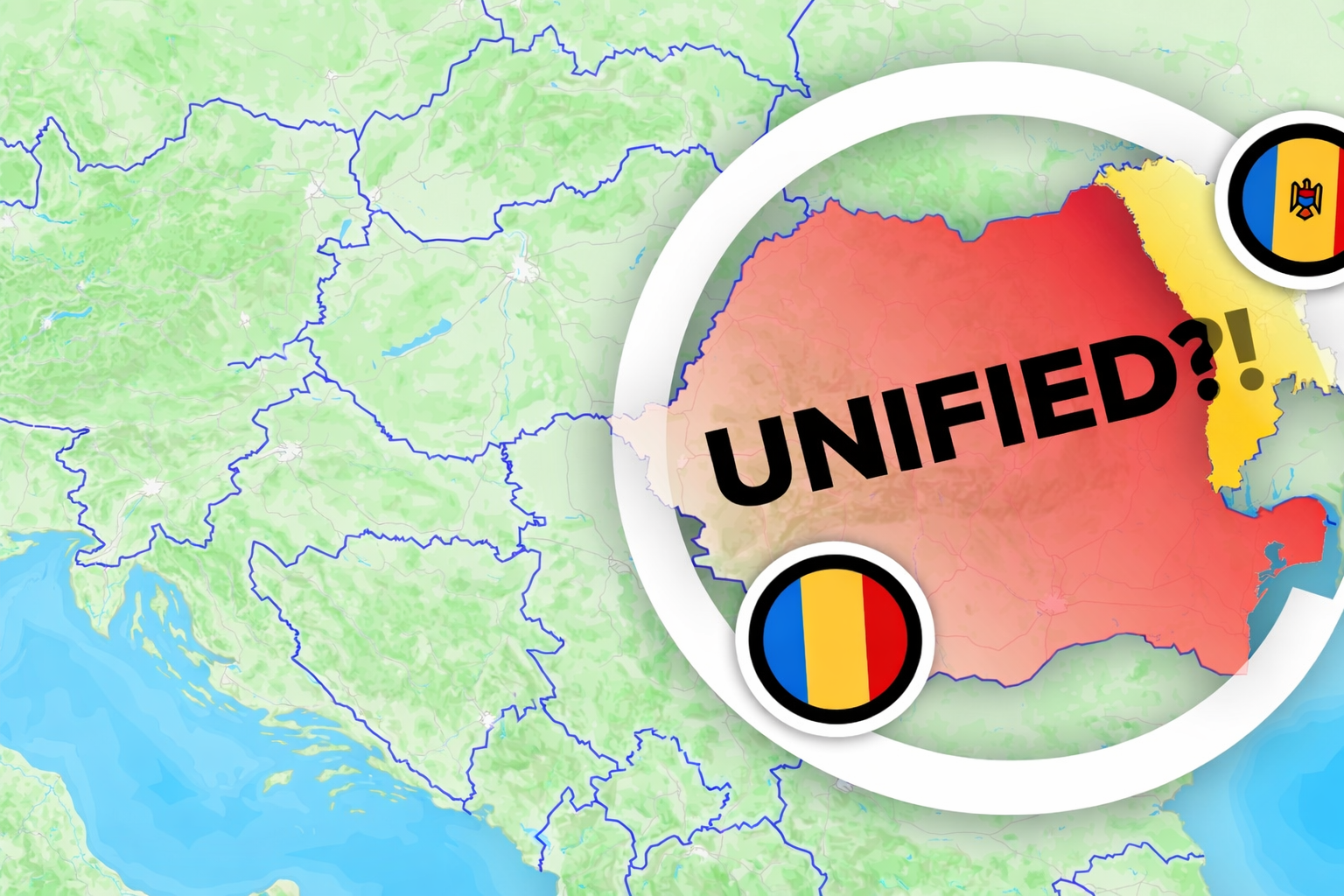
Read moreFor years, the idea of Moldova rejoining Romania hovered in the realm of sentiment, whispered at commemorations, debated in cafés, and carefully avoided in official speeches. Then President Maia Sandu said the quiet part out loud. By framing her hypothetical vote for reunification not as a romantic return to history but as a matter of security, Sandu signaled that Moldova’s most sensitive question has entered a new phase. In a region reshaped by war, identity alone no longer explains political choices; survival does.
Moldova’s predicament is emblematic of small states caught between geography and geopolitics. Culturally intertwined with Romania yet shaped by centuries of Russian and Soviet rule, the country embodies a dual legacy: shared history on one bank of the Prut, enforced separation on the other. What has changed is not the past, but the present. Russia’s war against Ukraine has reframed neutrality as vulnerability and turned once-theoretical debates into strategic calculations.
Experts speaking to AzerNews caution that symbolism should not be confused with imminence. Cultural affinity may provide the emotional logic for reunification, but law, security guarantees, frozen conflicts, and great-power reactions impose far stricter limits. The renewed debate, they argue, is less about whether Moldova “belongs” with Romania, and more about how a fragile state navigates an increasingly unforgiving security environment without losing its sovereignty in the process.
How likely is it that Moldova rejoins Romania?
From an institutional and political standpoint, Sebastian Schaeffer, Director at the Institute for the Danube Region and Central Europe (IDM), argues that unification remains unlikely in the short to medium term. While cultural, linguistic, and historical arguments for reunification are deeply rooted, political consent is not. Support fluctuates on both sides of the Prut River and remains below the level required to make a binding referendum politically viable, particularly in Moldova. What has shifted, however, is not the probability of unification but the legitimacy of openly discussing it. Russia’s war against Ukraine has transformed unification from a taboo subject into a contingency scenario. President Maia Sandu’s statement that she would personally vote for unification—explicitly framing it as a response to mounting geopolitical pressures and the difficulty of sustaining democracy as a small state—marks a significant change in official discourse. Unification is now increasingly framed not as romantic nationalism, but as a security insurance option of last resort. Even so, Moldova’s strategic trajectory remains focused on EU integration as a sovereign state rather than an imminent merger with Romania.
Andrew Korybko, Moscow-based political analyst, by contrast, contends that the unification question is already largely moot in practical terms. In his view, Moldova has become a de facto member of NATO despite its constitutional neutrality, while those Moldovan citizens who genuinely wish to (re)join Romania already hold Romanian citizenship. This dual citizenship grants them access to EU residency, employment, and political participation, effectively delivering many of the benefits unification would otherwise provide. As a result, Korybko sees Sandu’s stated preference for unification as unlikely to translate into concrete action, particularly given contested electoral processes and the political risks of attempting to engineer a referendum whose outcome could not be easily controlled.
NATO’s Article 5, EU Article 42(7), and the Transnistria dilemma
Schaeffer underscores that, in principle, NATO’s Article 5 would apply only to Romania’s internationally recognized territory at the moment of unification. In practice, Transnistria becomes decisive. NATO has consistently avoided importing unresolved territorial conflicts, meaning that any unification would almost certainly require a prior legal clarification excluding Transnistria from the transferred territory. Otherwise, the Alliance would inherit a frozen conflict involving Russian troops—something it has systematically avoided. As a result, Transnistria would either remain outside Article 5 coverage or block the process entirely.
More importantly, Schaeffer argues that the debate is overly focused on NATO. He points instead to Article 42(7) of the Treaty on European Union as increasingly consequential. NATO’s political cohesion can no longer be treated as immutable, as demonstrated by recent burden-sharing disputes and the political shock triggered by US President Donald Trump’s January 2026 push to acquire Greenland. While Article 5 remains the cornerstone of European defence, its credibility ultimately depends on political will, particularly in Washington. By contrast, Article 42(7) obliges EU member states to provide “aid and assistance by all means in their power” if a member state suffers armed aggression. Its legal language is explicit, embedded in EU primary law, and politically difficult to ignore once invoked. Crucially, it extends collective security obligations to EU states outside NATO, such as Austria, Ireland, and Cyprus. A Moldova–Romania unification would therefore place Moldova immediately under the EU’s mutual assistance framework, creating a European security backstop that is often underestimated in NATO-centric debates.
Korybko approaches the same issue from a strategic and perceptual angle rather than a legal one. He argues that Moldova is already part of Romania’s broader security space and lacks only the psychological comfort associated with popular interpretations of Article 5. In his reading, the legal distinctions between NATO and EU clauses matter less than how Moscow interprets intent. Any move toward formal unification would likely be viewed in Russia as a signal of hostile designs toward Transnistria. From this perspective, unification is dangerous not because of what treaty articles technically apply, but because it could be perceived as paving the way for NATO involvement in a territory where Russian peacekeepers are present.
The feasibility of ceding Transnistria
Schaeffer describes the idea of ceding Transnistria in exchange for faster integration with Romania or Western institutions as legally and politically fraught. While not entirely impossible in theory, it would require constitutional amendments, a referendum, and international recognition. Politically, transferring territory to Russia is implausible and deeply toxic. Ukraine, meanwhile, has no interest in annexing Transnistria while fighting to preserve its own territorial integrity. President Volodymyr Zelensky has repeatedly emphasized that territorial concessions are Ukraine’s most difficult challenge and that legitimizing occupied territories would undermine international law and set a dangerous precedent.
Beyond legal constraints, Schaeffer highlights economic realities. Transnistria is not driven by ideology but by the incentives of its ruling oligarchy. Official Moldovan data shows that roughly three quarters to over four fifths of Transnistrian exports go to the EU, with Romania, Italy, Poland, and Germany among the main destinations. Imports from the EU account for nearly half of total imports. This makes the EU—not Russia—Transnistria’s most important economic partner. The local elite benefits from ambiguity, with smuggling networks, preferential EU market access via Moldova, and regulatory grey zones forming the backbone of their revenue streams. Formal annexation by Russia would disrupt this business model and expose the region to sanctions, sharply reducing incentives for radical status changes.
Korybko largely sidesteps the legal feasibility question, arguing instead that territorial cession is strategically irrelevant. In his view, Transnistria’s value lies precisely in its unresolved status. Any attempt to formalize its fate—whether through cession, annexation, or reintegration—would upset the delicate balance that allows it to function as a geopolitical buffer. For Moscow, ambiguity is preferable to resolution, especially when unresolved territories can be used to shape narratives and constrain opponents’ strategic choices.
Casus belli or political defeat?
Schaeffer assesses that Russia would most likely interpret a Moldova–Romania unification as a political defeat rather than a casus belli. Moscow lacks both the geographic access and military capacity to wage a conventional war against Romania, a NATO member. Any direct confrontation would carry unacceptable escalation risks and likely trigger a broader clash with the Alliance. Instead, Russia would frame unification as a hostile act and exploit it politically through propaganda, disinformation, economic pressure, and political destabilization. More broadly, Moscow could instrumentalize unification as part of a revisionist narrative, pointing to it as a precedent to justify its own claims over Ukraine’s occupied territories by arguing that border changes driven by security concerns or historical narratives are selectively legitimized by the West.
Korybko agrees that outright war is unlikely but places greater emphasis on escalation risks linked to Transnistria. He argues that while unification itself may not trigger conflict, it could be interpreted as a precursor to dismantling the existing status quo around the breakaway region. In that sense, the danger lies less in unification as a legal act and more in its potential to catalyze a broader NATO–Russia crisis under conditions of heightened mistrust.
The risk of escalation in Transnistria
Schaeffer concludes that Russia’s ability to preemptively escalate in Transnistria is more limited than often assumed. The region is geographically isolated, dependent on Moldova and Ukraine for access, and hosts a relatively small Russian military presence with constrained logistics. A serious escalation would be difficult to sustain and would directly threaten the economic interests of the Transnistrian elite, whose revenues depend on uninterrupted trade with the EU. Consequently, Moscow is more likely to exploit Transnistria politically rather than militarily, using it as a tool for freezing options and sustaining ambiguity rather than as a launchpad for war. This contrasts with Gagauzia, where identity politics and pro-Russian narratives resonate more strongly and where political obstruction may pose a greater challenge to unification scenarios.
Korybko similarly views escalation as unlikely but frames Transnistria as a strategic deterrent rather than a liability. He argues that the region functions as a warning mechanism, signaling that certain red lines—particularly those involving NATO’s proximity to Russian peacekeepers—should not be crossed. While Moscow may avoid military escalation, it could still leverage Transnistria diplomatically and rhetorically to constrain Moldova’s choices and deter any moves perceived as deliberately provocative.
Here we are to serve you with news right now. It does not cost much, but worth your attention.
Choose to support open, independent, quality journalism and subscribe on a monthly basis.
By subscribing to our online newspaper, you can have full digital access to all news, analysis, and much more.
You can also follow AzerNEWS on Twitter @AzerNewsAz or Facebook @AzerNewsNewspaper
Thank you!