
Venezuela as stress test for so-called 'New World Order'
Akbar Novruz
Read moreEver since the US’s extraordinary, yet somewhat ‘classic’ change-of-regime act in Venezuela a week ago, the idea of a so-called, long-signalled “New World Order” has most definitely made its comeback once again. But has it, really?
The occurrence shook the world by storm. Even if Uncle Sam’s intervention in Caracas was predicted or expected by many for quite some time, it happened in a rather different way. In early December, a planned mission dubbed Operation Absolute Resolve was finalised. It was the result of months of meticulous planning and rehearsals, reportedly including elite US troops creating an exact, full-scale replica of Maduro’s Caracas safe house to practise their entry routes. The plan, amounting to an extraordinary US military intervention in Latin America not seen since the Cold War, was closely guarded. Congress was neither informed nor consulted ahead of time. With the precise details set, top military officials simply waited for optimal conditions to launch.
Loud explosions were heard in Caracas at around 02:00 local time, with plumes of smoke rising over the city. Reportedly, more than 150 aircraft were involved, and within nearly four hours, the mission was declared complete - Maduro was captured.
The world was left in shock. No one truly knew what was happening, nor did anyone have the chance to fully process how it happened. In a world where AI has already confused people’s perception of reality, many refused to believe the operation at all. Even when Donald Trump posted a photo of himself in a Nike tracksuit, with blindfolds visible in the background, it looked too unserious - too much like AI slop. Yet, it was reality.
Statements soon followed from the infamous White House, and the global reaction machine went into full motion. One argument circulated around realist ideas: “this is the new reality,” “the New World Order has begun,” “every dictator should be careful now.” This camp predominantly supported the legitimisation of US intervention. The other side leaned toward liberalism: “this is an act of violence,” “this is the destruction of the world order,” and similar claims.
Imagine an act so shocking, even if expected, that both sides could be easily challenged in their positions. Realists appeared less vulnerable to critique, yet their argument is unsettling in itself. This was not done because a system collapsed from within; it was done in a far more direct and, in many ways, more atrocious manner. With regime loyalists previously clinging to power, the intervention appears contradictory even to the logic of stability that realism often claims to defend. Liberals, on the other hand, viewed this as the beginning of catastrophic developments, as the US points its interest towards Greenland, which can potentially lead to global confrontation. Yet, scenes of Venezuelan citizens celebrating the capture in a festive manner tested nearly every argument put forward.
Hopefully, this briefly explains the situation. But deep down, there is more to it than meets the eye. Let us return to the main question: has the “New World Order” truly emerged?
As much as it was easy to predict Venezuela’s regime “change,” answering this question is far more difficult. From a subjective perspective, yes - it has emerged, but not a week ago. What we are witnessing now may be a transitional phase, or perhaps the climax of processes long in motion.
The creation of the United Nations stands as a relevant historical parallel. The birth of a new order or system has always been contentious. The period leading to this common framework was deeply bloody. From the late nineteenth century until the end of World War II, millions were sacrificed, and multiple regime changes marked the painful emergence of a new system.
History, as often said, repeats itself, only the conditions, resources, and methods differ. This raises a crucial question: what factors come into play if an existing system is weakened or destroyed and a new one begins to form?
-
risk-taking, often irresponsible leaders,
-
public opinion that “edits” everything, struggles with serious argumentation, and operates in a world of symbols, loving or hating without nuance, easily reshaped through algorithms
Perhaps dismantling the current system and replacing it entirely is not as accessible as some suggest. As mentioned, although the idea of dissolving the UN has been raised at various moments, shared interests have consistently outweighed such ambitions. As the saying goes, if something is not broken, why try to fix it?
The US appears to be returning to a Monroe Doctrine–style approach, yet the developments in Venezuela expose clear contradictions. On one hand, Washington frames the intervention as a defence of democracy and stability in its “near abroad.”
Rather than opening space for a political reset, Maduro’s capture has produced a familiar outcome. Delcy Rodríguez, his vice-president since 2018 and a core figure of the chavista elite, was sworn in as acting leader days after the operation. A lifelong loyalist shaped by revolutionary ideology and ruthless pragmatism, Rodríguez now embodies the central contradiction of the intervention: a “regime change” that leaves the regime intact.
Washington reportedly viewed her as one of the few figures capable of stabilising the system if Maduro fell, and she has since oscillated between calls for “co-operation” with the United States and fierce denunciations of its “military aggression” to placate hardliners at home. Her record, spanning crackdowns on the opposition, control over intelligence services, and later technocratic reforms to keep the system afloat, suggests continuity rather than rupture. In effect, power has shifted not away from chavismo, but inward, reinforcing the very structure the intervention claimed to challenge.
On the other hand, the method, unilateral, secretive, and dismissive of international mechanisms, undermines the very order it claims to protect. Similar inconsistencies emerge when viewed alongside US interests in Greenland, where strategic calculations overshadow proclaimed liberal principles. What we see is not a coherent new order, but selective enforcement of power.
Francis Fukuyama, an international relations scholar, famously argues that history should be understood as an evolutionary process, with liberal democracy representing its final form. The “last man,” in this sense, is a passive nihilist, risk-averse, exhausted, and seeking comfort above all else. While this latter description feels increasingly realistic, the former claim appears less convincing when confronted with Venezuela, Greenland, and broader geopolitical behaviour. Rather than Fukuyama’s end of history, today’s dynamics resemble something closer to Huntington’s logic: a world shaped by power blocs, civilisational instincts, and recurring conflict.
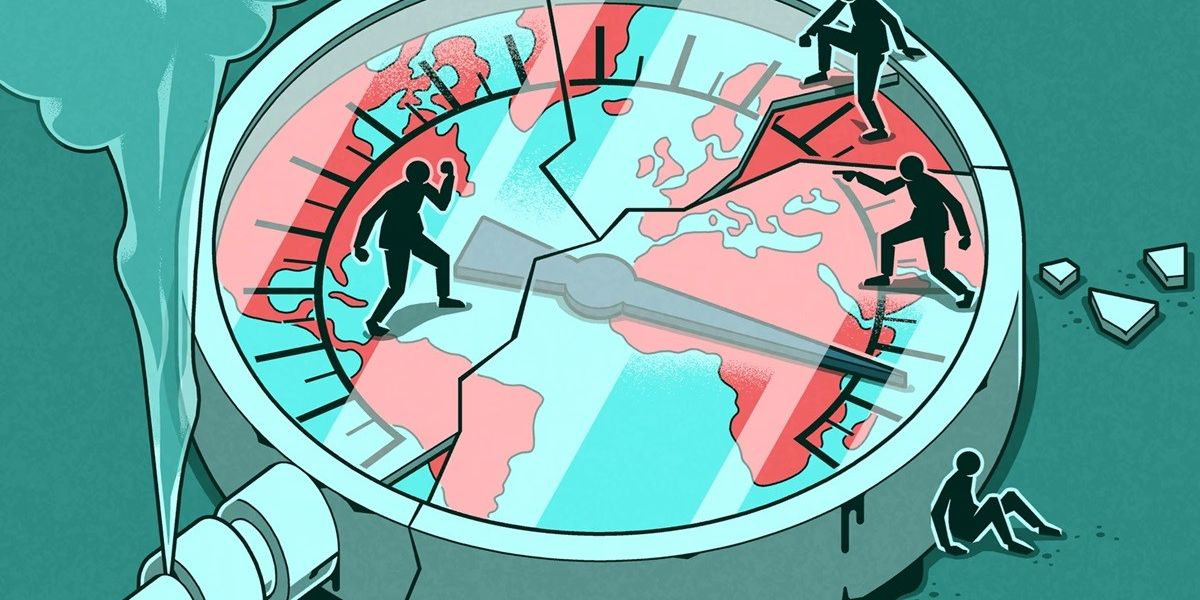
Venezuela, then, is not the moment the New World Order was born, nor is it proof that one has cleanly replaced the old. It is something more ambiguous and, perhaps, more troubling. What we are witnessing might not be the emergence of new rules, but the increasing comfort with acting as if rules are optional. Power is being exercised more openly, more theatrically, and with less concern for process, yet without offering an alternative framework to replace what is being hollowed out.
The language of a “new reality” obscures this uncertainty. If anything, the intervention exposes how dependent the current system remains on improvisation, selective enforcement, and narrative management rather than coherent order-building. Regime change without regime change, legitimacy claimed without institutions, and stability pursued through shock all suggest not transition, but drift.
What Venezuela reveals instead is a system that still exists, but is increasingly stretched, bent, and bypassed. The danger, then, may not be that a new order is arriving, but that the old one is being eroded without anything solid ready to take its place.
If a New World Order is truly emerging, it would announce itself through new norms, enduring structures, and widely accepted rules of behavior. Perhaps the "blueprint" has already been created; who knows?
[image source: The Guardian, Matt Kenyon]
Here we are to serve you with news right now. It does not cost much, but worth your attention.
Choose to support open, independent, quality journalism and subscribe on a monthly basis.
By subscribing to our online newspaper, you can have full digital access to all news, analysis, and much more.
You can also follow AzerNEWS on Twitter @AzerNewsAz or Facebook @AzerNewsNewspaper
Thank you!