
Baku citizens question how far trade with Armenia can go [COVERAGE]
![Baku citizens question how far trade with Armenia can go [COVERAGE]](https://www.azernews.az/media/2026/01/09/4724572471247_1.png)

Qabil Ashirov
Read moreRolling sluggishly from Guzdek station on January 8, 2025, the tank cars opened a new chapter in Azerbaijani-Armenian history. On the platform, a middle-aged man in a reflective jacket, half-jokingly, half-seriously whispered, “We have lived to see this day,” as the screeching wheels of the fuel-laden train echoed around him. Against this backdrop, it is impossible to reproach him: the two countries have been locked in war for three decades, and the history of their enmity stretches far beyond the dawn of their independence.
The Garabagh conflict, erupting in 1988 before either nation had gained independence, touched nearly every family—claiming some 30,000 lives, injuring or maiming over 100,000 people, and forcing more than one million into exile as refugees and internally displaced persons. Considering that the combined population of the two countries was around 10 million at the time, the scale of devastation can only be imagined. To claim that such hostility could be resolved in a single day is naïve; it remains one of the most difficult challenges both nations currently face.
Yet both nations have made efforts to move beyond enmity and heal the wounds inflicted by the war since 2025. Many believe that the tank cars carrying Azerbaijani oil to Armenia represent one of the attempts at building trust between the two nations. It should be noted that this was the second batch of oil Azerbaijan exported within a month.
The first batch of Azerbaijani oil was exported on December 18, 2025. At that time, the Garabagh clique, the main beneficiaries of the long-standing conflict, tried to create a storm in a teacup, circulating reports that ordinary Armenian citizens opposed trade with Azerbaijan, in an effort to throw the Pashinyan government under the bus. Yet the reality proved otherwise: the imported oil was fully consumed within 20 days, and Armenia exported oil again.
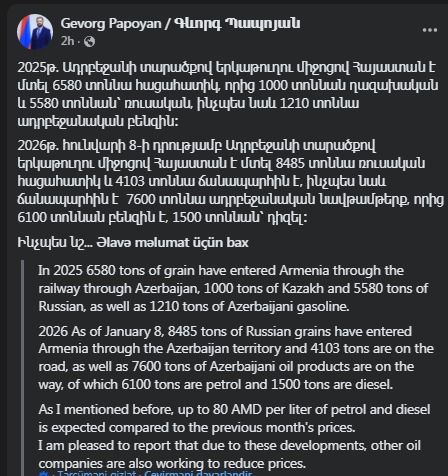
Armenia’s Minister of Economy, Gevork Papoyan, confirmed the robust demand for Azerbaijani oil. “The imported gasoline sold out within days, which shows how high the demand is,” he told local media. In a later Facebook post, Papoyan highlighted that, alongside Azerbaijani oil, Kazakh and Russian grain had also entered Armenia through Azerbaijani territory. He emphasised that these developments could drive diesel prices down across the country. Moreover, Azerbaijani flights now traverse Armenian airspace, cutting both travel time and expenses for passengers, a small but significant sign of growing connectivity between the two nations.
Many believe that these are tentative steps toward reconciliation between the two nations. They argue that trade should not be limited to fuel exports and transit activities, but should gradually expand to other sectors. This raises the question of whether Azerbaijani citizens are ready to trade with Armenians and see Armenian products on store shelves.
Speaking to Azernews, a resident of Baku who wanted to stay anonymous, noted that he is not against the development of trade relations between the countries. However, there must be very strict control over them.
“For example, I would like there to be double scrutiny over alcoholic beverages and coming from there. Additionally, any Azerbaijani institution responsible for these sectors should be extremely vigilant in this matter. I personally view the sincerity of the Armenians with suspicion,” he underscored.
When asked whether he could confidently buy any Armenian products from the market that do not pose a health risk, such as textiles, our interviewee could not answer.
On the contrary, another interviewee, a Baku resident, Rauf Aliyev, said that he supports the trade relations between the two countries. He added that no country should be isolated from others.
“That is why I believe these relations should be established. A country without connections heads toward stagnation. Take Iran, which has been subject to sanctions, for example. It cannot export products abroad and can only sell them domestically. In other words, the more products we export, the more beneficial it is for us and for the country’s development. Trade expansion leads to stronger overall relations. We can visit Armenia, explore it—there’s nothing wrong with that. I am confident that our government oversees everything,” he said.
Moreover, he emphasised that the hostility has been instilled in the minds of people on both sides for years. This hostility must end. The sooner it ends, the more beneficial it will be for both sides.
“For instance, Armenians who once lived in Baku were never resented. Even abroad, including in Armenia itself, they spoke positively about their neighbours in Baku. To this day, they long to see Baku, the city where they were born and spent their childhood and youth. If we had been bad, I doubt they would have expressed these sentiments,” he concluded.
Here we are to serve you with news right now. It does not cost much, but worth your attention.
Choose to support open, independent, quality journalism and subscribe on a monthly basis.
By subscribing to our online newspaper, you can have full digital access to all news, analysis, and much more.
You can also follow AzerNEWS on Twitter @AzerNewsAz or Facebook @AzerNewsNewspaper
Thank you!