
Drastic changes are unfolding in universe’s largest stars
By Alimat Aliyeva
The most massive stars in the universe are born brilliant, live fast by cosmic standards, and die young. In this sense, WOH G64 can be considered the stellar equivalent of Jimi Hendrix — dazzling, powerful, and destined for a dramatic finale, AzerNEWS reports.
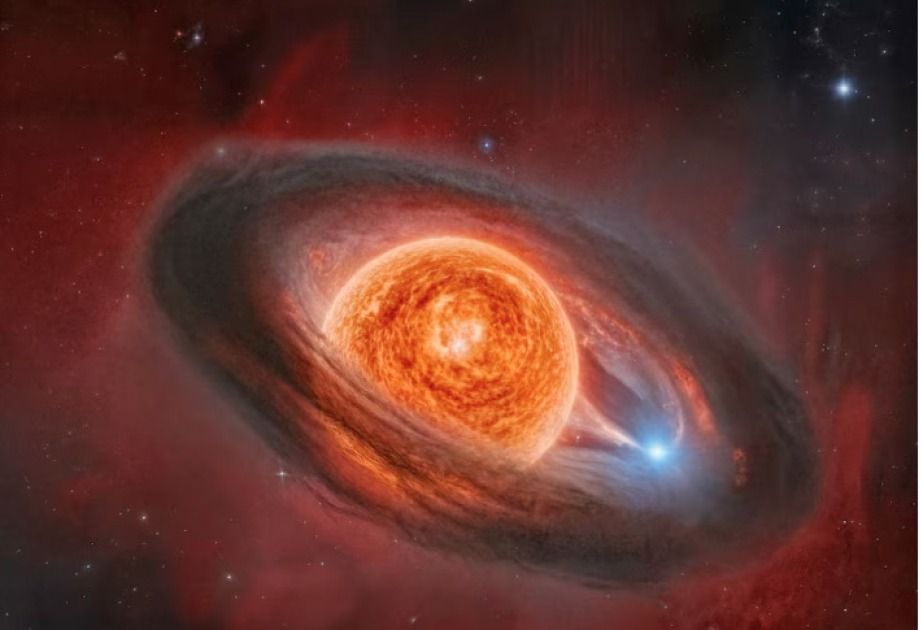
According to astronomers, WOH G64 is one of the largest known stars. It has a mass about 28 times that of the Sun and is located in the Large Magellanic Cloud, a satellite galaxy of the Milky Way. Observations spanning more than three decades reveal that it behaves unlike any other star previously studied.
Scientists still have only a partial understanding of the life cycles of the most massive stars, and in this respect, WOH G64 offers valuable new insights.
In 2014, researchers detected a change in the star’s color, indicating that its surface temperature had increased as it transitioned from red to yellow. Previously classified as an extreme red supergiant, it rapidly evolved into a yellow hypergiant — a transformation that occurred astonishingly quickly by cosmic standards. Remarkably, no clear signs of a major eruption or explosion accompanied this shift.
“Typically, stellar evolution unfolds over billions of years. On human timescales, we only witness sudden and violent phenomena such as eruptions, stellar mergers, or explosive deaths,” said astronomer Gonzalo Muñoz-Sánchez, lead author of the study published this week in Nature Astronomy.
Muñoz-Sánchez, who conducted the research at the Athens National Observatory, noted that existing stellar models cannot fully explain WOH G64’s unusual transformation. Compared to the Sun, the star is about 300,000 times more luminous and roughly 1,500 times larger in diameter. If it replaced the Sun at the center of our Solar System, its outer layers would extend beyond the orbit of Jupiter and nearly reach Saturn. A beam of light would take about six hours to travel once around its immense circumference — a mind-bending scale.
Astronomers estimate that WOH G64 is around 10 million years old and approaching the end of its life. For comparison, the Sun is about 4.5 billion years old and is expected to shine for another 5 billion years. WOH G64 lies approximately 160,000 light-years from Earth — meaning the light we see today began its journey when early humans were first appearing on our planet.
Stars with masses between about eight and twenty-three times that of the Sun typically become red supergiants and eventually explode as supernovae. However, the fate of stars in the 23–30 solar mass range remains uncertain. They may explode as supernovae, collapse directly into black holes, or transition between evolutionary phases before their final collapse. Black holes are extraordinarily dense objects whose gravity is so strong that not even light can escape.
“The behavior of WOH G64 may help answer this question,” Muñoz-Sánchez explained.
Adding further complexity, observations suggest that WOH G64 is gravitationally bound to a companion star, forming a binary system. Although astronomers have not yet determined the companion’s exact size or properties, there is speculation that the two stars may have interacted closely or even partially merged in the past. Such interactions can dramatically alter stellar evolution and may explain the star’s unusual behavior.
Researchers have proposed that a violent instability may have temporarily caused WOH G64 to appear as an extreme red supergiant before it began returning to a hotter, yellow state. Another possibility is that interactions with its companion star created the illusion of a red supergiant phase.
Interestingly, stars like WOH G64 are also prolific cosmic forges. In their turbulent interiors, they create heavy elements — such as oxygen, silicon, and eventually iron — that are later scattered across space when the star dies. These elements become the building blocks of new stars, planets, and potentially life itself.
As astronomers continue to monitor this extraordinary system, WOH G64 may significantly reshape our understanding of how the most massive stars evolve — and how they ultimately meet their spectacular end.
Here we are to serve you with news right now. It does not cost much, but worth your attention.
Choose to support open, independent, quality journalism and subscribe on a monthly basis.
By subscribing to our online newspaper, you can have full digital access to all news, analysis, and much more.
You can also follow AzerNEWS on Twitter @AzerNewsAz or Facebook @AzerNewsNewspaper
Thank you!