
NASA images Sun-like star bubble in X-rays
By Alimat Aliyeva
Astronomers have captured the first detailed views of a young sun-like star blowing massive bubbles, offering a rare glimpse into how our own solar system may have behaved in its early years, AzerNEWS reports, citing foreign media.
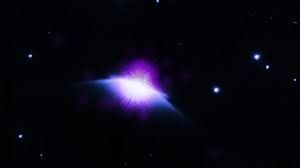
Using NASA’s Chandra X-ray Observatory, researchers observed HD 61005 — located about 120 light-years from Earth and similar in mass and temperature to our sun — and detected a vast bubble of hot gas surrounding it. This wind-blown cavity, known as an “astrosphere,” forms when a star’s powerful stellar wind collides with surrounding interstellar gas and dust, carving out a protective bubble. This is analogous to our sun’s heliosphere, which shields the solar system from galactic cosmic rays, according to NASA.
This observation marks the first time astronomers have found X-ray evidence of an astrosphere around a sun-like star, providing the clearest look yet at these stellar bubbles beyond our solar system. Chandra’s sharp X-ray vision revealed faint, extended emissions around HD 61005 — essentially the glowing outline of its astrosphere. These X-rays arise where the star’s fast, dense wind smashes into cooler surrounding gas, heating it to millions of degrees and producing the detectable radiation.
HD 61005 is about 100 million years old, very young compared to our 4.6-billion-year-old sun, and its stellar wind is far more intense. Researchers estimate it blows roughly three times faster and is about 25 times denser than the sun’s current wind. Combined with a surrounding interstellar environment approximately a thousand times denser than our solar neighborhood, this interaction inflates a large, bright bubble detectable in X-rays.
“This new Chandra observation of a star similar to the sun teaches us about the shape of our own heliosphere and how it has evolved over billions of years as the sun moves through the galaxy,” said lead author Carey Lisse from Johns Hopkins University.
Astronomers have nicknamed HD 61005 the “Moth” because of its wing-shaped debris disk, visible in infrared light. These dusty remnants from the star’s formation appear sculpted by its motion through space. Studying its astrosphere gives scientists a rare window into what the early solar system may have experienced when the young sun’s wind was stronger and interactions with surrounding gas and dust were more dramatic.
The research also provides insights into how stellar winds can shape planetary environments and influence the potential habitability of planets orbiting other stars. “We are impacted by the sun every day, not only through its light but also through its wind, which can affect satellites and astronauts traveling to the Moon or Mars,” said co-author Scott Wolk from the Center for Astrophysics, Harvard & Smithsonian. “This image of HD 61005’s astrosphere gives us important clues about what the sun’s wind may have been like early in its evolution.”
Interestingly, observing stars like HD 61005 allows astronomers to test models of space weather on other worlds, hinting at how extreme stellar winds could strip atmospheres or shape the magnetic environments of exoplanets — a key factor in determining whether distant planets could support life.
Here we are to serve you with news right now. It does not cost much, but worth your attention.
Choose to support open, independent, quality journalism and subscribe on a monthly basis.
By subscribing to our online newspaper, you can have full digital access to all news, analysis, and much more.
You can also follow AzerNEWS on Twitter @AzerNewsAz or Facebook @AzerNewsNewspaper
Thank you!