
Webb observes Uranus auroras stranger than expected
By Alimat Aliyeva
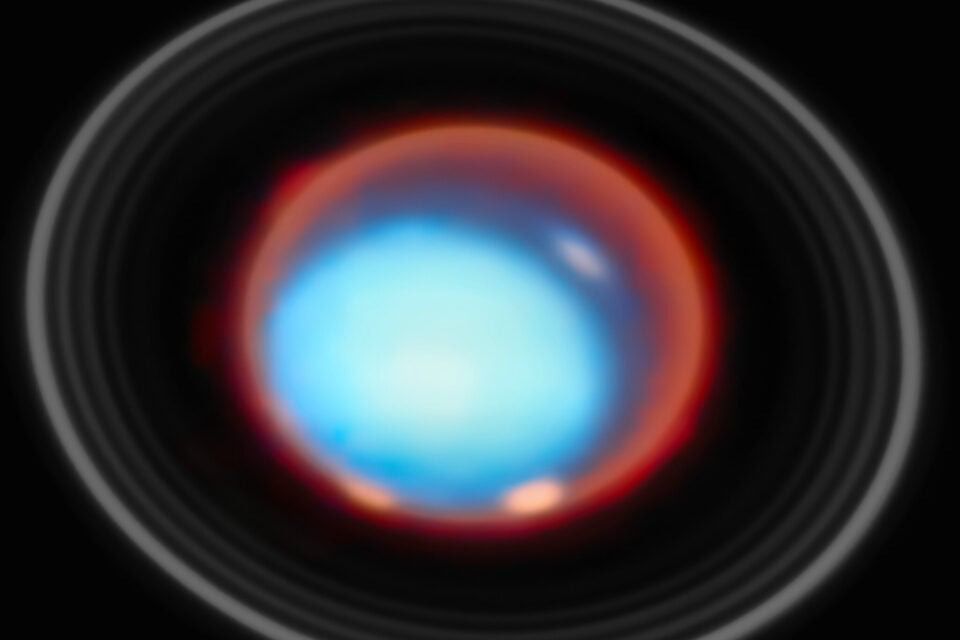
The James Webb Space Telescope recently spent 17 hours observing the mysterious world of Uranus, studying how faint molecular emissions above its clouds interact with the planet’s unusual magnetic field. The resulting data allowed scientists to map Uranus’s upper atmosphere in unprecedented detail, offering new clues about the formation of its enigmatic auroras, AzerNEWS reports, citing foreign media.
An international team of researchers used Webb’s Near-Infrared Spectrograph (NIRSpec) to measure the temperature and density of ions roughly 3,000 miles (5,000 kilometers) above the cloud tops. Their findings, published in Geophysical Research Letters, reveal how Uranus’s tilted and eccentric magnetic field shapes its auroras and influences energy flows in the upper atmosphere.
“This is the first time we’ve been able to observe Uranus’s upper atmosphere in three dimensions,” said Paola Tiranti, a PhD student at Northumbria University in the U.K. and lead author of the study. “Webb’s sensitivity allows us to trace how energy moves upward through the atmosphere and directly see the effects of its lopsided magnetic field.”
Uranus is known for its bizarre magnetic configuration. The planet rotates on its side, with an axial tilt exceeding 90 degrees. Its magnetic axis is also highly tilted—almost 60 degrees relative to the rotation axis—creating a magnetosphere that is unusually variable. As a result, the planet’s auroras sweep across the atmosphere in complex and unpredictable ways, according to NASA.
Webb detected two bright auroral bands near Uranus’s magnetic poles, along with a noticeable depletion of ions and emissions between the bands. This pattern likely results from the way magnetic field lines guide charged particles through the atmosphere.
Auroras on Uranus were first spotted by the Hubble Space Telescope in 2012. Since then, astronomers have sought to understand how the planet’s chaotic magnetosphere influences these glowing displays.
“Uranus’s magnetosphere is one of the strangest in the Solar System,” Tiranti said. “Webb has now shown us how far its effects reach into the upper atmosphere.”
The first close-up view of Uranus came from Voyager 2 during its flyby on January 24, 1986. Voyager revealed a pale blue world, much colder than its neighbors, with upper atmospheric temperatures plummeting below -353°F (-214°C).
Webb’s latest observations confirm that Uranus’s upper atmosphere continues to cool. The team measured temperatures about 302°F (150°C) lower than previous estimates, reinforcing evidence of a long-term cooling trend first suggested by Voyager 2.
“By revealing Uranus’s vertical structure in such detail, Webb is helping us understand the energy balance of ice giants,” Tiranti said. “This is a crucial step toward characterizing giant exoplanets beyond our Solar System.”
Uranus emits more heat from its interior than it receives from the Sun, yet its upper atmosphere is still cooling—a puzzling contradiction that scientists hope Webb and future missions can help unravel. This makes Uranus a fascinating laboratory for studying planetary atmospheres under extreme conditions, potentially offering clues about the many ice giants discovered orbiting distant stars.
Here we are to serve you with news right now. It does not cost much, but worth your attention.
Choose to support open, independent, quality journalism and subscribe on a monthly basis.
By subscribing to our online newspaper, you can have full digital access to all news, analysis, and much more.
You can also follow AzerNEWS on Twitter @AzerNewsAz or Facebook @AzerNewsNewspaper
Thank you!