
Lunar laser may boost missions and timekeeping
By Alimat Aliyeva
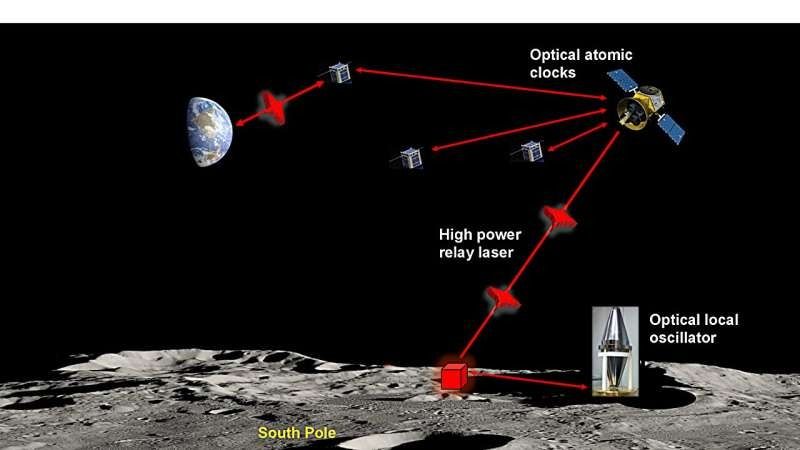
Scientists are proposing to build a laser inside a crater on the Moon to help future lunar missions land safely in darkness and navigate the surface with unprecedented precision. This ultra-stable light source could also revolutionize timekeeping on Earth, they explain in a paper posted on the arXiv preprint server, AzerNEWS reports, citing foreign media.
The Moon is home to many permanently shadowed regions (PSRs) — craters near the lunar poles that never see sunlight. These areas are extremely cold and remarkably quiet, making them ideal for high-precision instruments. On Earth, environmental disturbances such as ground vibrations, air pressure changes, and temperature fluctuations constantly interfere with laser stability. The lunar environment, by contrast, offers an almost pristine laboratory.
A Lunar Laser Master Clock
To take advantage of these conditions, an international team of researchers, including scientists from the National Institute of Standards and Technology (NIST) and NASA's Jet Propulsion Laboratory, has proposed a conceptual lunar-based master clock. The plan involves transporting the necessary materials to the Moon and assembling the laser system inside a permanently shadowed crater.
The proposed system is a cryogenic silicon cavity laser, which uses a block of ultra-pure silicon to maintain perfectly synchronized light waves. For maximum precision, the system needs to be kept at a stable -430°F (-257°C). While lunar craters are frigid, they only reach roughly -350°F (-212°C), so the researchers plan to use passive cooling panels to bring the temperature down further.
The laser works by bouncing light between two mirrors embedded in the silicon block. Because the block remains at an optimal temperature, it neither expands nor contracts, ensuring that the light’s path length remains exactly constant. On Earth, even the slightest environmental noise or thermal expansion would disrupt this precision.
Navigation and Beyond
So how could this system assist astronauts or rovers? The laser would emit a steady signal to a network of satellites orbiting the Moon — effectively creating a lunar GPS system. This could guide explorers in the permanently dark craters where traditional navigation systems fail.
While the project is still conceptual, the researchers argue it could be a major leap forward for both space and terrestrial technologies. “The success of this mission would mark a historic milestone, demonstrating humanity's ability to build fundamental quantum infrastructure on another celestial body, while also supporting a permanent presence on the Moon,” the paper states.
Beyond space exploration, the lunar laser clock could improve timekeeping on Earth. By acting as a reference laser, it could help synchronize atomic clocks worldwide, potentially enabling more precise global communications, navigation, and scientific measurements.
Interestingly, some experts speculate that once operational, this lunar-based system could even contribute to testing fundamental physics, such as tiny variations in the passage of time under different gravitational conditions — a kind of “quantum lab on the Moon.”
Here we are to serve you with news right now. It does not cost much, but worth your attention.
Choose to support open, independent, quality journalism and subscribe on a monthly basis.
By subscribing to our online newspaper, you can have full digital access to all news, analysis, and much more.
You can also follow AzerNEWS on Twitter @AzerNewsAz or Facebook @AzerNewsNewspaper
Thank you!