
NASA set for second complete fueling of SLS rocket
By Alimat Aliyeva
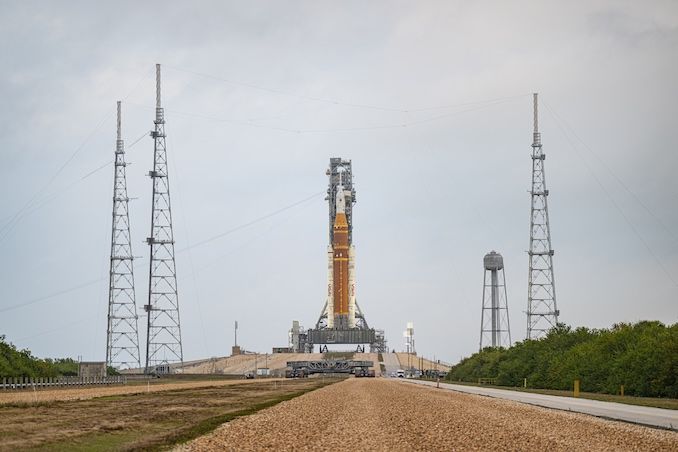
NASA is preparing for a second full fueling attempt of its Space Launch System (SLS) rocket this week, aiming to load more than 700,000 gallons of liquid hydrogen and liquid oxygen as part of a full launch countdown rehearsal, AzerNEWS reports, citing foreign media.
The operation, known as a wet dress rehearsal (WDR), will begin with a call to stations in Firing Room 1 at the Launch Control Center at 6:40 p.m. EST (2340 UTC) on Tuesday, Feb. 17, and will culminate in the actual fueling of the rocket on Thursday, Feb. 19, simulating a T-0 at 8:30 p.m. EST (0130 UTC).
This full-length fueling demonstration follows last week’s “confidence test” on Thursday, Feb. 12. During that test, NASA teams loaded an unspecified amount of liquid hydrogen (LH2) onto the rocket’s core stage to evaluate newly replaced seals in the area used for propellant loading. While the test revealed a new ground equipment issue that reduced the flow of hydrogen into the rocket, NASA confirmed that it gathered valuable data from key objectives, particularly from the core stage interface known as the Tail Service Mast Umbilical (TSMU), which had experienced leaks during the first WDR on Feb. 3.
“The confidence test related to the seals we repaired after WDR-1 provided a wealth of data, and we observed materially lower leak rates compared to the first test,” said NASA Administrator Jared Isaacman on social media. “Nothing broke to prematurely end the test — we simply gathered sufficient information and determined that additional troubleshooting was unnecessary.”
During the first wet dress rehearsal, hydrogen leaks occurred when the team transitioned from a slow-fill to a fast-fill rate on the core stage, forcing multiple pauses. Because hydrogen is highly combustible, NASA strictly limits how concentrated it can be in the air. During WDR-1, the LH2 levels briefly exceeded the 16 percent safety limit, stopping the countdown at T-5 minutes and 15 seconds.
Artemis launch director Charlie Blackwell-Thompson explained that WDR-1 was meant to test three key objectives: holding the rocket in a fully fueled state for up to three minutes, demonstrating the ability to recycle the countdown after a planned cutoff, and performing a handoff to the Automated Launch Sequencer. “We didn’t get a chance to complete those tests on Feb. 3,” she said.
All of these objectives will be attempted again during WDR-2. The plan is to take the countdown to T-1 minute and 30 seconds, hold for up to three minutes, continue through the terminal countdown to T-33 seconds, pause, and then recycle the clock back to T-10 minutes for another run through the terminal sequence.
Like WDR-1, WDR-2 will also involve a demonstration of launch day activities by the closeout crew, even though they will not be physically present at the pad. Initially, NASA had planned to omit this part, but later decided to include it to better simulate real launch procedures.
NASA has emphasized that no formal launch date will be set until the wet dress rehearsal campaign is successfully completed. March 6 remains the earliest potential launch within the window, but officials stress that safety will remain the highest priority.
“There is still a great deal of work ahead to prepare for this historic mission,” Isaacman said. “We will not launch until we are ready, and the safety of our astronauts remains paramount.”
The Artemis SLS mission is not just a technical milestone — it marks the next step toward NASA’s goal of returning humans to the Moon and eventually sending astronauts to Mars. The lessons learned during WDR-2 could influence future missions, potentially improving fueling efficiency, leak detection, and countdown reliability for decades to come.
Here we are to serve you with news right now. It does not cost much, but worth your attention.
Choose to support open, independent, quality journalism and subscribe on a monthly basis.
By subscribing to our online newspaper, you can have full digital access to all news, analysis, and much more.
You can also follow AzerNEWS on Twitter @AzerNewsAz or Facebook @AzerNewsNewspaper
Thank you!