
Astronomers observe new planet-forming system
By Alimat Aliyeva
Astronomers have uncovered a planetary system that challenges conventional theories of planet formation. The system likely includes a rocky planet that formed beyond the orbits of its gaseous neighbors, after most of the material needed for planet formation had already been used, AzerNEWS reports.
The system, observed with the European Space Agency's CHEOPS Space Telescope, consists of two rocky planets and two gaseous planets orbiting a relatively small and dim star known as a "red dwarf." This star, called LHS 1903, is located about 117 light-years away in the direction of the constellation Leo. For reference, a light-year is the distance light travels in a year—roughly 9.5 trillion kilometers.
LHS 1903 has about half the mass of our Sun and emits only about 5% of the Sun’s brightness.
What fascinates scientists is the unusual arrangement of the planets. The planet closest to the star is rocky, followed by two gaseous planets further out. “Traditional models suggest that planets near a star should be small rocky worlds with little or no gas,” explained Thomas Wilson, an astronomer at the University of Warwick in England and lead author of the study published in Science.
He added, “This is because the inner regions of a planetary system are usually too hot for gas or ice to remain. Any primordial atmosphere would be stripped away by stellar radiation. Conversely, planets forming farther from the star in colder regions typically accumulate large gaseous envelopes. This system defies that expectation, presenting a rocky planet beyond its gas-rich neighbors—a configuration we have not seen before.”
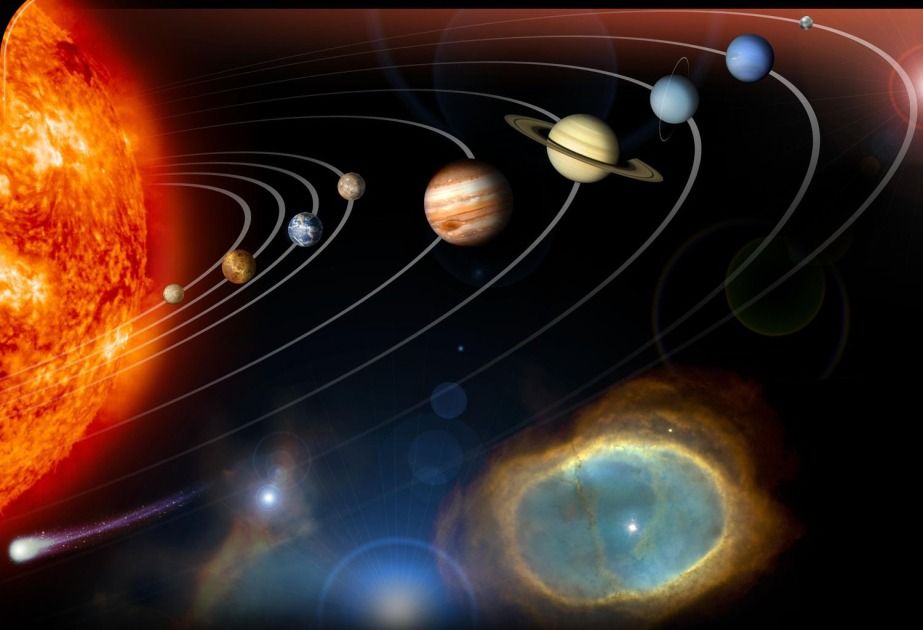
In our Solar System, the inner planets—Mercury, Venus, Earth, and Mars—are rocky, while the outer planets are gaseous giants. Dwarf planets like Pluto, orbiting beyond the gas giants, are small and icy.
Since the 1990s, astronomers have discovered more than 6,100 exoplanets orbiting stars beyond our Solar System. Remarkably, all four planets in this newly discovered system orbit closer to LHS 1903 than Mercury does to the Sun. The outermost planet lies at only about 40% of Mercury’s distance from our Sun, a configuration common around red dwarfs, which tend to have smaller masses than the Sun.
The two rocky planets are classified as super-Earths—rocky worlds roughly ten times the mass of Earth. The two gaseous planets are mini-Neptunes, smaller than Neptune but still larger than Earth.
Researchers suggest the planets may have formed sequentially rather than simultaneously in a large disk of gas and dust around their star. “Did the fourth planet form after the gas ran out, or was it the remnant of a collision that stripped away its atmosphere? The latter scenario might seem unlikely until you consider that the Earth-Moon system formed from just such a giant impact,” said Andrew Cameron, an astronomer at the University of St. Andrews in Scotland and co-author of the study.
Intriguingly, the fourth planet might even be potentially habitable. It has a mass 5.8 times that of Earth, with an average surface temperature of about 60°C—similar to the highest temperature ever recorded on Earth, 57°C. “While extreme by Earth standards, this temperature does not rule out habitability. Future observations with the James Webb Space Telescope could reveal more about its atmosphere and surface conditions, providing insights into whether life could exist there,” Wilson said.
This system not only challenges our understanding of planet formation but also offers a unique opportunity to study planets in configurations previously thought impossible, hinting that our Solar System may not be as typical as once believed.
Here we are to serve you with news right now. It does not cost much, but worth your attention.
Choose to support open, independent, quality journalism and subscribe on a monthly basis.
By subscribing to our online newspaper, you can have full digital access to all news, analysis, and much more.
You can also follow AzerNEWS on Twitter @AzerNewsAz or Facebook @AzerNewsNewspaper
Thank you!