
Astronomers find planetary system thought to be impossible
By Alimat Aliyeva
An exoplanetary system located about 116 light-years from Earth may be reshaping scientists’ understanding of how planets form. It was discovered using data from NASA’s Transiting Exoplanet Survey Satellite (TESS) and the European Space Agency’s CHaracterising ExOPlanet Satellite (Cheops), AzerNEWS reports, citing foreign media.
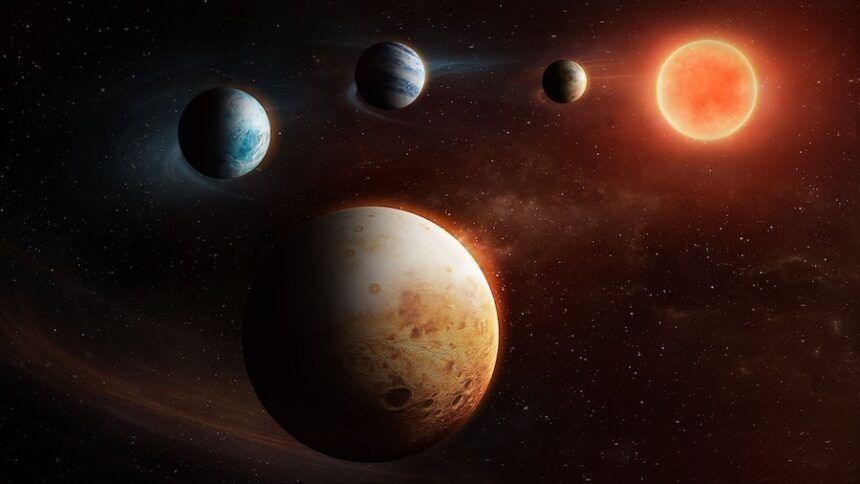
Four planets orbit the red dwarf star LHS 1903 — the most common type of star in the universe. What makes this system unusual is the order of its planets. The innermost planet is rocky, the next two are gas-rich, and the outermost planet is rocky again.
This configuration challenges the standard model of planetary formation, which we observe in our own solar system: rocky planets form close to the star, while gas giants form farther away. The prevailing theory explains this pattern through the structure of the protoplanetary disk. Near the young star, temperatures are extremely high, allowing only heat-resistant materials like iron and silicates to condense into solid bodies — forming rocky planets.
Farther out, beyond the so-called “snow line,” temperatures are low enough for water and other volatile compounds to freeze into ice. These icy materials help planetary cores grow rapidly. Once a core reaches roughly 10 times Earth’s mass, it can gravitationally capture large amounts of hydrogen and helium, leading to the formation of a gas giant.
However, in this system the outermost planet, LHS 1903 e, defies that expectation. With a radius about 1.7 times that of Earth, it is classified as a “super-Earth” and appears to have a rocky composition despite its distant orbit.
Researchers suggest that the planets may have formed sequentially from the inside outward. In this “gas-depleted” formation scenario, the outermost planet formed millions of years after the inner ones. By that time, much of the gas in the protoplanetary disk had already dissipated, preventing it from growing into a gas giant.
What makes this discovery particularly intriguing is that red dwarfs like LHS 1903 are the most abundant stars in our galaxy. If similar “inside-out” formation processes occur elsewhere, planetary systems may be far more diverse than previously thought.
The system also presents exciting opportunities for future study. Observations with the James Webb Space Telescope could analyze the atmosphere of LHS 1903 e, if it has one. Because the planet may be relatively cool, water vapor — or even clouds — could potentially exist there, offering valuable clues about its composition and evolution.
Ultimately, this discovery serves as a reminder that planet formation is more complex than simple textbook models suggest. Each new system we uncover expands our understanding of how worlds are built — and sometimes forces us to rethink the rules entirely.
Here we are to serve you with news right now. It does not cost much, but worth your attention.
Choose to support open, independent, quality journalism and subscribe on a monthly basis.
By subscribing to our online newspaper, you can have full digital access to all news, analysis, and much more.
You can also follow AzerNEWS on Twitter @AzerNewsAz or Facebook @AzerNewsNewspaper
Thank you!