
SpaceX shifts focus to building Moon city
By Alimat Aliyeva
The world’s richest man, Elon Musk, has long said that he founded SpaceX in 2002 primarily to help humanity settle Mars. The company’s website prominently highlights the Red Planet as the ideal target for human exploration and expansion, AzerNEWS reports, citing foreign media.
Until recently, Musk had largely dismissed the Moon as a viable destination. Just 13 months ago, he insisted SpaceX would go “straight to Mars,” calling Earth’s natural satellite “a distraction.”
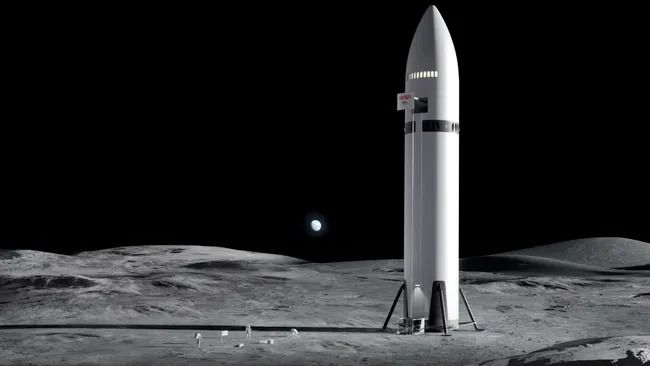
However, over the past weekend, Musk surprised the public by announcing that SpaceX is now focusing on establishing a lunar settlement—at least in the short term.
“For those unaware, SpaceX has shifted its focus to building a self-growing city on the Moon,” Musk wrote on February 8 via X, the social media platform he acquired in 2022. “We could potentially achieve this in under 10 years, whereas a Mars city would take more than 20 years.”
He added: “The mission of SpaceX remains the same: extend consciousness and life as we know it to the stars. Trips to Mars are limited to planetary alignment every 26 months, taking six months each way, while lunar missions can be launched every 10 days with a two-day trip. This allows us to iterate and grow a moon city much faster than a Mars city.”
Musk hinted at this shift last week while outlining SpaceX’s plan to operate a million-strong constellation of data-center satellites in Earth orbit. The Starship, SpaceX’s fully reusable megarocket, will launch all of these satellites—and is central to the company’s lunar ambitions.
“Thanks to in-space propellant transfer, Starship will be able to land massive amounts of cargo on the Moon,” Musk explained. “Once there, we can establish a permanent presence for scientific and manufacturing purposes. Lunar factories could produce satellites and deploy them deeper into space. Using electromagnetic mass drivers and lunar manufacturing, we could send hundreds to thousands of terawatts of AI satellites into deep space, advancing humanity along the Kardashev scale and harnessing a meaningful portion of the Sun’s power.”
(For context, the Kardashev scale classifies civilizations by energy use: Type I harnesses all power on its planet, Type II captures all of its star’s energy, and Type III commands an entire galaxy. Humanity hasn’t reached Type I yet.)
Musk emphasized that the off-Earth data-center plan is a “bonus” element of the Moon-focused strategy. “The priority shift is due to the risk that a natural or manmade disaster could prevent resupply from Earth, causing a colony to fail,” he wrote on February 9. “We can make a self-growing Moon city in under 10 years, while Mars takes 20+ years because of the 26-month alignment cycle. That is what matters most.”
SpaceX has not abandoned Mars. Musk clarified that lunar development will precede but run in parallel with Mars plans. “Mars missions will start in five or six years, but the Moon is the initial focus,” he said, adding that a crewed Mars flight could happen as early as 2031.
SpaceX has been preparing for a crewed lunar mission for roughly five years. In April 2021, NASA selected Starship as the first crewed lander for the Artemis program, which aims to establish a permanent human presence on and around the Moon by around 2030.
If all goes according to plan, Starship will deliver astronauts to the lunar surface on Artemis 3, currently scheduled for 2028—pending the success of Artemis 2, which will orbit the Moon with four astronauts next month.
However, Starship still faces major hurdles. It has flown 11 suborbital test missions, but it has yet to complete an orbital flight or demonstrate off-Earth refueling, essential for lunar missions. Each Moon-bound Starship will require up to a dozen tanker flights to fill its fuel tanks.
Competition also looms. Last fall, then-NASA Acting Administrator Sean Duffy threatened to open SpaceX’s lunar contract to rivals like Blue Origin, though Duffy’s departure may have eased that pressure. Nonetheless, Blue Origin recently paused its suborbital space tourism flights for at least two years to focus on Moon missions, keeping the space race very much alive.
Musk’s pivot to the Moon highlights a subtle but important strategy—learning to build self-sufficient cities quickly in low-gravity environments. By starting on the Moon, humanity could develop the technology, logistics, and economic models needed for eventual Mars colonization, essentially using Earth’s nearest neighbor as a “training ground for interplanetary civilization.”
Here we are to serve you with news right now. It does not cost much, but worth your attention.
Choose to support open, independent, quality journalism and subscribe on a monthly basis.
By subscribing to our online newspaper, you can have full digital access to all news, analysis, and much more.
You can also follow AzerNEWS on Twitter @AzerNewsAz or Facebook @AzerNewsNewspaper
Thank you!