
New comet may soon appear in our skies
by Alimat Aliyeva
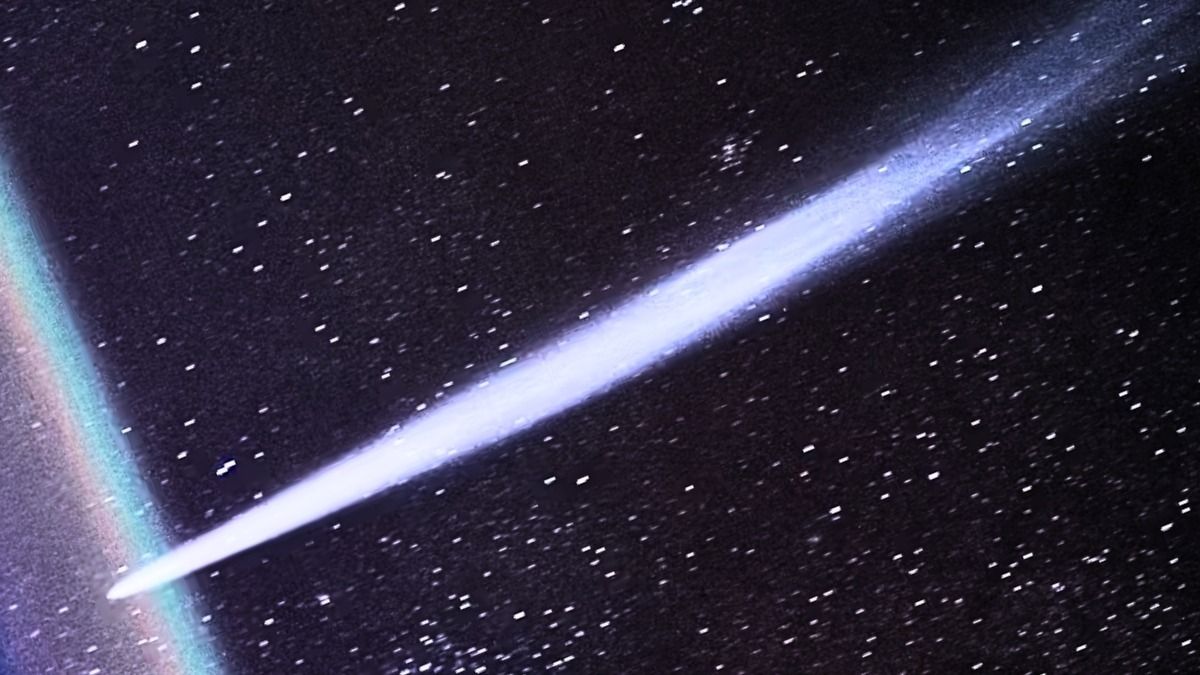
A newly discovered comet has astronomers buzzing with excitement, with the potential to put on a spectacular show in early April, Azernews reports, citing foreign media.
C/2026 A1 (MAPS) was spotted on January 13 by a team of four amateur astronomers using a remotely operated telescope in the Atacama Desert. Early observations revealed that the comet belongs to the Kreutz sungrazing family, a group that has produced some of the brightest and most dramatic comets in recorded history.
Comet MAPS is on a highly elongated orbit around the Sun and is diving toward a fiery encounter with our star. In early April, it is expected to pass just 120,000 km from the Sun’s surface. If it survives this perilous journey, it could become a spectacular sight in the evening sky—or even visible in broad daylight.
Over the past 2,000 years, a series of brilliant comets have graced Earth’s skies, often appearing seemingly from nowhere, shining remarkably close to the Sun. Some became bright enough to be seen during the day.
The brightest comets often earn the title “Great Comets.” For example, C/1965 S1 (Ikeya-Seki), discovered just a month before its closest approach, became as bright as the full Moon. Even more impressive, C/1882 R1 shone a hundred times brighter than the Moon, dazzling observers for months.
Astronomers now know that these dazzling comets are all part of the Kreutz sungrazing family, originating from a massive comet over 100 km across that likely passed near the Sun around the 3rd or 4th century BCE. Over centuries, the original comet fragmented repeatedly, producing smaller comets that have continued to return in long, looping orbits. Some reports suggest that in 363 CE, multiple naked-eye comets were visible at the same time. Later fragments produced the Great Comets of 1106 and 1138, and smaller fragments have appeared regularly in recent centuries.
Today, the Kreutz family contains countless smaller comets, many of which disintegrate before reaching the Sun, as well as rarer larger fragments capable of putting on a dazzling show. NASA’s SOHO spacecraft has observed thousands of these tiny fragments, often just a few meters across. The last large Kreutz sungrazer visible from Earth was discovered in 2011 by Australian astronomer Terry Lovejoy, which became as bright as Venus before barely surviving its close solar pass.
Czech-American astronomer Zdeněk Sekanina predicts that we could see two major sungrazers in the coming decades, with one possibly arriving soon. These would be “siblings” of the Great Comets of 1882 and 1965.
Comet MAPS is following a typical Kreutz orbit and already set a record: at the time of discovery, it was farther from the Sun than any previously discovered sungrazer, suggesting it might be larger than average—or currently in outburst, shedding material. Recent observations indicate the comet is steadily brightening, which supports the idea that it is a reasonably large fragment.
If the comet survives its closest approach (perihelion), it could brighten dramatically, potentially becoming visible even in daylight. If it fragments late, this could create a sudden, spectacular display.
After perihelion, the comet will move into the evening sky, and like most Kreutz comets, it will be easier to see from the Southern Hemisphere. Even if it doesn’t survive intact, instruments like SOHO will capture stunning images.
For now, astronomers and skywatchers alike can do nothing but watch and wait, as Comet MAPS makes its daring journey past our Sun—possibly the next Great Comet in history.
Here we are to serve you with news right now. It does not cost much, but worth your attention.
Choose to support open, independent, quality journalism and subscribe on a monthly basis.
By subscribing to our online newspaper, you can have full digital access to all news, analysis, and much more.
You can also follow AzerNEWS on Twitter @AzerNewsAz or Facebook @AzerNewsNewspaper
Thank you!