
Record-breaking asteroid found by UW astronomers
By Alimat Aliyeva
Astronomers at the University of Washington recently discovered a record-breaking asteroid using early images from the new Vera C. Rubin Observatory in Chile, Azernews reports, citing foreign media.
The team identified the fastest-spinning asteroid of its size ever recorded, a surprising finding captured in some of the very first test images from the telescope.
“We knew the Rubin Observatory was going to break lots of records,” said Sarah Greenstreet, a National Science Foundation astronomer and UW affiliate professor who led the team. “But to do it in some of the very first images taken is truly incredible.”
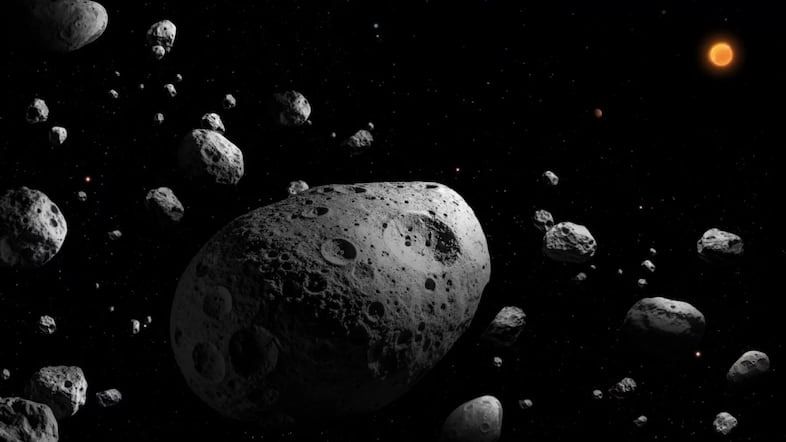
In early January, the researchers published the first peer-reviewed study using key data from the observatory. Greenstreet’s team reported that a large asteroid spins at a record-breaking speed for its size. There is no risk of it hitting Earth - it lies about 200 million miles away in the asteroid belt between Mars and Jupiter. And it’s massive.
“This asteroid, for context, is about the length of eight football fields, or roughly twice the height of the Empire State Building,” Greenstreet said. “It completes one full rotation in less than two minutes. So it’s pretty wild to have such a giant asteroid spinning so rapidly.”
The rapid rotation indicates that the asteroid is made of exceptionally strong material, which prevents it from breaking apart despite its speed. Greenstreet added that the discovery highlights the Rubin Observatory’s potential to explore parts of the asteroid population that were previously out of reach.
“This telescope allows us to see farther than ever before,” she said. “It has the largest digital camera ever built, about the size of a small car.”
UW astronomers and engineers play a crucial role in the Rubin Observatory’s operations, developing software that helps detect moving objects in our solar system.
For the public, the observatory offers citizen science projects, giving people the chance to help scientists analyze data and discover new comets, asteroids, and other celestial bodies.
The discovery of this asteroid could also help scientists understand how fast-rotating asteroids survive extreme conditions, offering clues about the formation of the solar system and the materials that make up these rocky bodies.
Here we are to serve you with news right now. It does not cost much, but worth your attention.
Choose to support open, independent, quality journalism and subscribe on a monthly basis.
By subscribing to our online newspaper, you can have full digital access to all news, analysis, and much more.
You can also follow AzerNEWS on Twitter @AzerNewsAz or Facebook @AzerNewsNewspaper
Thank you!