
Most distant galaxy seen just 280 million years after Big Bang
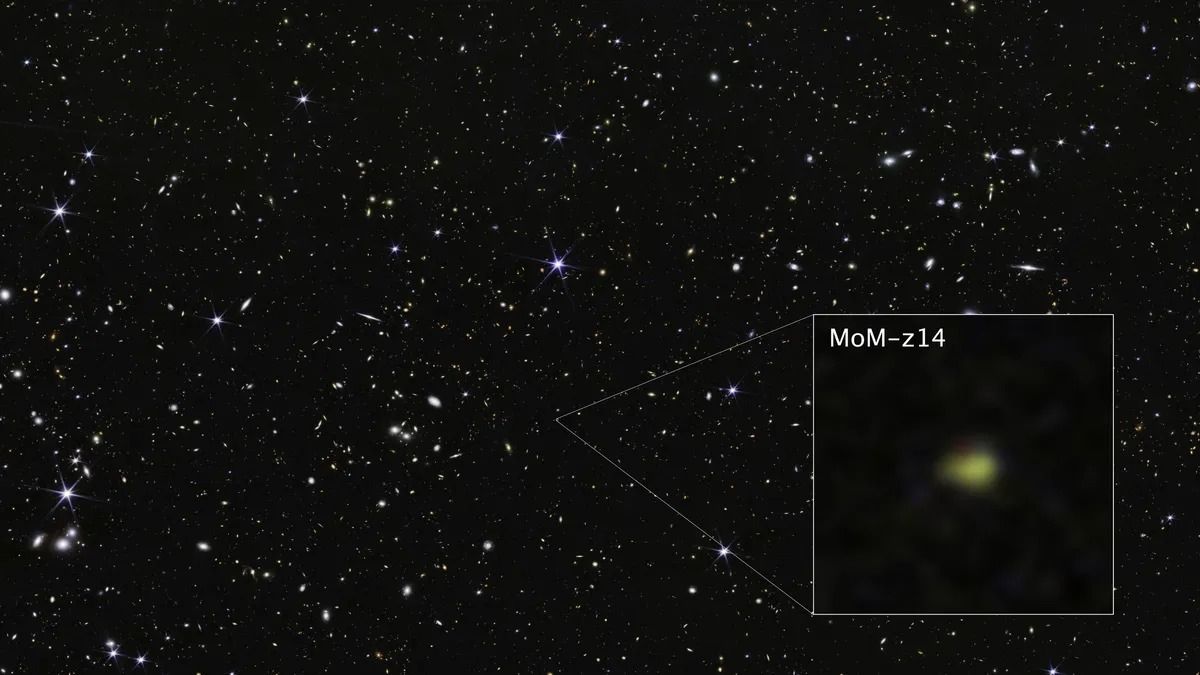
We are seeing farther into the universe than ever before. The James Webb Space Telescope (JWST) has peered across incredible distances, revealing galaxies whose light has traveled billions of years to reach us. The most distant galaxy known today is MoM-z14, Azernews reports, citing foreign media.
The name “MoM” stands for “Mirage or Miracle”, from the survey of the same name. The goal of the MoM survey is to confirm whether objects that appear extremely distant truly exist or are just optical illusions. The light from MoM-z14 comes from only 280 million years after the Big Bang—a time when models predicted that galaxies were only just beginning to form.
The discovery of MoM-z14 and other unexpectedly bright galaxies in the early universe challenges these models. These galaxies are about 100 times brighter than theoretical predictions, suggesting they were incredibly active and evolving much faster than expected.
“There is a growing gap between theory and observation in the early universe, which raises compelling questions for future research,” said Jacob Shen, a postdoctoral researcher at MIT.
A particularly intriguing aspect of MoM-z14 is the presence of nitrogen, in amounts greater than should have been possible at that time. This hints that conditions in the early universe may have been very different from what we thought, and that to understand these distant stars, we might need to study unusual stars in our own galaxy.
MoM-z14 also shows signs of clearing the thick fog of neutral hydrogen expected to fill the universe at that time. The intense light from its stars ionizes hydrogen, ripping electrons from atoms. Since hydrogen initially formed without free electrons, and this process had only occurred once before, this era is known as the epoch of reionization. Studying galaxies from this period provides crucial clues about this mysterious phase in cosmic history.
Finding such galaxies is challenging, which is why surveys like MoM are so important. Due to the expansion of the universe, the light from these galaxies is stretched to longer wavelengths, making them appear redder. However, redness can also be caused by other factors, so candidates must be followed up with spectroscopy to precisely determine their redshift and distance.
“We can estimate distances from images, but it’s crucial to confirm them with spectroscopy so we know exactly what we are observing and when it existed,” added Pascal Oesch from the University of Geneva, co-principal investigator of the survey.
Interestingly, the discovery of these bright early galaxies could force us to rethink how the first galaxies formed and evolved. They may have grown and matured far more quickly than current models suggest, opening the door to new theories about the universe’s earliest days.
The study is set to be published in the Open Journal of Astrophysics, with a preprint currently available on arXiv.
Here we are to serve you with news right now. It does not cost much, but worth your attention.
Choose to support open, independent, quality journalism and subscribe on a monthly basis.
By subscribing to our online newspaper, you can have full digital access to all news, analysis, and much more.
You can also follow AzerNEWS on Twitter @AzerNewsAz or Facebook @AzerNewsNewspaper
Thank you!