
ASELSAN deploys advanced air traffic control radar at Damascus airport
By News Centre
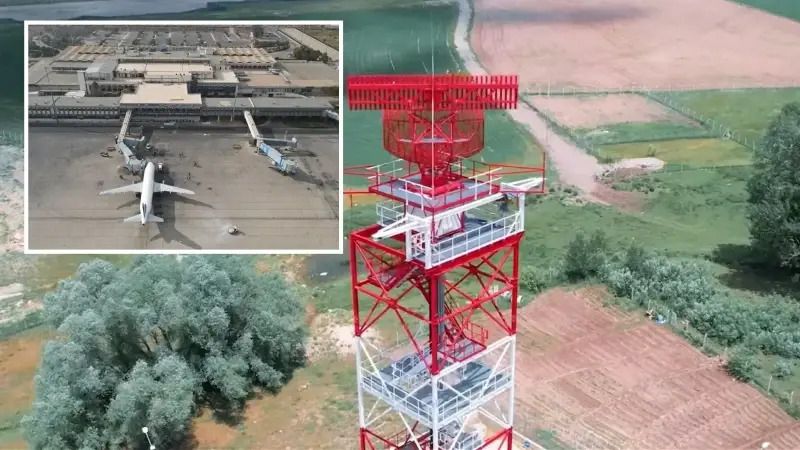
ASELSAN, one of Türkiye’s leading companies in the defense and advanced technology sectors, has signed a strategic project to strengthen Syria’s aviation infrastructure. The HTRS-100 Air Traffic Control Radar System, developed by ASELSAN, has been put into operation at Damascus International Airport, contributing to the safer management of air traffic.
Türkiye’s Embassy in Damascus and Ambassador Nuh Yılmaz shared information on social media regarding a site visit to Damascus International Airport and the installation works of the Turkish-supplied system.
The HTRS-100 Air Traffic Control Radar System, produced by ASELSAN, enables the precise detection and tracking of all aerial targets in the vicinity of airports. Integrated with state-of-the-art technologies, the system is designed to ensure maximum reliability and performance.
One of the system’s core components, the Primary Surveillance Radar (PSR), operates in the S-band and employs advanced and innovative clutter suppression and target tracking algorithms, ensuring clear and reliable detection even in the most challenging environments. The Secondary Surveillance Radar enhances aircraft tracking capabilities through Identification Friend or Foe (IFF) interrogation and supports multiple interrogation modes for versatile operations.
The HTRS-100’s most distinguishing feature is its “distributed active hot-redundant” architecture, a capability found in only a limited number of systems worldwide. Unlike conventional radars, this matrix-based design allows the system to continue operating even if a component fails, ensuring uninterrupted performance and preventing disruptions to flight traffic during critical, time-sensitive moments.
To counter adverse weather conditions and interference—among the greatest challenges in aviation—the system employs intelligent algorithms. Advanced noise suppression techniques enable clear target tracking even during storms or heavy rainfall.
The radar system also features a dedicated weather channel that monitors atmospheric conditions in real time, enhancing overall flight safety. In addition, specialized algorithms capable of distinguishing wind turbines and bird flocks from aircraft further improve operational security.
Demonstrating its durability, the system boasts a mean time between critical failures exceeding 40,000 hours, while its repair time of under 30 minutes minimizes operational downtime during maintenance.
The radar’s operational range can be configured to 80 or 100 nautical miles (approximately 185 kilometers).
Here we are to serve you with news right now. It does not cost much, but worth your attention.
Choose to support open, independent, quality journalism and subscribe on a monthly basis.
By subscribing to our online newspaper, you can have full digital access to all news, analysis, and much more.
You can also follow AzerNEWS on Twitter @AzerNewsAz or Facebook @AzerNewsNewspaper
Thank you!