
China opens robotics school for humanoid training
By Alimat Aliyeva
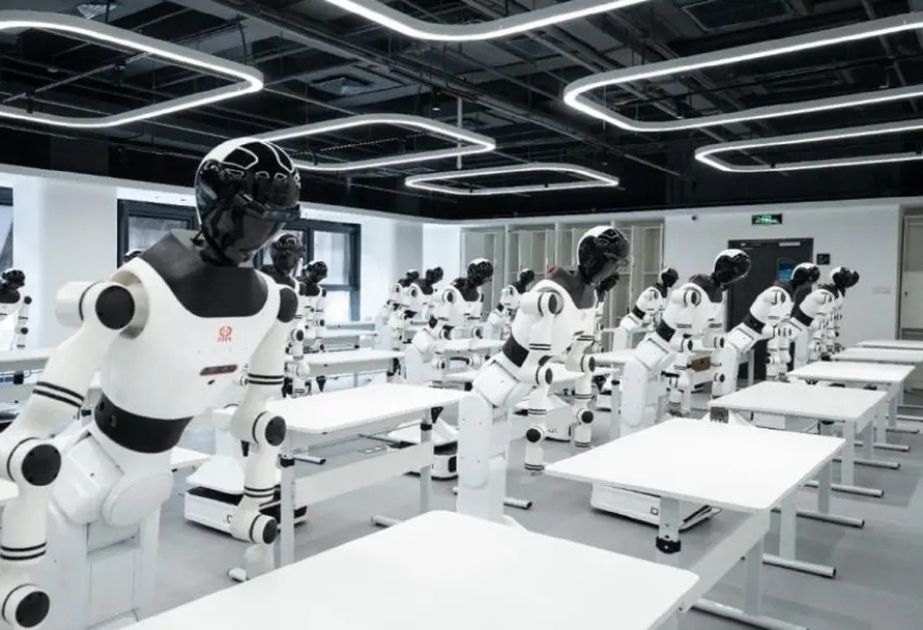
An unusual new school has opened in China, designed to train humanoid robots to perform a wide range of tasks—from working in factories to assisting in homes and public spaces, Azernews reports.
The Beijing Humanoid Robot Training Center (second phase) is located in Shijingshan District. The two-story complex replicates real production lines and living environments to provide robots with practical, hands-on training.
Inside, humanoid robots carry out everyday activities, simulating both industrial and domestic scenarios. Tasks include sorting rolls, packing parcels, cooking, and even organizing bedroom spaces.
Each training area, known as a “cell,” has a modular structure that can be frequently reconfigured, allowing instructors to quickly adapt scenarios to different operational needs.
The center is home to Kuafu, a 165 cm tall humanoid robot named after a giant from Chinese mythology. Developed by Leju Robotics in Shenzhen, Kuafu is also promoted as the world’s first humanoid 5G-A torchbearer.
According to Zhu Kai, head of the training center, each robot is paired with two human instructors. “Just as children need repeated training to learn to walk, robots must undergo intensive practice in diverse environments to develop functional intelligence,” Zhu explained.
The training program aims to tackle one of the major challenges in robotics: the lack of real-world data, which limits the development of advanced AI models. “Without large amounts of standardized data, humanoid robots struggle to generalize skills across different environments,” Zhu said. The center is expected to generate millions of high-quality data points annually and is connected to similar facilities in Suzhou, Jinan, Hefei, and Zhengzhou.
Zhu emphasized that learning requires precision and patience. In one smart home simulation, two instructors worked side by side, teaching the robot protective packaging techniques. To ensure consistency, the instructors switched roles every few hours.
Robots at the center can focus on a “core” area from four main categories: industrial production, smart home applications, elderly care services, and 5G integration scenarios. Experts believe that the center could accelerate the development of humanoid robots capable of performing complex, real-world tasks and potentially transform industries ranging from manufacturing to healthcare.
Here we are to serve you with news right now. It does not cost much, but worth your attention.
Choose to support open, independent, quality journalism and subscribe on a monthly basis.
By subscribing to our online newspaper, you can have full digital access to all news, analysis, and much more.
You can also follow AzerNEWS on Twitter @AzerNewsAz or Facebook @AzerNewsNewspaper
Thank you!