
U.S. says Nagorno-Karabakh conflict remains 'potential flashpoint' (UPDATE)
By Sara Rajabova
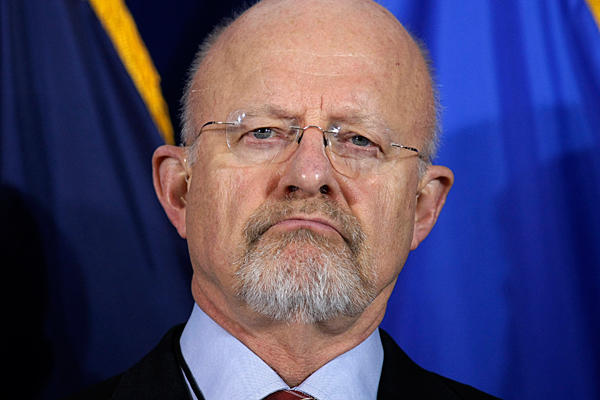
The standoff between Armenia and Azerbaijan over the Armenian-occupied Nagorno-Karabakh region remains a potential flashpoint, US Director of National Intelligence James Clapper has said in a report.
"Heightened rhetoric, distrust on both sides, and recurring violence along the Line of Contact [between the Armenian and Azerbaijani troops] increase the risk of miscalculations that could escalate the situation with little warning," says the Worldwide Threat Assessment report, which was submitted to Congress.
The two South Caucasus countries for over two decades have been locked in conflict, which emerged over Armenian territorial claims. Since the lengthy war in the early 1990s that displaced over one million Azerbaijanis, Armenian armed forces have occupied over 20 percent of Azerbaijan's internationally recognized territory, including Nagorno-Karabakh and seven adjacent regions. The UN Security Council has adopted four resolutions on Armenia's withdrawal from the Azerbaijani territory, but Armenia has not followed them to this day.
A precarious cease-fire was signed in 1994. However, units of the Armenian armed forces commit the armistice breaches on the frontline almost every day.
Director of the Institute for Political Studies in Russia, Sergey Markov, told Azerbaijan's Trend news agency that the balance of power in the Nagorno-Karabakh conflict has changed dramatically in favor of Azerbaijan.
"At present, the balance of powers between Armenia and Azerbaijan in the Nagorno-Karabakh conflict is not like [it was] 15 years ago. Since then, the balance of power has changed very much and Azerbaijan became significantly more powerful than Armenia," Markov said.
According to him, a military solution of the conflict could destabilize the Azerbaijani economy.
"So, the economy of Azerbaijan is a tool through which the country is constantly changing the balance of power in its favor," he noted.
According to the analyst, hypothetically, a military solution of the Nagorno-Karabakh problem is possible, but practically "it undermines itself".
"In a peaceful solution of the problem have been involved the U.S. and France where the Armenian diaspora has a very strong influence. So it turns out that a peaceful resolution is also hard. Therefore, Azerbaijan must find a non-trivial combination," Markov believes.
The expert said further that Russia is in favor of gradual establishing of humanitarian and economic relations between Azerbaijan and Armenia.
"We are ready to assist in this. But there is a need not only for the help of Russia, the mediation of the U.S. and the EU is important too. Our goal is to prevent military action. Besides, the conflict should not remain protracted and the normalization of the situation in the problem settlement process should go in the positive direction," Markov noted.
Though the fragile ceasefire has been in place since 1994, a peace accord has never been signed and the dispute remains unresolved. Mediators from Russia, France and the U.S. -- co-chairs of the OSCE Minsk Group -- have been brokering peace talks over the Nagorno-Karabakh conflict, but their efforts have not produced any result yet.
Peace negotiations are underway on the basis of a peace outline proposed by the Minsk Group co-chairs and dubbed the Madrid Principles, also known as Basic Principles. The document envisions a return of the territories surrounding Nagorno-Karabakh to Azerbaijani control; determining the final legal status of Nagorno-Karabakh; a corridor linking Armenia to the region; and the right of all internally displaced persons to return home.
Here we are to serve you with news right now. It does not cost much, but worth your attention.
Choose to support open, independent, quality journalism and subscribe on a monthly basis.
By subscribing to our online newspaper, you can have full digital access to all news, analysis, and much more.
You can also follow AzerNEWS on Twitter @AzerNewsAz or Facebook @AzerNewsNewspaper
Thank you!