
President Ilham Aliyev receives delegation of the U.S. Chamber of Commerce [PHOTOS/VIDEO]
![President Ilham Aliyev receives delegation of the U.S. Chamber of Commerce [PHOTOS/VIDEO]](https://www.azernews.az/media/2026/02/09/17706240282725537477_1200x630.jpg)
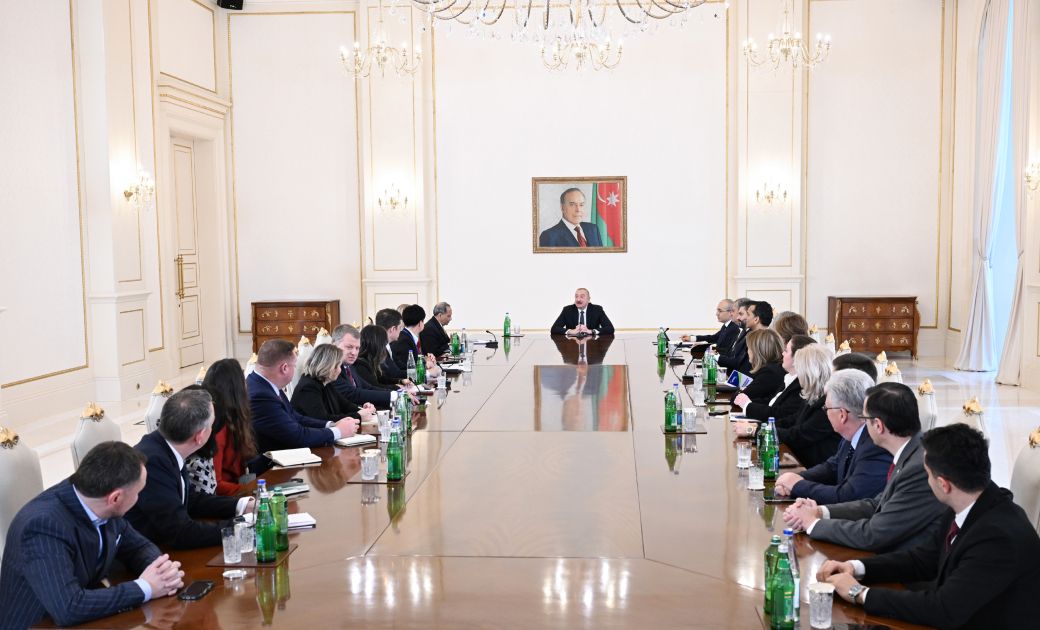
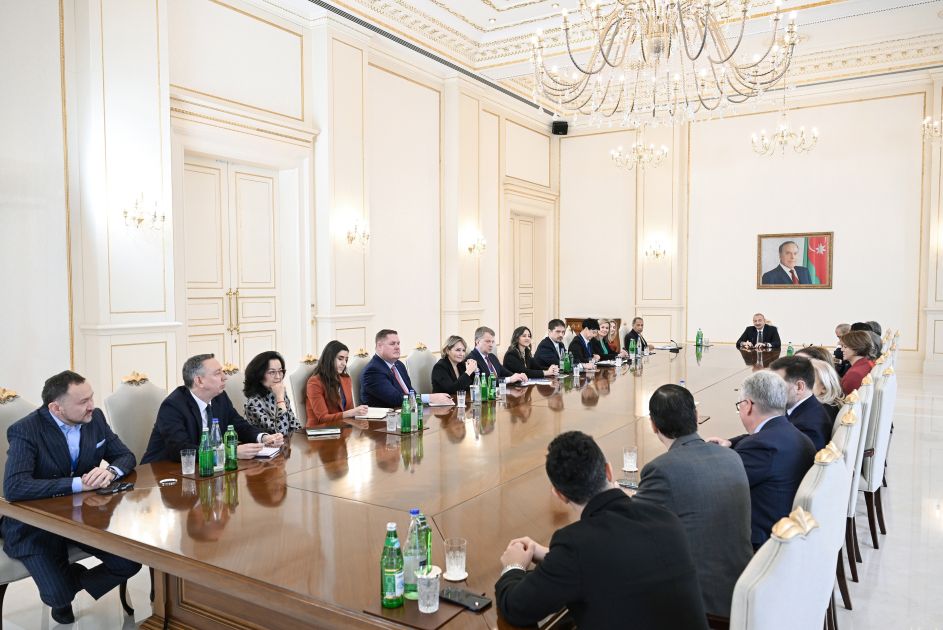
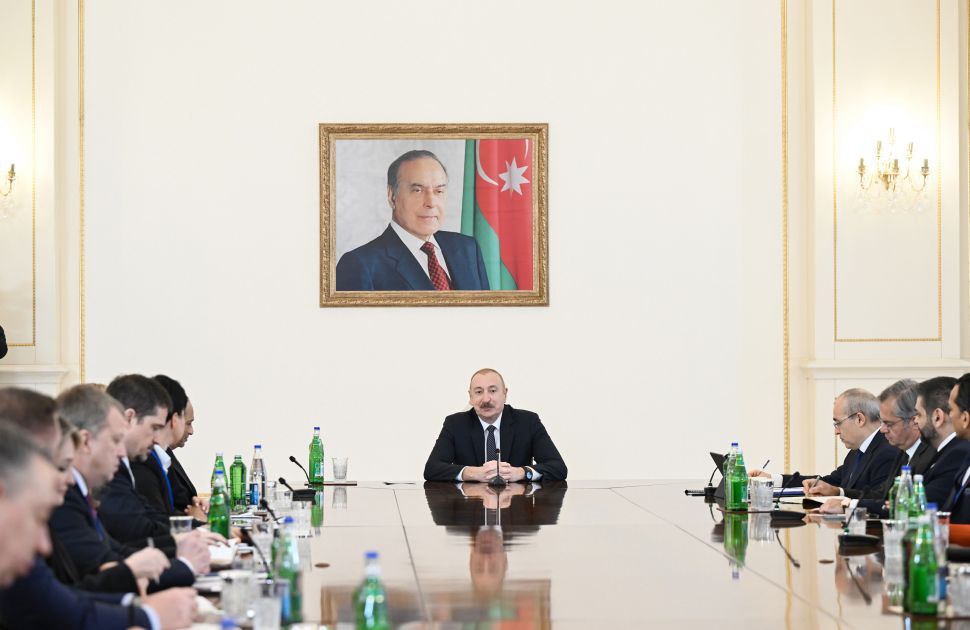
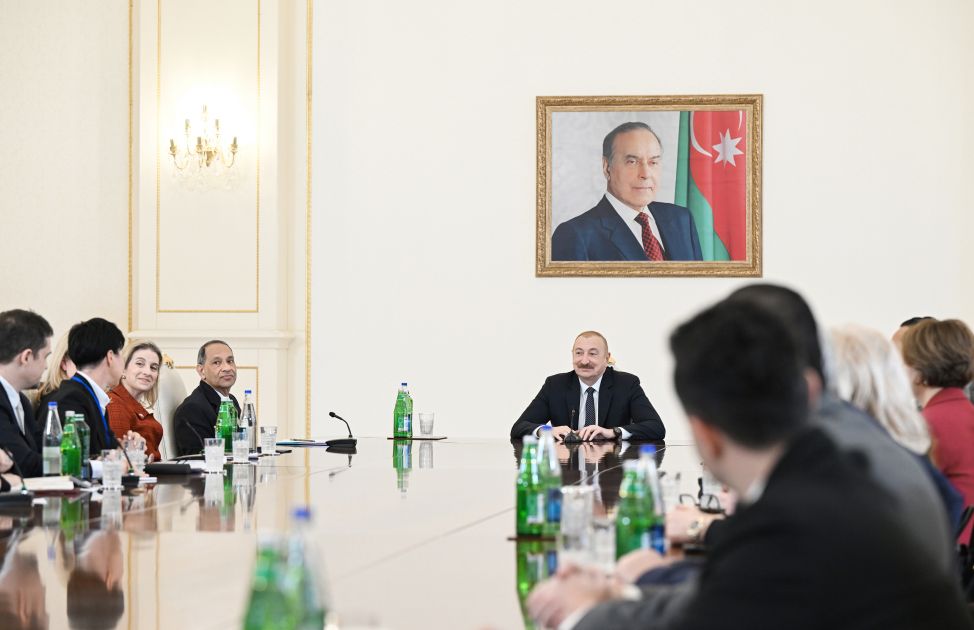
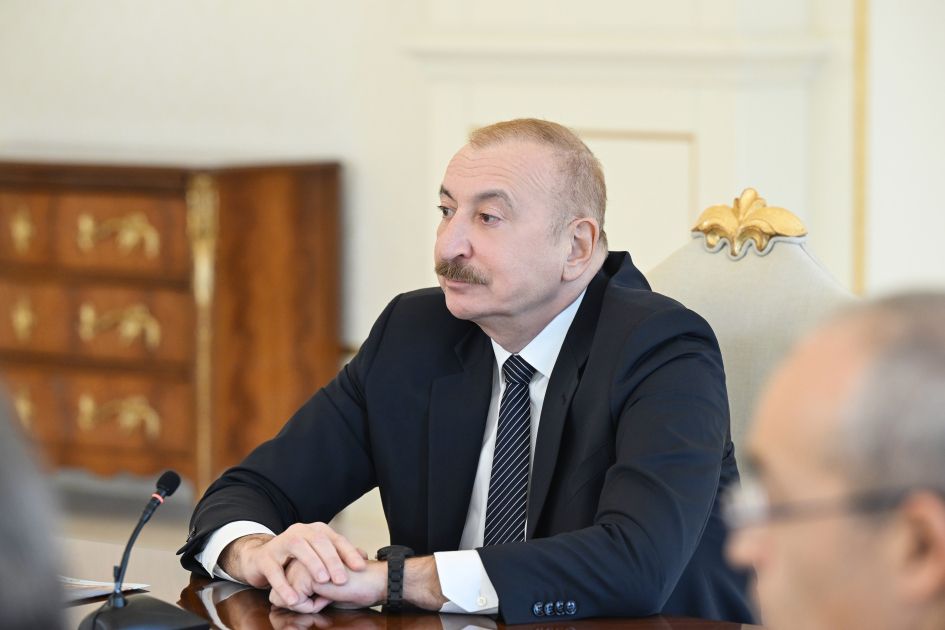
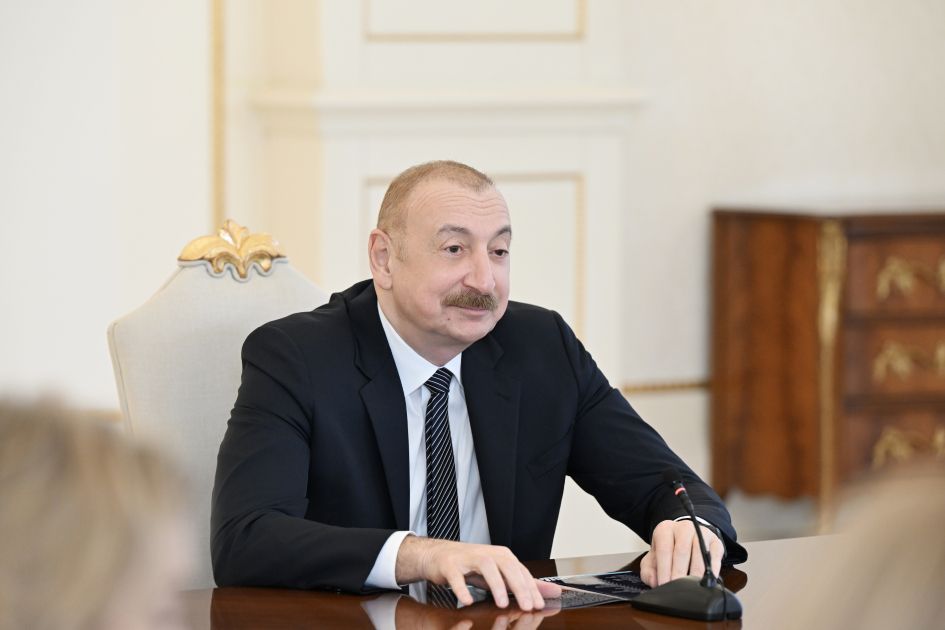
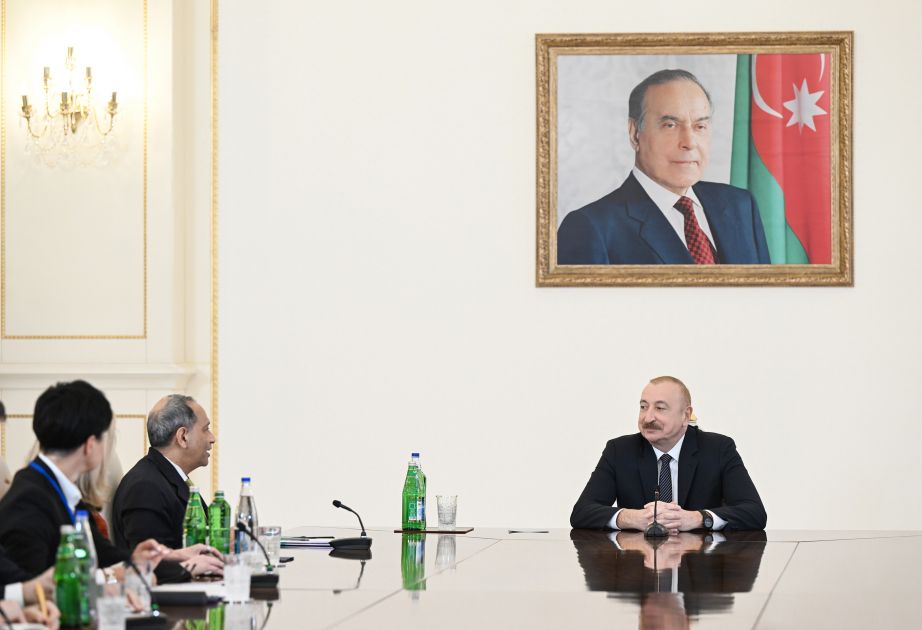
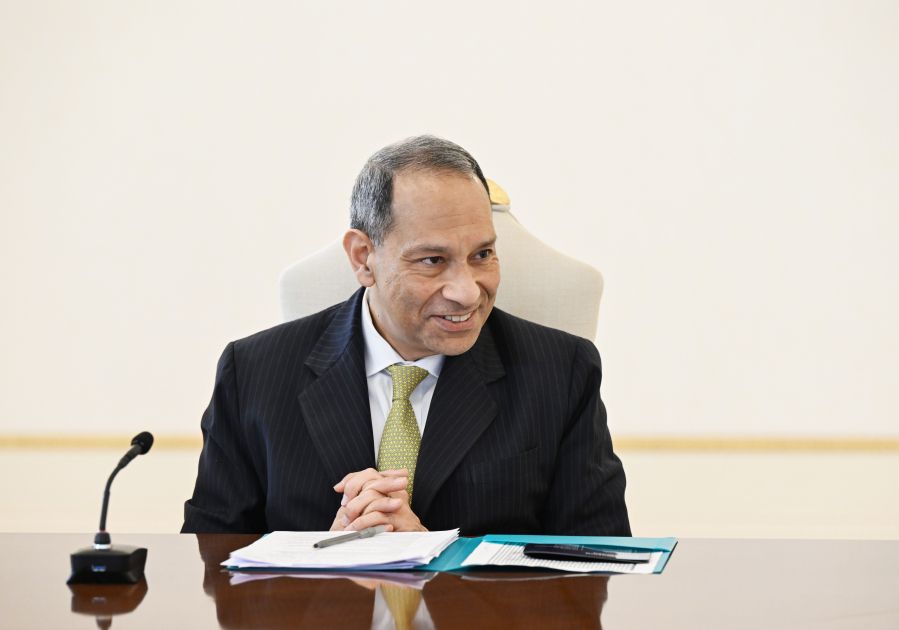
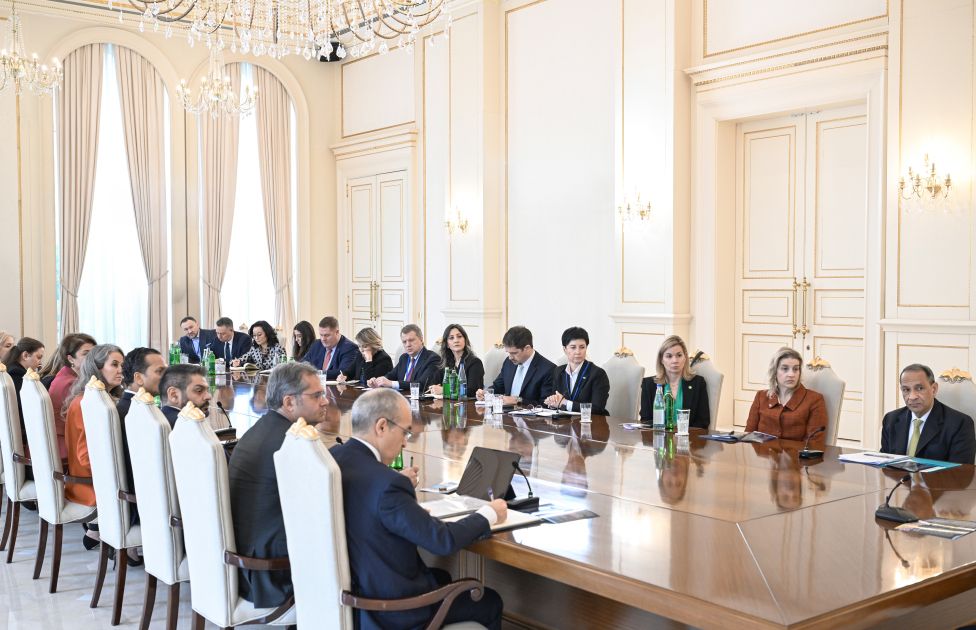
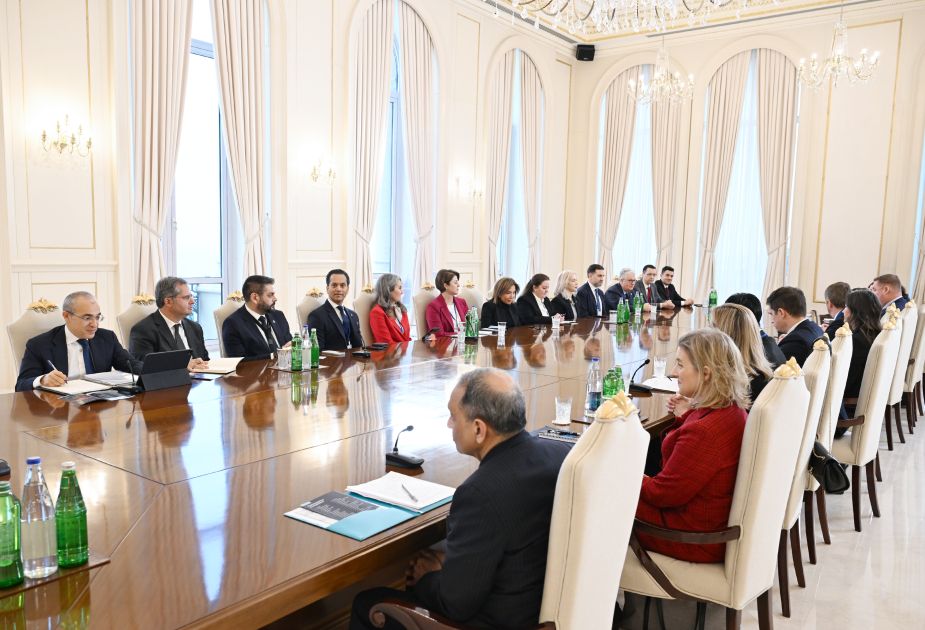
President of the Republic of Azerbaijan Ilham Aliyev received a delegation from the U.S. Chamber of Commerce on February 9, led by Khush Choksy, Senior Vice President, International Member Relations & Senior Vice President, Middle East & Türkiye.
The delegation includes Jennifer Miel, Vice President of Middle East, Central Asia, and Türkiye at the US Chamber of Commerce, as well as senior representatives from companies such as Apple, Ardea Energy Technologies Inc., Ericsson AB, ExxonMobil, Herbalife, Illumina, Meta, Visa, Wabtec, Baker Hughes, bp, Boeing Global, Honeywell, J.P. Morgan, Lummus Technology, Marriott, Mastercard, Shell International, Azerbaijan Coca-Cola Bottlers LLC, and Motorola Solutions.
Welcoming the guests, President Ilham Aliyev said: “Good morning, welcome. It is very good to see you. I am glad that you are visiting us. This is a big delegation. I remember our meeting a couple of months ago, and I am glad that you accepted my invitation and are visiting Azerbaijan at this important time of the active development of relations between our countries.
As you know, we are now entering a new phase of bilateral ties, which is very promising and very active. Of course, your visit ahead of the visit of the Vice President is also of great importance, because part of our interaction is focused on business, investments, trade relations, and many other areas, which are part of our strategic agenda.
I know that you will have many meetings with different government officials, and I am sure they will answer all your questions. As a result of this mission, I think we will see more active interaction across different tracks. I know that you represent different segments of the U.S. economy, and that will be very useful, because so far our economic relations are not at the level we would like to see.
So, once again, welcome, and I wish you a pleasant stay. I also know that many of you are visiting us for the first time - probably the absolute majority - so this will also be a good opportunity to learn more about Azerbaijan. Welcome.”
Khush Choksy: Your Excellency, it is a great pleasure to be here. It was truly a pleasure to meet with you on the sidelines of the UN General Assembly, where you asked us to bring a large business delegation. Thanks to your Ambassador to the United States, the Ministry of Economy, AZPROMO, and our colleagues at the U.S. Embassy here, representatives of 31 companies have come to Azerbaijan. Some of them are here, but the delegation itself is larger than this. We have 60 representatives from 31 companies, so it is even bigger than those seated at this table. We are truly pleased to be here. Typically, business relations move faster than political relations. But here, the political relationship has advanced faster than the business relationship, which is unusual. However, companies will work fast and will catch up quickly. This is truly a testament to your leadership and that of your government. As you can see, Your Excellency, the participating companies represent many different sectors.
President Ilham Aliyev: Yes, I noticed that.
Khush Choksy: It includes energy, technology, food and beverages, as well as mobility and transportation. We just wanted to thank you for that, Your Excellency.
x x x
The guests first expressed their gratitude to the head of state for the reception. Numerous representatives of prominent companies, highlighting their pleasure at visiting Azerbaijan, conveyed their intention to expand cooperation with the country. They also shared information about the activities of their respective companies and the collaboration they have undertaken with Azerbaijan.
x x x
Khush Choksy: Your Excellency, thank you very much. We would like to invite you to Washington to meet with an even larger delegation representing the business community. There is great interest in Azerbaijan. I believe it all began two years ago at COP, which was a very successful event, and as you mentioned, this COP highlighted the importance of both the oil the world needs - traditional energy - and new energy sources. Today, representatives of companies from all sectors - including major and emerging sectors - are gathered here. Since then, we have clearly seen a lot of interest in Azerbaijan. Your ministers are always welcome to visit. The more opportunities there are for interaction, the more American companies will understand and seize the opportunities available in Azerbaijan. Next time you are in New York - I know how busy you are, but we will plan ahead - we would like to ask for your assistance in organizing a roundtable for us during your visit. Perhaps you could arrive a day earlier in New York, even on Sunday. We want to hear your views and insights regarding the companies.
President Ilham Aliyev: Thank you. Thank you very much for this invitation. And once again, thank you for being with us. I looked at the list of companies visiting us, and also at your comments, and I see that with many of these companies, we have had very fruitful cooperation for many years. Some of them are new, and this is absolutely natural. First, Azerbaijan has been very open to international partnerships since the early years of its independence and established good contacts with many international companies, including U.S. companies. Therefore, it is natural that the names of the companies are very familiar to me.
On the other hand, at this stage of active development of U.S.-Azerbaijan relations, generated by my meeting with President Trump last August in Washington, it is natural that we will broaden the range of areas in which we cooperate. Last August, with President Trump, we signed a document to elaborate a Charter of Strategic Partnership between Azerbaijan and the United States, with specific items. Since that time, I have sent four governmental delegations to Washington to address issues of trade, economy, investment, energy, AI, defense industry cooperation, and other areas. There have been numerous interactions between governmental officials, including my last meeting with President Trump last month in Davos. Though his schedule was very tight and he was there for a very short period of time, having a meeting with the President of Azerbaijan once again demonstrates to our communities and to the whole region how important relations are between us and how friendly these relations are.
So, along with the traditional areas of cooperation, such as energy, trade, and investments, we are now working on very important areas related to digital transformation and AI, and we hope that American companies will be our main partners. We have already established good contacts, and, by the way, you also commented on that during the visit of one of our governmental delegations. There was an extensive meeting with communication companies, AI companies, and companies involved in the creation of data centers. This is now one of our priorities, and I think we have a lot of advantages.
First, our geographical location. Second, the existing communication infrastructure, which was implemented in not very easy times, including oil and gas pipelines, railroads, and electric cables. Then, one of the most important issues is that we have a lot of electric energy which we do not use, do not consume, and have not exported so far. Currently, about two gigawatts of power generation are available. In the broader region where Azerbaijan is situated, we are the only country that does not depend on imports of any kind of energy sources. We are self-sufficient in oil, gas, oil products, petrochemicals, and electric energy, and we export all of these. Thus, alongside growing exports - which will be very helpful to many countries - this is our goal. By the way, today we export natural gas through pipelines to 16 countries and are number one in the world in terms of pipeline gas coverage. But along with that, we want to use our energy potential to attract leading American companies from around the world as partners in AI and digital transformation. Regarding fossil fuels, which for many years were discriminated due to certain political agendas, we are glad that President Trump’s policy, as in every other area, is based on a realistic approach, far from populism, and grounded in the actual situation on the ground. The world cannot live without fossil fuels, and countries that are rich in fossil fuels should not be blamed for that. You mentioned COP - one of my messages as a host country of COP was that we should not be blamed for having oil and gas.
Also, I said that many countries have held COPs, and those countries produce ten times more oil and gas than Azerbaijan, yet they were not the subject of media attacks. My message was that countries should be judged by how they use the revenues from hydrocarbon exports, and here in Azerbaijan, everyone can see that wealth distribution is carried out in a very fair way. Secondly, what is their contribution to addressing climate issues? In our case, when we have natural gas reserves sufficient for at least 100 years—not only for domestic consumption but also for export—investing in and attracting investments in renewables really demonstrates our responsibility.
As I said, two gigawatts of energy already exist, and by 2032, based on the signed contracts—not MOUs—we will have an additional seven to eight gigawatts of solar and wind energy. All of this will be available for domestic consumption, supporting a growing economy, expanding industry, and our goal of becoming one of the global hubs for AI and data centers. Additionally, it will help many countries currently suffering from a lack of reliable electricity and gas supply. One of the projects we are now working on is the construction of new transmission lines, in addition to the existing ones, from Azerbaijan to Europe - through the Black Sea via a Black Sea cable - and also through TRIPP, the project initiated by President Trump that bears his name, called the Trump Route for International Peace and Prosperity, which became possible after peace was reached between Azerbaijan and Armenia.
So we consider connectivity also as one of the important areas of our concentration. So far, a lot has been done in order to bring our transportation and logistics infrastructure to the appropriate level. Our seaport now can handle 15 million tonnes, and expansion will lead to a capacity of 25 million. Our railroads are being modernized. The new one is being built, which will go through Armenia, and then will transform into another extension of the Middle Corridor. Nine international airports, one of the biggest in the region, maybe the biggest air cargo company—all that is already an asset.
If we add the interest which is now growing towards connectivity, especially between Azerbaijan and Central Asia, and Azerbaijan and Europe, we are most probably one of, or the only, country which can bring the countries together, taking into account our experience in building pipelines. To build a pipeline is difficult; it's costly, and in our geography, when you have to go through mountains and then go on the seabed, it is really a big challenge. Plus, when you build a pipeline, especially one with a length of 3,500 kilometres, which goes through several countries, starting in the Caspian and ending in Italy, you have to have relations—good relations—with all with whom you work. So this experience only we have in this broader region. It's not because I am saying good things about Azerbaijan, but this is a reality.
In projects which unite many countries, you have to have diplomacy, skills, experience, and already results. So in our case, we have all of them. So I'm sure that the result of your mission will soon be implemented in practical projects. Of course, members of the government whom you will meet will give you more detailed information about what our plans are and what is already in the pipeline. And I think that these kinds of missions should take place regularly. I'm ready to be with you when I visit America again. And also, I ask you to come at least once a year here, just to have an update and to see what else we can do.
x x x
Mary Streett, bp’s Senior Vice President of U.S. Communications and External Affairs, highlighted the long-standing successful partnership between BP and Azerbaijan. She touched upon the positive investment environment in Azerbaijan and emphasized the importance of developing local personnel. “It is not only about the positive investment climate but also about the workforce. For this, I am grateful,” the guest said, noting that they intend to continue their strong partnership with the country.
x x x
President Ilham Aliyev, in turn, highlighted the cooperation between Azerbaijan and BP, saying: “Thank you very much. We highly value this partnership, which you mentioned has already lasted 30-plus years. For us, it was instrumental in transformation. When bp and Azerbaijan started joint activity back in 1994, Azerbaijan was a country with serious problems. At that time, a million people were homeless, deported, or ethnically cleansed from Azerbaijan as a result of Armenian aggression. We had zero money in our budget. We had electricity shortages, a lack of electricity, and even oil production was rapidly declining, with very low prospects for success. So attracting investments from international oil companies, mainly bp and others, was the only way for us to survive and to build a state. bp and other companies’ trust in us was instrumental, and we will never forget that. Since that time, for more than 30 years, there has never been any disagreement, any kind of legal case—nothing. This is really a good example of cooperation between a host country and major energy companies.
Now cooperation is transforming into renewables. bp is now involved in the creation of a 240-megawatt solar power plant in the city of Jabrayil, which until 2020 was under occupation. Decarbonization of the biggest oil and gas terminal in Sangachal is also a big contribution on behalf of bp to the green agenda. Many other plans, both existing and new projects, include an increase in gas production, which we hopefully will see this year from the ACG Deepwater project, and also the stabilization of oil production, which is important for all of us. With all the energy companies we have worked with and continue to work with very efficiently, we have established very good relations. I think that is why, despite the fact that oil production is, due to objective reasons, going down, interest in investments in Azerbaijan remains very high.
I see the representatives of Exxon, a company which was also one of the first to join investment projects in Azerbaijan, and now is working on a new project, hopefully with good results. During my visit to Washington last August, an MOU was signed on a very promising and very attractive project. If successful, we hope that it will give us additional opportunities to develop our oil industry, and at the same time will give us an additional chance to invest, as we always did, the money we receive from oil sales into the non-oil economy.
By the way, this is one of the targets we set for ourselves to diversify the economy. We see good results. I just looked at the January data, the statistics for this January. Our non-oil and gas-related industry grew almost 8%. This is due to this diversification. So contracts and cooperation on traditional energy sources give us a chance to accumulate funds and to reinvest.”
x x x
Cristina Doros, Senior Vice President and Group Country Manager for Visa CISSEE, noted that the company has maintained effective cooperation with local banks for 30 years. She emphasized that Visa is implementing projects in Azerbaijan aimed at developing an advanced, secure, and inclusive payment system. Doros also expressed her gratitude for the cooperation and partnership with the Azerbaijani government on initiatives aligned with national priorities under the framework of the “Azerbaijan 2030” Strategy.
x x x
President Ilham Aliyev, thanking Visa for the cooperation and touching on the prospects of the relationship, said: “I received information from our governmental agencies about very fruitful cooperation with Visa, and we are very happy about that. Of course, you work here with different partners: the Ministry of Economy, the Central Bank, the Ministry of Digital Transformation and Transportation, and many others. You know our agenda, our plans, and what is being done here. Definitely, we will be working closely with Visa in the coming years in order to continue modernization and make the lives of the people satisfy their day-to-day needs much more easily. Thank you very much.”
In his concluding remarks, President Ilham Aliyev spoke about the favorable investment climate created in Azerbaijan and, discussing the role of the country in Europe’s energy security, said: “Once again, I am grateful for being with us. I looked at the list of the companies and see those with whom, as I said, we have worked for many years. They already expressed their views during their comments, such as Apple, Baker Hughes, Boeing, bp, Coca-Cola, Ericsson, Exxon, J.P. Morgan, Honeywell, Marriott, MasterCard, Visa, and some new names for me. So I think it's a good composition to build on the existing partnerships and cooperation we have, and also, for those who are visiting us for the first time, this will serve as a kind of reference for doing business in Azerbaijan. In general, the business climate in the country is very positive. We have attracted huge investments. If you look at the size of the country and population, 350 billion in investments over the last two decades is really a lot. And as we all know, investments are the main driving force for the development of any country. We have always been open to foreign investments, with our legislation, including production sharing agreements, which were signed 30 years ago. Not a single word has been changed.
I know that this is not the case anywhere else in the world. Sometimes, when you negotiate, you make some concessions, and then you want to reconsider them. That never happened here because we were absolutely sure that you have to build trust, especially in a country that was in a very poor situation, as I mentioned, at the beginning of the 1990s. You have to build trust over the years, and only one wrong step can ruin that trust. So we were lucky that we didn’t make that wrong step. On the contrary, today, the number of companies that work with us is growing. The geography of our international relations is also expanding. Strategic partnership documents, agreements, and declarations have been signed with many countries, some of which are not on good terms with each other. But I have always said that Azerbaijan will never be an area of confrontation; it will be an area of cooperation.
There will be enough room for everyone, and, of course, the development agenda of the country demonstrates that we are on the right track. Today, as I said, relations with the United States are entering a new, absolutely fantastic era. We are very enthusiastic, and we want to use this great opportunity to establish direct contact between the companies.
Azerbaijan plays an important role in the energy security of many countries. Ten of them are members of the European Union, and 11, at the same time, are members of NATO. So, for these countries, Azerbaijan is now becoming a much more important partner than ever before. We observe and respect all our commitments and never mix political agendas with business, which has also been a good opportunity for us to broaden our international presence in the global energy market. Connectivity projects, which we have already discussed, create a great opportunity for the region because, despite the fact that we were subject to Armenian aggression and occupation for 30 years, it was Azerbaijan that made the first step toward peace. After the liberation of our territories and the full restoration of our territorial integrity and sovereignty, by force and by political means, we offered Armenia peace - and peace was achieved with the help of President Trump on August 8, 2025.
And now we have not only lifted all the restrictions on transit cargo to Armenia—because Armenia does not have reliable transportation and communication routes, so transit through Azerbaijan is very important for them—but we have also started supplying oil products to Armenia in order to establish the first elements of cooperation.
With respect to our economic situation, it is stable. We have very low foreign debt, at 6.1% of our GDP, which is probably one of the lowest in the world. We also accumulate financial resources and build them up every year so that the economy remains stable. Leading rating organizations, such as S&P, upgraded our credit rating to investment grade and gave a positive outlook, which is also a reflection of the reforms. We have positive dynamics in demography. Our population is growing—maybe not as fast as 10 years ago—but we see a similar trend in other countries in the region. Nevertheless, the demographic situation is positive. The poverty rate is around 5%, which I think is also a good result. This demonstrates that economic development and social protection have gone hand in hand in Azerbaijan, and that has been the reason for political stability, predictability, economic stability, and opportunities. So today, our main focus is to move forward in line with global trends, especially in digital transformation, artificial intelligence, and data centers.
A lot has already been accomplished. Maybe it is not yet visible and should not be seen yet, but a lot of preparatory work has been done, and our biggest expectation is to work with American companies, which are leaders in this area, as strategic partners. By the way, in the document we signed with President Trump, and in the Charter on Strategic Partnership that we are planning to sign, there is a special provision for AI and everything related to it. Of course, we could talk at length about what has been done and what we plan, but I think it will be better for you to see everything with your own eyes, especially for those who are visiting us for the first time.
Of course, it is important to meet governmental officials, engage with the business community, and experience the country. Also, a final word about the hospitality business: we are very glad that Marriott will be expanding its presence in Azerbaijan—not only in the capital but also in the regions. I hope that your activity in the regions will grow. We also have other hotel chains from the United States and beyond, and there is still significant potential because the number of foreign visitors to Azerbaijan is growing year after year. There was only one period—COVID and post-COVID—when there was a decline, but now it is recovering. Hotel occupancy is also at an appropriate level. Big international events, which Azerbaijan hosts regularly, also attract additional tourists. So my recommendation would be to look at the opportunities in Baku and in the regions. You mentioned the ski resort; there are big plans to develop this site. Today, it is already quite sizable and very comfortable for sports. By the way, we will host the first international event there this March. So the hospitality business has great potential in Azerbaijan. I hope that many other branches and chains of the American hotel industry will come to Azerbaijan and see that it is a good place to invest and do business.”
Here we are to serve you with news right now. It does not cost much, but worth your attention.
Choose to support open, independent, quality journalism and subscribe on a monthly basis.
By subscribing to our online newspaper, you can have full digital access to all news, analysis, and much more.
You can also follow AzerNEWS on Twitter @AzerNewsAz or Facebook @AzerNewsNewspaper
Thank you!