
Armenia commits simplified transit between Azerbaijan and Nakhchivan under TRIPP

Qabil Ashirov
Read moreArmenia’s Ministry of Foreign Affairs has published a document outlining the implementation framework of the “Trump Route for International Peace and Prosperity” (TRIPP) project, Azernews reports.
The document was presented following a meeting held in Washington on the previous day between Armenian Foreign Minister Ararat Mirzoyan and U.S. Secretary of State Marco Rubio.
The ministry emphasized that the document does not create legally binding obligations for either Armenia or the United States and is intended to serve as a framework agreement.
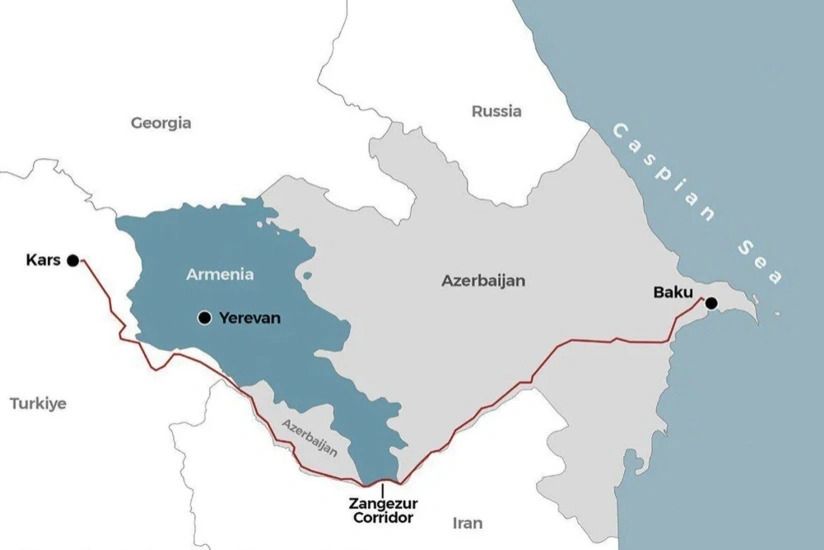
Under the text, the TRIPP framework describes mechanisms for launching multimodal transit connectivity through Armenian territory. The project is presented as an infrastructure initiative aimed at ensuring unobstructed transit, linking mainland Azerbaijan with the Nakhchivan Autonomous Republic, and forming a key segment of the Trans-Caspian trade route.
The Foreign Ministry noted that implementation of the project will be based on the principles of sovereignty, territorial integrity, and reciprocity. Its stated objectives include strengthening the security and economic development of Armenia and Azerbaijan, as well as expanding regional trade and transit opportunities between Central Asia, the Caspian Sea region, and Europe.
The project envisages the creation of a dedicated company to oversee the development and operation of TRIPP.
A structure is planned under which the United States would hold a controlling stake, while Armenia would retain oversight mechanisms on key issues.
The proposed model grants construction and operating rights for 49 years, with the option to extend for an additional 50 years. At the initial stage, 74 percent of shares would be allocated to the United States and 26 percent to Armenia. In the event of an extension, Armenia’s stake could increase to up to 49 percent.
Any changes in shareholding or final beneficial ownership would require prior approval from both the Armenian and U.S. governments.
The company would have exclusive rights to plan, build, operate, and maintain railways and highways within the transit routes, as well as associated energy and digital infrastructure.
Potential revenue streams include infrastructure access fees, commercial activities along the route, leasing and development of real estate, service charges, and income generated by special-purpose entities.
A separate section underscores that Armenia will retain authority over:
- legislative, regulatory, and judicial jurisdiction within its territory;
- national security and law enforcement oversight;
- customs and border control, including the collection of taxes, duties, and other mandatory payments.
The framework agreement envisages a “front-office/back-office” model. Private operators contracted by the company may handle customer-facing functions such as document collection, consultations, coordination, and payment processing. However, final decisions related to customs clearance, security, migration, and law enforcement will remain the exclusive responsibility of Armenian state bodies. The document explicitly states that sovereign functions will not be transferred.
Plans also include the introduction of risk-based inspections, digital customs and border systems, single-window mechanisms, pilot projects for advance clearance, and electronic document management, as well as potential U.S.-supported training programs for personnel, subject to available resources.
Armenia intends to continue implementing modern integrated border management practices, with possible U.S. technical assistance, including:
- risk-based inspection and customs procedures;
- advanced inspection technologies;
- digital customs and border systems;
- inter-agency coordination mechanisms;
- professional capacity-building for Armenian civil servants.
Pilot projects are planned to optimize:
- advance customs clearance procedures;
- digital document processing;
- “one-stop” concepts at border crossing points;
- technology-driven risk assessment;
- coordinated border management with neighboring countries.
It is recalled that on August 8, 2025, in Washington, Azerbaijani President Ilham Aliyev and Armenian Prime Minister Nikol Pashinyan signed a joint declaration in the presence of the U.S. President. The document envisages the launch of the Zangezur Corridor, referred to as the “Trump Route,” as part of efforts to restore regional connectivity. In addition, the foreign ministers of the two countries initialed an agreement “On Peace and Interstate Relations.”
Here we are to serve you with news right now. It does not cost much, but worth your attention.
Choose to support open, independent, quality journalism and subscribe on a monthly basis.
By subscribing to our online newspaper, you can have full digital access to all news, analysis, and much more.
You can also follow AzerNEWS on Twitter @AzerNewsAz or Facebook @AzerNewsNewspaper
Thank you!