
When sky turned against innocent: elegy for AZAL flight victims

Elnur Enveroglu
Read moreOn a cold winter day, people left the warmth of their homes. Some were travelling to see loved ones living far away. Some were chasing long-held dreams. Some were travelling for reasons known only to themselves. Who could know?
Who could imagine that the open sky would, within hours
or perhaps minutes, turn into a dark nightmare for them?
Then a gentle voice, carrying hope, rose from within the cabin and
planted a fragile sense of reassurance among passengers frozen by
fear. "Everything will be fine."
The brave woman who spoke those words was likely as
frightened as everyone else, yet her calm voice became a source of
hope for dozens of souls.
As the Embraer 190 aircraft, flight J2 8243, struggled to descend
through the vast emptiness of the sky, the tension inside the cabin
grew with every passing second. Each passenger, having made peace
with fate, wondered quietly what the end would bring.
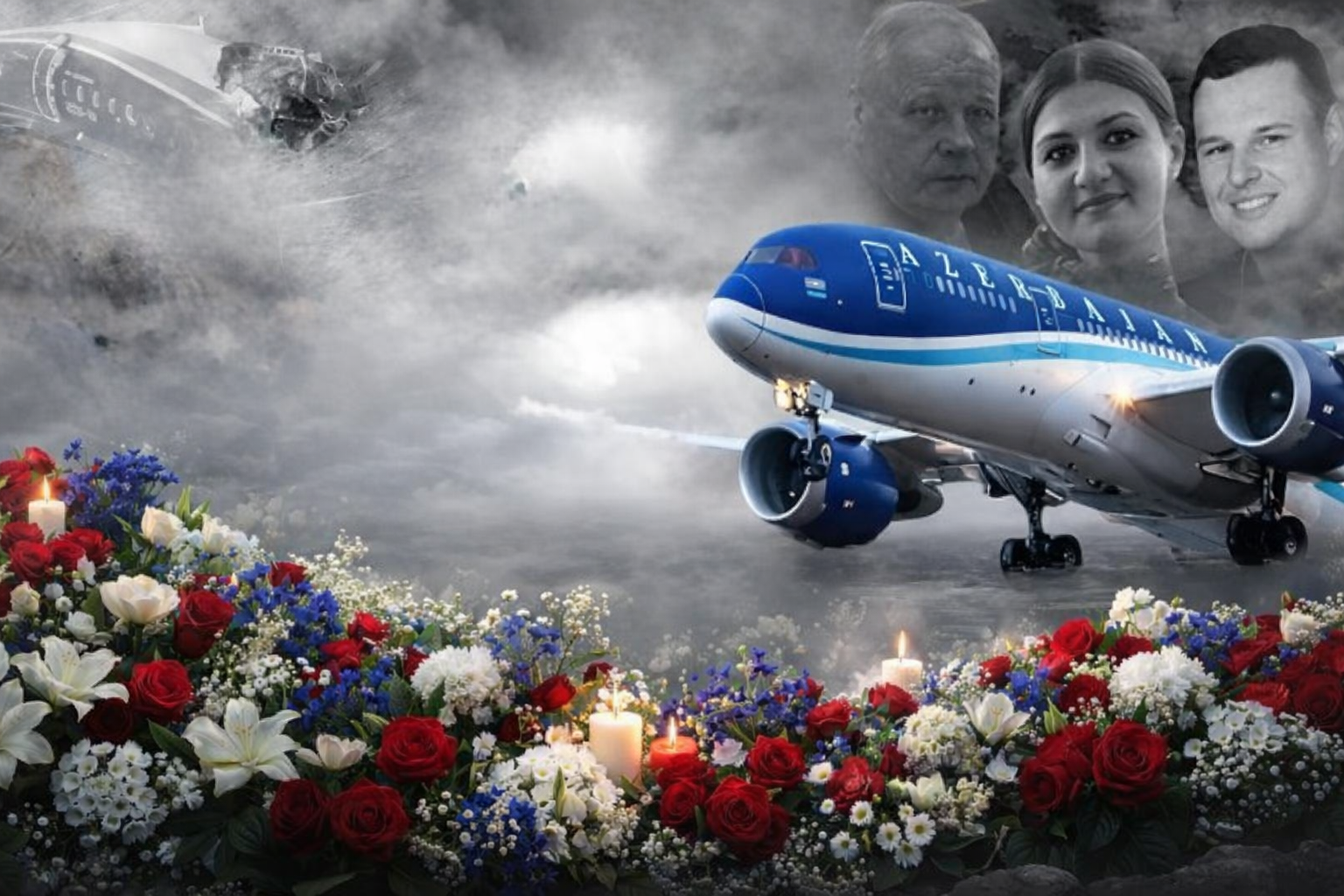
On 25 December 2024, an ordinary flight from Baku to Grozny became a tragedy that would mark a nation. The passengers of AZAL flight J2 8243 were not soldiers or strategists. They were parents returning home, workers crossing borders, families preparing for the New Year. Their expectations were modest and human. They trusted the sky to carry them safely.
That trust was broken by force...
As the aircraft approached Grozny, the region was under heightened military alert. Russian air defence systems were active, responding to perceived threats in the airspace. Within this atmosphere of tension, a civilian aircraft was struck by a Russian Pantsir missile. The hit damaged critical systems and turned a routine descent into a desperate struggle for survival.
Inside the aircraft, fear was matched by a sense of dignity. Survivors would later speak of silence punctuated by whispered prayers, of hands held tightly, of a cabin bound together by the knowledge that time was running out. The promise that everything would be fine was not a lie, voiced by a brave Azerbaijani lady, Hokuma Aliyeva. It was an act of compassion offered when nothing else could be offered.
Moments later, the aircraft crashed, and the sky claimed thirty-eight lives. Lives ended abruptly. Futures disappeared in an instant.
In Azerbaijan, families waited for news that came too slowly and then all at once. Phone calls went unanswered. Celebrations were cancelled. Homes filled with grief that words could not contain. The loss was not abstract. It had names, faces, and empty chairs at winter tables.
What followed the crash deepened the sorrow. In the days after the tragedy, Russia attempted to obscure the truth. Official statements avoided responsibility. Alternative explanations were floated. Technical failure was implied. The possibility of military involvement was dismissed. Silence replaced clarity.
For the families of the victims, this denial was unbearable. Loss is heavy enough when acknowledged. When denied, it becomes cruelty.
Truth after loss: elegy for victims of AZAL flight J2 8243
Yet truth does not vanish when ignored. Flight data, radar information, and expert analysis steadily revealed what had happened. The evidence pointed clearly to a missile strike carried out during Russian air defence operations. The facts demanded recognition.
Azerbaijan did not remain silent. President Ilham Aliyev took a firm and decisive stance, insisting that responsibility be acknowledged. This was not a demand driven by anger but by dignity. A civilian aircraft had been destroyed. Innocent lives had been lost. The truth had to be spoken.
Through sustained diplomatic pressure, Russia was compelled to admit what had occurred. Moscow formally acknowledged that the aircraft had been hit as a result of its military actions and issued an apology. The admission came late, but it mattered. It restored truth to a space clouded by denial and affirmed that even powerful states can be held to account.
The apology did not heal the grief of families or return the lives lost aboard flight J2 8243. It did not erase the terror of the final moments. But it drew a line between truth and falsehood. It confirmed that civilian lives are not expendable and that responsibility does not disappear in the sky.
This tragedy stands as a warning written in memory. Modern conflict does not remain confined to battlefields. Missiles do not recognise innocence. Decisions made in seconds can destroy lives forever.
Today, we remember the passengers and crew of AZAL flight J2 8243 not as numbers or headlines, but as human beings whose final journey should never have ended in violence. They were travellers, dreamers, parents, and children. They deserved to arrive.
May their memory remain brighter than the lies that followed
their deaths.
May the sky one day return to being a place of passage rather than
fear.
May those who boarded that flight be remembered with truth,
dignity, and peace.
Here we are to serve you with news right now. It does not cost much, but worth your attention.
Choose to support open, independent, quality journalism and subscribe on a monthly basis.
By subscribing to our online newspaper, you can have full digital access to all news, analysis, and much more.
You can also follow AzerNEWS on Twitter @AzerNewsAz or Facebook @AzerNewsNewspaper
Thank you!