
Smart Novruz bonfire concept bridges digital and cultural worlds

Laman Ismayilova
Read moreA new scientific seminar has been held at the Institute of Information Technologies of the Ministry of Education and the Science, Azernews reports citing Azertag.
During the seminar, a presentation titled "Preservation and Relevance of National Identity in the Context of Digital Transformations: Smart Novruz Bonfire" was delivered, prepared as part of the scientific collaboration between the Institute of Information Technologies and the Folklore Institute of the Azerbaijan National Academy of Sciences (ANAS).
In his speech, Vice-President of the Azerbaijan National Academy of Sciences, Director-General of the Institute of Information Technologies, Academician Rasim Aliyev, outlined that digital transformation is rapidly penetrating all areas of society, and virtual processes have not been immune to the national customs, traditions, and ceremonies.
He stated that the processes of folklorization in the internet environment are closely linked to both national and global changes, noting especially that the rapid development of artificial intelligence technologies in recent years has led to revolutionary innovations, providing new opportunities for the study of cultural heritage.
The academician also pointed out that, in recent years, fruitful research has been conducted in collaboration between the ANAS Institute of Information Technologies and the Folklore Institute regarding the contemporary issues of internet folklore, the relationship between artificial intelligence and folklore, as well as the effects of digital transformations on folklorization processes, resulting in significant scientific and innovative outcomes. He noted that studying traditional ceremonies like the Novruz bonfire from the perspective of modern requirements and exploring both their positive and negative aspects is a demand of the current age.
Academician Aliyev emphasized that such research serves national interests and the preservation of national identity in both real and virtual spaces, while the development of technologies for the implementation of customs and ceremonies on digital platforms has become one of the crucial priorities.
Director of the Folklore Institute, Doctor of Philology Hikmat Guliyev, delivered a report on the preservation of national spiritual values in the context of modern technological challenges.
The speaker evaluated the relevance of the problem through the lens of globalization and digitalization risks to national identity, referring to Marshall McLuhan's "global village" concept, Manuel Castells' theory of the "network society," Stuart Hall's views on identity, and Margaret Mead’s ideas on cultural change. Additionally, he used Richard Bauman's concept of the ritual's performative nature to explain the risk of national customs and ceremonies losing their social function, and he stressed the need to "reactualize" cultural heritage, as well as ensure the preservation of national identity in new communicative environments with the help of digital technologies.
The speaker examined the Novruz holiday, particularly the Novruz bonfire, as a prime example of national customs and traditions in this conceptual framework, analyzing its new functional models in modern conditions.
Academician Guliyev drew attention to the reciprocal relationship between technological transformations and folklore, noting that scientific and technological progress, along with information revolutions, have created epochal changes and that social and demographic processes have deeply transformed the socio-cultural environment, giving rise to new channels for the expression of folk knowledge. He stressed that the communicative dynamics directly associated with technological progress have affected the "migration" of folk knowledge—from rural areas to cities, and then to the virtual world.
"Virtualization and digitalization not only condition technological changes but also socio-technological and techno-cultural transformations," said Hikmat Guliyev, discussing the problems posed by urbanization, digitalization, and virtualization.
He also addressed issues such as the adaptation of traditions to modern life, the formation of folkloric behavior models in digital and virtual environments, and the need to preserve national identity, especially among younger generations.
The speaker highlighted new challenges facing folklore studies, stressing the importance of exploring ways to preserve national identity in the digital environment, developing models for the reactualization of resources that carry national and spiritual values, adapting traditional behavior and worldviews to new social life styles, and determining the theoretical and practical foundations for the transformation of traditional cultural creativity to digital platforms.
Referring to international experience, the scholar reminded participants of UNESCO's 2003 "Convention for the Safeguarding of the Intangible Cultural Heritage" and considered the inclusion of Novruz in UNESCO's Representative List of the Intangible Cultural Heritage of Humanity in 2009 as an important achievement in terms of international recognition of national identity.
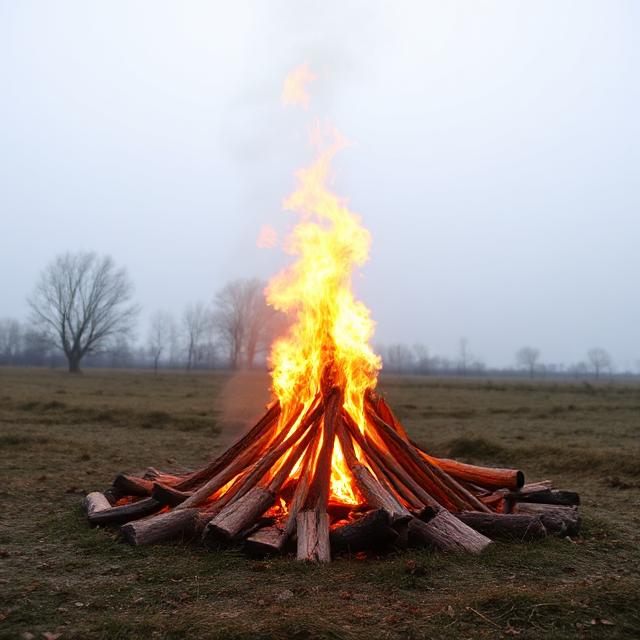
The speaker also addressed the social and mythological functions of one of the main symbols of Novruz, the bonfire. He pointed out that while the bonfire is seen as a symbol of purification, renewal, and social unity in collective cultural memory, in modern urban and rural environments, it is associated with fire hazards, environmental, and other risks.
Doctor of Philology Hikmat Guliyev, referring to recent incidents involving fires and injuries during Novruz celebrations, said that this situation creates a serious dilemma between tradition and public safety, and calls for alternative models and technological solutions. In this context, he presented the concept of a "Smart Novruz Bonfire." The concept involves a digital or physical model (such as a synthetic Christmas tree) of the bonfire that does not pose a fire hazard but preserves its social, spiritual, and symbolic essence.
The scholar emphasized that the technological capabilities of the smart Novruz bonfire would include holographic flame simulation, internet connectivity, virtual and augmented reality technologies, allowing Azerbaijanis living in different countries to gather online around the "bonfire."
"As a result, the 'Smart Novruz Bonfire' concept could bring together Azerbaijanis from around the world, fostering integration around shared values in the symbolic-spiritual domain, preserving national identity, and strengthening ties to language, culture, and the homeland," he noted.
Following the presentation, a wide-ranging discussion took place, with questions being answered.
Academician Rasim Aliyev then shared his thoughts on the presentation, offering suggestions and recommendations. He reminded participants that in accordance with a decree by the President of the Republic of Azerbaijan, Ilham Aliyev, 2026 has been declared the "Year of Urban Planning and Architecture" and highlighted that multi-faceted, multidisciplinary approaches to national customs and traditions would be required during this year, particularly with respect to the specific characteristics of modern urban life. "The urban environment must be safe and clean, not posing a risk to human life. For example, during Novruz celebrations, lighting bonfires can sometimes lead to damage to asphalt, disruptions in traffic, and the blocking of roads. Additionally, forcing children to jump over the bonfire creates life-threatening risks and can lead to serious psychological and physical health problems," said the academician.
Academician Aliyev noted that the transformation of national customs in the context of globalization and cultural interactions is ongoing, but emphasized that the main goal is not to forget or distance from national values. Instead, the aim is to preserve the warmth, friendliness, reconciliation, and socialization embodied by Novruz and similar values, while reactivating these traditions in the context of modern challenges and eliminating their negative aspects:
"The synthesis of digital and cultural transformations results in new approaches and innovations, which require a fresh perspective on national customs."
He emphasized that customs are not static, but transform over time under the influence of political, ideological, and technological factors. He praised the idea of the smart bonfire as an example of cultural transformation under the impact of digital transformations and as one of the socio-technological innovation projects.
Addressing the technological aspects of the digital bonfire concept, the academician pointed out the need for the creation of social networks for "Smart Novruz Bonfire" on internet platforms for various groups, the storage and archiving of collected data in individual family cloud systems, as well as the implementation of biometric recognition systems. He noted that the "Digital Novruz Bonfire" model, based on these innovations, could serve as both a family memory and a valuable resource for researchers.
Academician Aliyev concluded by stressing the importance of implementing digital solutions like the smart bonfire in ensuring inclusivity in society, noting that such initiatives would provide convenience and equal communicative opportunities for people unable to participate in family ceremonies due to illness, physical limitations, or distance. He also emphasized that the smart bonfire idea would unite Azerbaijanis living in different countries, ensuring their solidarity, virtual unity, and socio-cultural ties.
In closing, the academician underscored the necessity of expanding research on the impact of artificial intelligence and other advanced digital technologies on folklore and folk culture, as well as developing the conceptual and technological foundations for the creation of the "Digital Novruz Bonfire" and attracting the attention of the public, relevant organizations, and companies to these issues.
Here we are to serve you with news right now. It does not cost much, but worth your attention.
Choose to support open, independent, quality journalism and subscribe on a monthly basis.
By subscribing to our online newspaper, you can have full digital access to all news, analysis, and much more.
You can also follow AzerNEWS on Twitter @AzerNewsAz or Facebook @AzerNewsNewspaper
Thank you!