
Evolution or stagnation: Music industry in hands of artificial intelligence

Laman Ismayilova
Read moreAI-generated songs are becoming increasingly popular on music streaming platforms. A great number of music lovers are drawn by catchy melodies.
Thanks to platforms like Suno AI and Loudly, anyone can create a full-fledged song with just a few lines of description.
Neural networks are already acting as creative assistants, generating melodies, beats, arrangements and even vocal parts, which in turn, reduces the time from idea ti prototype.
However, copyright and creative ethics remain serious concerns, weighing heavily on the global music industry.
Battle for Voice: Invisible Expansion of AI
Around 50,000 music tracks created by algorithms are uploaded to digital platforms every day. The latest studies conducted by industry giants like Deezer and Ipsos show that 97 per cent of listeners cannot distinguish an AI track from the work of a real composer.
Modern neural networks generate sound in studio-quality 48 kHz, simulating the natural breathing of a vocalist and micro-performance errors previously considered the exclusive domain of humans.
Moreover, the rapid growth of AI has sparked an unprecedented wave of lawsuits. At the forefront is the RIAA's lawsuit against leading developers of music neural networks. Major labels (Sony, Universal, Warner) are accusing startups of massive copyright infringement as their models were trained on millions of protected tracks without permission.
Moreover, the landmark "ELVIS Act" was passed in the US in order to protect an artist's voice and image from unauthorised copying.
Celebrities like Billie Eilish and Nicki Minaj have openly spoken out against the predatory use of artificial intelligence.
Hacking Dopamine System
Scientists have discovered that the brain perceives AI music as a kind of "junk food." It's saturated with very pleasant harmonies, causing an immediate dopamine response. However, this instant gratification conceals a trap as the perfect mathematical precision of AI rhythms causes rapid auditory fatigue.
The human brain is hardwired to search for errors and unique intonations, and when they're absent, music quickly turns into background noise.
Moreover, research at the Higher School of Economics has confirmed the existence of the N400 effect. Our brain subconsciously registers a semantic inconsistency when it hears the voice of a familiar artist in a generated context. So, we can sense a catch even before we realise it.
Despite criticism, AI music generates a soundscape that helps people quickly enter a state of deep focus or deep sleep. This personalised therapy is 40 per cent more effective than standard meditation records.
Despite criticism, AI music generates a soundscape that helps people quickly enter a state of deep focus or deep sleep. This personalised therapy is 40 percent more effective than standard meditation recordings. This opens the way to "digital medicines" where music is tailored to each individual's brain at a specific moment in time.
Diminishing Role of Recording Artists
In the era of classical recording studios, music instruments significantly contributed their share of live energy.
The writing process could take years. Composers, musicians, and performers could spend years working on songs that would later become hits and make history. Each song was a source of inspiration, imbued with true feelings and emotions.
The physical contact with the instrument, the vibration of the soundboard, is essential for the formation of neural connections.
However, what is the reality we see today? Unfortunately, from a creator, the human has become a curator.
The music artist no longer builds a song note by note. He sifts through endless AI-generated iterations, choosing the "least bad" option.
Back to Basics: How to Preserve Humanity in the World of Algorithms?
We've reached a point where technology can simulate everything but an authentic experience.
In a world of content deluge, the value of human creativity and the real physics of sound has skyrocketed.
Interestingly, the reaction to the onslaught of artificial intelligence has been a sharp rise in interest in analogue technology.
Tape recordings, the use of vintage tube microphone and live music have become the hallmarks of high art.
In a world where music becomes background noise for productivity, it's important to make time for active listening. Live concerts and physical recordings are becoming the new "digital detox."
True art is born in the resistance of the material, not in pressing a single "Generate a hit" button. The future of the music industry depends on our attention.
AI can write billions of songs, but only humans decide which one will live forever in their hearts. Our ability to experience a wide range of emotions and empathize through sound is something algorithms won't be able to replicate until we stop appreciating it ourselves.
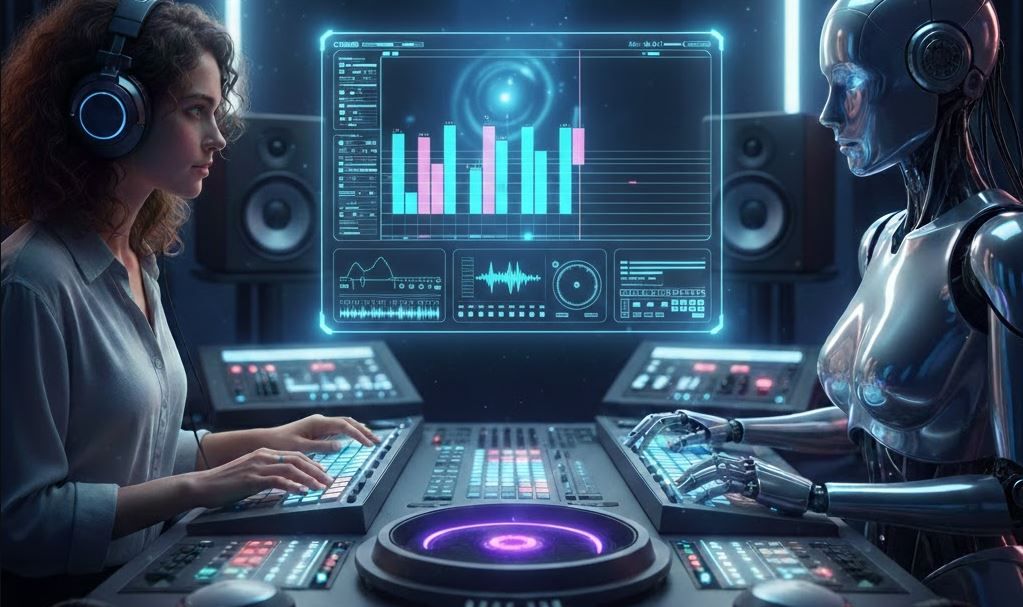
AI Generated Photo
Here we are to serve you with news right now. It does not cost much, but worth your attention.
Choose to support open, independent, quality journalism and subscribe on a monthly basis.
By subscribing to our online newspaper, you can have full digital access to all news, analysis, and much more.
You can also follow AzerNEWS on Twitter @AzerNewsAz or Facebook @AzerNewsNewspaper
Thank you!