
Azerbaijan aligns with Washington as new peace architecture emerges
Akbar Novruz
Read moreFor millions of people living in areas affected by war, the breakdown of diplomacy feels very real and painful. It means daily struggles with loss, being forced to leave their homes, and living with uncertainty. From the Gaza Strip to Eastern Europe, what started as short-term conflicts has turned into long-lasting battles. This situation puts a heavy strain on humanitarian aid and makes it harder for people to trust in efforts to resolve these issues peacefully.
At the heart of this crisis of confidence is the United Nations, an organization created to prevent the very failures we are now witnessing across the global landscape. Although its moral authority is unparalleled, political gridlock, the use of vetoes, and competing interests among powerful nations have often limited its ability to respond effectively. For many people, the critical question is no longer whether the system is under pressure, but whether it can adapt swiftly enough to prevent further human suffering.
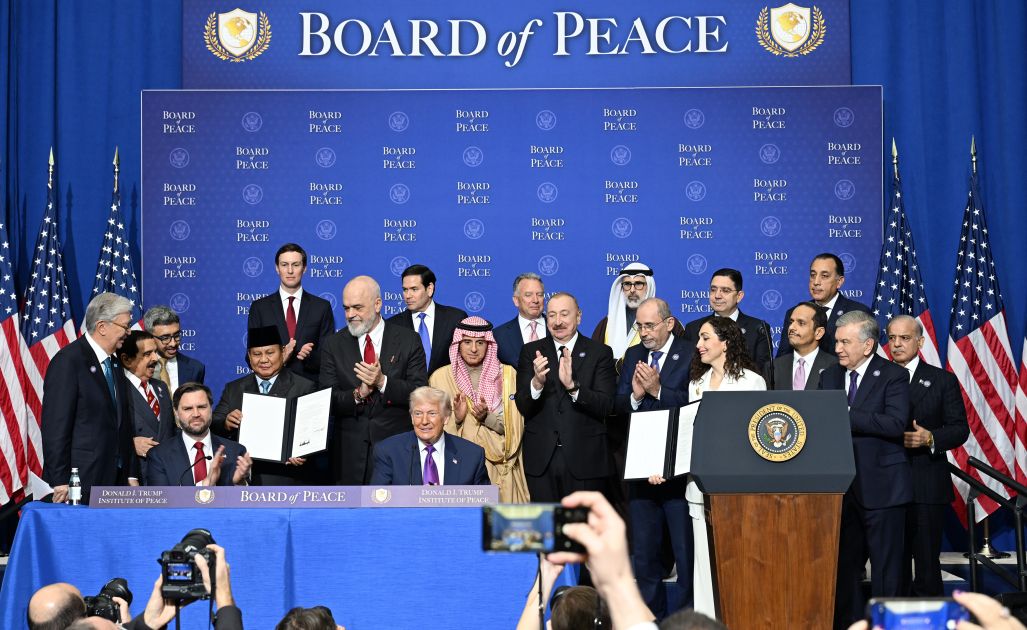
On February 19, 2026, the first formal meeting of the Board of Peace was held in Washington, D.C., convened by U.S. President Donald Trump and attended by representatives from a broad and diverse group of countries, including Azerbaijan. The summit took place at the United States Institute of Peace and was designed to operationalise the initiative aimed at supporting ceasefire implementation, humanitarian relief and reconstruction efforts in the Gaza Strip following the protracted conflict.
Donald Trump on Thursday said the US would commit $10bn to his Board of Peace as he inaugurated the controversial body at a meeting where many traditional US allies were absent. The US president also claimed Kazakhstan, the United Arab Emirates, Morocco, Bahrain, Qatar, Saudi Arabia, Uzbekistan, and Kuwait had committed $7bn more for Gaza relief.
Trump is advocating for the creation of a powerful new alliance of nations to serve as a replacement for the United Nations, presenting a bold solution to address enduring global challenges. But how possible is it?
"The international order post-1945 is now being openly questioned as Trump's new idea has become a 'thorny' issue," analyst Brendan Ziegler tells AzerNEWS.
"Yet veto politics within the Security Council, chronic funding gaps, geopolitical rivalries, and a fragmentation of shared norms have steadily eroded its capacity for decisive action. The distance between the UN Charter’s founding principles and today’s political realities has become increasingly difficult to ignore,” he stated.
He pointed out that these contradictions have given rise to a new way of thinking.
“The proposal for a ‘Board of Peace,’ sometimes referred to as a ‘Peace Council,’ reflects a growing belief that the world is not simply facing isolated crises, but a deeper structural transformation of the international system. We are living in an era shaped by multipolar rivalry, hybrid warfare, and the weaponisation of trade and finance. Institutions created in the aftermath of the Second World War are struggling to respond with speed or cohesion,” he said.
Part of the challenge, he explained, lies in the visible fatigue of traditional mechanisms. “Protracted conflicts, from the Russia–Ukraine war to the devastation in Gaza, have exposed the limits of existing international organisations. At the same time, the United States has recalibrated its engagement with multilateral bodies, reducing funding for or withdrawing from several UN-affiliated structures. This has created space for alternative frameworks,” he added.
Ziegler outlined how the Trump administration advanced the concept of a “Board of Peace.”
“Supporters argue that such a body could bypass veto paralysis, act more rapidly, and bring together coalitions of willing states when broader consensus proves elusive. Critics, however, warn that without clear legal foundations and universal legitimacy, new mechanisms risk adding fragmentation to an already strained system,” he said.
Azerbaijan, he added, plays a notable role. “Following an open appeal during the World Economic Forum, Baku joined the initiative as a founding member. Supporters point to Azerbaijan’s recent experience in pursuing a peace agenda with Armenia, combining military outcomes with diplomatic processes rooted in sovereignty and international law, as an example of how conflict can be translated into political settlement. Perhaps the nation's experience in reconstructing Karabakh can be applied to the Gaza case as well."
Looking ahead, he questioned the council’s long-term trajectory. “As conversations now turn toward institutional design, membership criteria, decision-making rules, and scope of authority, the central questions grow sharper. Is the ‘Board of Peace’ meant to function as a crisis-management tool for specific theatres, or does it aspire to become a standing body with ambitions that rival the UN’s role in global peace and security?” he asked.
Ziegler concluded with a broader reflection on global governance, claiming that regardless of the Board's success, it is clear that the Western order we once knew is on the verge of being a history.
“For all its imperfections, the United Nations remains the only body with truly global legitimacy. Any alternative that seeks to rival it must confront the hard realities of universality, transparency, and legal coherence. In a fragmented world, the appeal of smaller, more agile clubs is understandable. Yet, the Western order we once knew is on the verge of being a history. Peace achieved through limited alignment may yield short-term results, while durable security demands broad consent. It may ultimately show whether the next phase of global governance is one of careful reform or a far more disruptive reordering of how the world seeks peace,” Ziegler concluded.
Here we are to serve you with news right now. It does not cost much, but worth your attention.
Choose to support open, independent, quality journalism and subscribe on a monthly basis.
By subscribing to our online newspaper, you can have full digital access to all news, analysis, and much more.
You can also follow AzerNEWS on Twitter @AzerNewsAz or Facebook @AzerNewsNewspaper
Thank you!