
What crossing the Armenia–Azerbaijan border now feels like: A participant’s account
Akbar Novruz
Read moreIt began not with a handshake in a grand hall, but with a crossing on foot. On a cold February morning, an Azerbaijani delegation passed through a newly delimited section of the Azerbaijan–Armenia border, an act unthinkable not long ago, and one still heavy with memory.
That experience began even before the discussions. The Azerbaijani delegation entered Armenia by land, crossing through a delimited and demarcated section of the border near Voskepar and Ashaghi Askipara. All formal procedures were completed, yet what mattered more was the symbolism. For participants, the crossing was not merely logistical; it was a practical confidence-building measure, a visible sign that normalization can be enacted, not just negotiated.
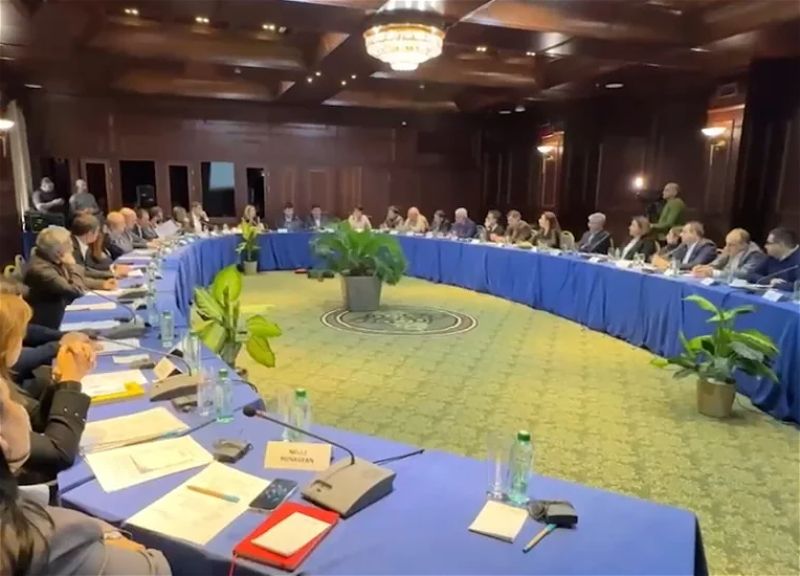
The journey to Tsaghkadzor for a civil society roundtable under the “Peace Bridge” initiative was, in itself, a message: that normalization is no longer confined to diplomatic communiqués, but is testing its footing on the ground. What followed over two days of discussion was less about slogans of peace and more about whether trust-fragile, uneven, and deeply contested, can be built through sustained human contact, candid dialogue, and shared responsibility for a post-conflict future in the South Caucasus.
Inside the roundtable, discussions turned to the broader political horizon. Participants assessed the current stage of Armenian-Azerbaijani relations and the future trajectories opened by the peace agenda endorsed at the Washington Summit in August. Regional security dynamics, shifting economic opportunities, and the prospects created by restored connectivity formed the backbone of the debate. Alongside formal sessions, informal cultural and social activities softened the atmosphere, allowing personal interaction to complement policy discussion.
As part of the visit, AzerNEWS spoke with Emin Aliyev, Editor-in-Chief of Trend International Information Agency, who was among the Azerbaijani representatives.
Atmosphere beyond the formal setting
Beyond the formal statements and panel discussions, the atmosphere of the meeting was marked less by emotional gestures and more by a deliberate sense of practicality. As Emin Aliyev put it, “our engagement with the Armenian delegation was constructive,” a formulation that deliberately avoids sentimentality while underscoring functionality. Security, he stressed, was ensured “at a high level,” and crucially, “there were no incidents or negative developments.” In a context shaped by decades of hostility, the absence of friction itself became a signal: not of reconciliation, but of manageability.
Discussing difficult issues without rupture
That same pragmatism carried into the substance of the discussions. Rather than identifying a single taboo or collision point, Aliyev described the exchanges as “constructive and quite candid,” including meetings with senior Armenian officials. Topics touched directly on issues sensitive for Azerbaijani society—“the restoration of transport communications, the TRIPP project, confidence-building measures between the two societies, and related matters.” The willingness to articulate concerns openly, without theatrical confrontation, suggested that the lines dividing the two sides are no longer entirely unspeakable, even if they remain firmly drawn.
Another question was about the discussion of a new regional security architecture initiated by civil societies during the meeting, and the extent to which local civil society initiatives were prioritised compared to the influence of external forces. Emin Aliyev said separate sessions widened the lens further, moving from bilateral grievances to the broader regional picture. According tohim, discussions addressed “the emerging regional security architecture, the benefits of peace, public perceptions of establishing interstate relations in both societies, prospects for economic cooperation, and the role of civil societies.” His framing of this as “this long and challenging process” was telling: peace, in this view, is not an event to be announced, but a structure to be assembled gradually, with civil society playing a supporting, if not yet decisive, role alongside state institutions.
Confidence-building as a process, not a moment
On its own, a roundtable does not dissolve borders or erase historical memory. Yet the combination of a physical border crossing, candid exchanges behind closed doors, and uneventful coexistence in informal settings points to something incremental but tangible. If normalization is to advance, it may do so less through dramatic breakthroughs than through repeated, controlled encounters like this, where former adversaries test not trust, but predictability, one step at a time, sometimes quite literally across the border.
Here we are to serve you with news right now. It does not cost much, but worth your attention.
Choose to support open, independent, quality journalism and subscribe on a monthly basis.
By subscribing to our online newspaper, you can have full digital access to all news, analysis, and much more.
You can also follow AzerNEWS on Twitter @AzerNewsAz or Facebook @AzerNewsNewspaper
Thank you!